


ΕΑΝ ΠΡΟΤΙΜΑΤΕ ΕΛΛΗΝΙΚΑ ΠΑΤΗΣΤΕ ΤΗ ΣΗΜΑΙΑ ΣΤΟ ΚΑΤΩ ΜΕΡΟΣ ΤΗΣ ΟΘΟΝΗΣ
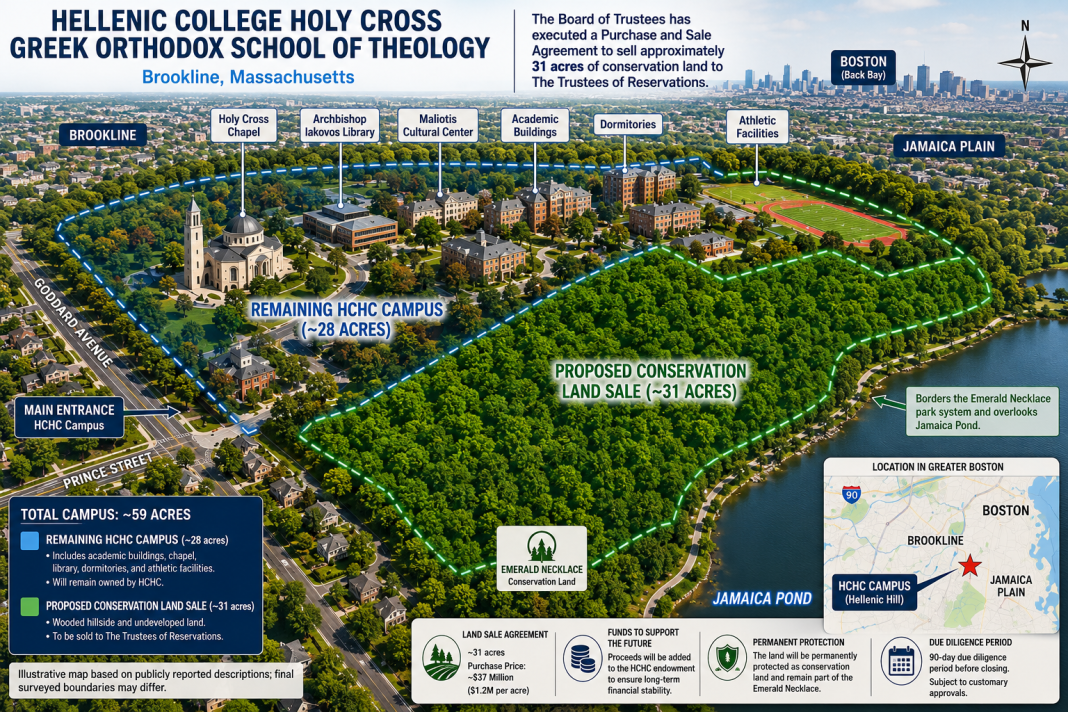
OUR MAIN PHOTO: A 3D image of the property – the part to be sold is the wooded area…
Why is the Greek Orthodox Archdiocese selling more than half of Holy Cross Seminary’s historic campus—and can the faithful trust what happens next? It raises difficult questions about stewardship, transparency, and the future of GOARCH.
By Helleniscope’s Editorial Team
A decision by the GOARCH has stunned many throughout the Greek-American community.
Hellenic College Holy Cross has signed an agreement to sell approximately 31 acres of its historic 59-acre campus in Brookline, Massachusetts—meaning that more than half of the original property will be transferred if the sale is completed.
The buyer is The Trustees of Reservations, a respected conservation organization, and the Archdiocese says the proceeds—approximately $37 million—will strengthen the school’s endowment.
But for many Greek Americans, this is about far more than money.
This is not just another parcel of real estate. The campus sits in one of Greater Boston’s most prestigious neighborhoods, adjacent to Jamaica Pond and surrounded by some of the most valuable residential property in New England.
Real estate experts have noted that, if the land were legally developable, its market value could be many times higher than the agreed sale price, with estimates exceeding $200 million. The Archdiocese maintains, however, that the parcel is protected conservation land and not available for conventional residential development.
The extraordinary value of this location is illustrated by nearby sales. In 2020, NFL legend Tom Brady and Gisele Bündchen sold their neighboring Brookline estate—approximately five acres—for about $33.9 million, underscoring the premium commanded by this area.
Yet the deepest concern expressed by many faithful is not the price.
It is the permanence.
This land was not acquired by wealthy investors. It was purchased through the sacrifices of generations of Greek immigrants who dreamed of establishing a permanent center for Orthodox theological education in America.
Once this land is sold, it can never be recovered.
This represents the irreversible loss of one of the Greek Orthodox Archdiocese’s most important historic assets.
Supporters of the transaction argue that preserving the institution requires strengthening its financial future. Opponents respond that institutions facing financial pressure should reform their governance—not dispose of irreplaceable property accumulated over generations.
That debate naturally leads to an even more difficult question.
Can the faithful have confidence that the proceeds of this sale will be managed wisely?
The Archdiocese says the funds will be placed into the school’s endowment to provide long-term financial stability.
However, the seminary has a long history of financial challenges and administrative difficulties. Only a few years ago, enrollment had fallen so sharply that reports indicated the institution employed more faculty and administrative staff than enrolled students, raising serious questions about management and long-term planning and inviting the State Educational authorities, which had HCHC under constant review for years.
For many donors and faithful, trust – not simply dollars – is now at the center of this debate.
If generations sacrificed to build this institution, what assurances exist that the proceeds from selling more than half of its historic campus will be preserved, invested responsibly, and used solely to strengthen Orthodox theological education?
In recent years, the GOARCH leadership has often presented itself as though it were a team of seasoned real estate developers rather than stewards of the Church. Whenever a new property transaction is proposed, some officials speak with the confidence of master dealmakers—as the Greek expression goes, “με ύφος χιλίων καρδιναλίων” (“with the air of a thousand cardinals”).
No one better exemplifies this, critics argue, than Bishop Nektarios (Papazafiropoulos) of Diokleia, the Archdiocese’s General Chancellor, who has become one of the principal advocates of these real estate initiatives. Nobody cares that he already helped cripple St. Demtrios of Astoria financially with his utterly stupid idea of building the empty lot across the Church on 31st Street, while there were no funds available in the parish and no donations…
Yet those who have worked closely with the current leadership paint a very different picture. They describe an administration marked not by exceptional business acumen, but by chronic managerial shortcomings. In the view of its harshest critics, the same people who now ask the faithful to trust them with tens of millions of dollars have repeatedly demonstrated a lack of sound judgment and effective administration.
As one particularly biting criticism puts it: they are so administratively inept, they could bankrupt a neighborhood pizzeria within a few months.
If that assessment is even partly true, many faithful are asking a simple question: Why should anyone believe they will succeed in managing the proceeds from the sale of one of the Archdiocese’s most valuable and irreplaceable assets?
That is the question many Greek Americans are asking today.
And it is a question that deserves a clear and transparent answer.
AS OF 11 AM TODAY, SATURDAY, AUGUST 7, THE COMMENTS ARE RE-ACTIVATED.
August 5, 2026, www.helleniscope.com
DISCLAIMER: The views and statements expressed in this article constitute constitutionally protected opinions of this author.














It is interesting that they waited until “after the Clergy Laity budget vote” to announce the “raking in” of another 31 million from an alternate source…
Isn’t it ironic that they ask the Laity to “vote” for “intended use of annual donations”, but they don’t ask the Laity to vote on a “liqudation of Archdiocese assets” which are clearly the inheritance of “intended use of donations from prior generations”?
There is probably some legal angle there that the Laity could challenge based on procedural violations of the Charter as well as based on the above precedent on inclusion of the Laity in “major financial decisions” such as the annual budget…
Administratively inept leadership and puppet board of trustees who do not act for the university but for their benefactors. The new story is that meteopolitan of Nathanael is the front runner to be the president next.