


ΕΑΝ ΠΡΟΤΙΜΑΤΕ ΕΛΛΗΝΙΚΑ ΠΑΤΗΣΤΕ ΤΗ ΣΗΜΑΙΑ ΣΤΟ ΚΑΤΩ ΜΕΡΟΣ ΤΗΣ ΟΘΟΝΗΣ
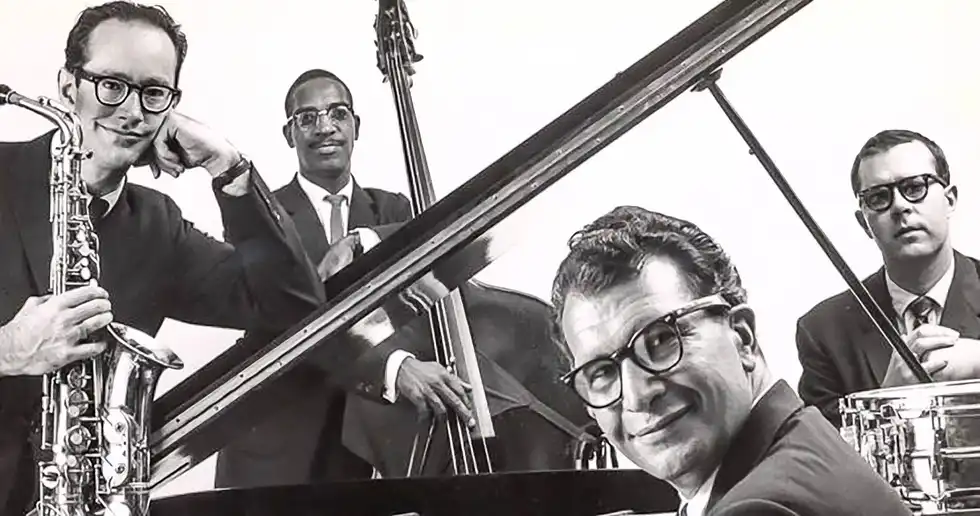
OUR MAIN PHOTO:
How an unusual five-beat rhythm, a drummer’s ingenuity, and Paul Desmond’s unforgettable melody created one of the most beloved recordings in jazz history.
By Nick Stamatakis
I was a teenager and young adult in Greece in the post-1974 era (until 1985 when I emigrated) when the famous Third Program of ERT Radio, established by Manos Hadjidakis, introduced in 1975 a remarkable musical “Odyssey” called “The Universality of Jazz”… What a wonderful program!! I still have fantastic memories of listening to Jazz as I was nightly absorbed into my serious educational travails…
“Take Five,” perhaps the most recognizable jazz recording ever made, began not as an attempt to write a hit, but as an experiment.
In the late 1950s, pianist Dave Brubeck had become fascinated by rhythms outside the familiar four beats of American jazz. Travels through Europe and the Middle East had exposed him to music in unusual meters, and he began wondering: Why did jazz always have to swing in four?
The question led to Time Out, Brubeck’s groundbreaking 1959 album devoted to unusual time signatures.
And the piece that would make the album famous began with his drummer, Joe Morello.
Morello had been experimenting with a rhythm in 5/4—five beats divided naturally into three plus two. Brubeck loved the groove and wanted a composition built around it, partly to give Morello room for an extended drum solo.
For the melody, he turned to his alto saxophonist, Paul Desmond.
This is one of the great ironies of jazz history: Dave Brubeck did not write “Take Five.” Paul Desmond did.
Desmond came up with two melodic ideas, and Brubeck helped shape them into the piece we know. Against Morello’s five-beat pulse and Brubeck’s hypnotic piano figure, Desmond played that cool, descending saxophone melody for the first time.
Something extraordinary happened.
The odd rhythm stopped sounding odd.
Instead of making listeners count one-two-three-four-five, the quartet made them feel one-two-three, one-two. What should have sounded complicated became effortless.
That was the genius of “Take Five.” It was an experiment that didn’t sound like one.
The recording was made in 1959 for Time Out. Nothing about it suggested a hit: it was instrumental jazz, written in an unfamiliar meter, on an album deliberately exploring difficult rhythmic ideas.
 The Dave Brubeck Quartet performs.
Yet listeners couldn’t forget it.
When “Take Five” was reissued as a single in 1961, it became an international success and one of jazz’s great crossover records. The melody written almost as an assignment became Paul Desmond’s immortal composition and the signature recording of the Dave Brubeck Quartet.
And there is one final grace note to the story.
When Desmond died in 1977, he left the royalty rights from “Take Five” to the American Red Cross, allowing the music to continue generating money for humanitarian work long after his death.
So “Take Five” carries several beautiful contradictions.
The Dave Brubeck Quartet’s most famous composition wasn’t written by Dave Brubeck. Its unforgettable saxophone melody grew from a piece intended partly to showcase Joe Morello’s drums. And the five-beat rhythm that should have made the music difficult became the very thing that made it unforgettable.
Four musicians took something that shouldn’t have been a hit and made it sound completely natural.
Five beats. One unforgettable melody. And one of jazz’s happiest accidents.
AS OF 11 AM TODAY, SATURDAY, AUGUST 7, THE COMMENTS ARE RE-ACTIVATED.
August 5, 2026, www.helleniscope.com
DISCLAIMER: The views and statements expressed in this article constitute constitutionally protected opinions of this author.
















Helleniscope:
Thank You for highlighting the memories of American Cultural Contribution through
Music. Brubeck had a unique talent , a refreshing art-style enjoyed internationally from the 50’s until the 21st century.
Never been a fan of jazz, thanks to overexposure to Dixieland. But the first time I heard Take Five, I was captivated. I fell in love with it. Sixty years later, it’s still my favorite jazz piece. In fact, when I saw the headline for this article, I broke out into the biggest grin and scrolled right over. Thanks!