

ΕΑΝ ΠΡΟΤΙΜΑΤΕ ΕΛΛΗΝΙΚΑ ΠΑΤΗΣΤΕ ΤΗ ΣΗΜΑΙΑ ΣΤΟ ΚΑΤΩ ΜΕΡΟΣ ΤΗΣ ΟΘΟΝΗΣ
The battle over St Catherine’s is no longer about whether the monks can stay, but whether permanent use can replace ownership without changing the monastery’s historic status. This is a troublesome alteration of the historic status of the oldest monastery of Christianity.
By Nick Stamatakis
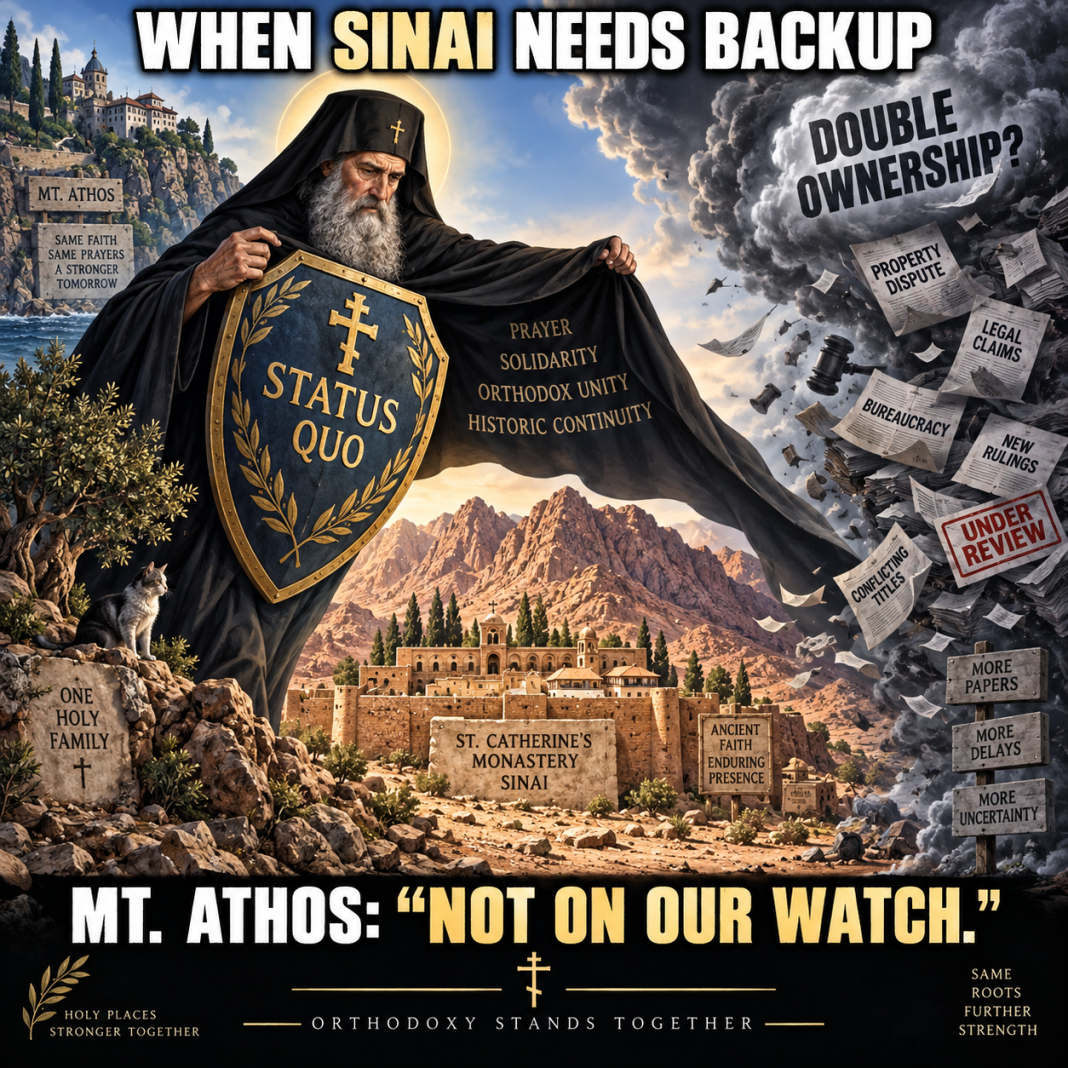
The intervention of Mount Athos has pushed the dispute over St Catherine’s Monastery in Sinai into a more consequential phase, because the issue is no longer simply whether the monks will remain, but under what legal title they will remain and whether a perpetual right of use can legitimately be presented as preservation of the historic status quo.
In a letter to the newly elected Archbishop of Sinai, Pharan and Raitho, Symeon, the Holy Community of Mount Athos, representing the twenty Athonite monasteries, challenged the property formula now being discussed between the Sinai Brotherhood and the Egyptian authorities. Greek reporting has described it as a form of “double” or “dual ownership,” under which Egypt would retain legal or “bare” ownership while the Brotherhood would receive a perpetual right of religious possession, use and administration.
Mount Athos disputes the premise. Ownership and use, it argues, are not equivalent rights, and converting a historic claim of ownership into a state-recognized right of perpetual use changes status rather than preserving it. The concern extends beyond Sinai, because the same logic could affect other ancient ecclesiastical institutions whose property rights predate modern registration systems.
Estia newspaper highlighted the political significance of the intervention on its front page on September 12, describing the Athonite letter as an “ultimatum” directed not only at Archbishop Symeon but also at the governments of Kyriakos Mitsotakis and Abdel Fattah el-Sisi. The term is editorial rather than formal, but it captures the wider stakes: the settlement now concerns not merely property law, but monastic autonomy, ecclesiastical legitimacy and the power of the modern state to redefine rights claimed through centuries of uninterrupted possession.
The dispute itself had been developing for years over dozens of parcels surrounding the historic monastery, including churches, chapels, cells, gardens and agricultural land whose ownership had never been fully reconciled with modern Egyptian land law. By 2024, negotiations were already under way to resolve the matter politically, and the atmosphere appeared favorable when President Sisi visited Athens in May 2025, and both governments emphasized the special status of St Catherine’s.
That changed on May 28, 2025, when the Ismailia Court of Appeal issued the ruling that transformed a property dispute into an international ecclesiastical controversy. The court did not close the monastery or expel the monks, but it refused to recognize ownership over key categories of disputed property and instead distinguished between state ownership and what it called “religious possession.” For a number of religious sites, the Archbishop’s right to possess and use the property for ecclesiastical purposes was recognized while underlying ownership was treated as belonging to the Egyptian state.
This distinction shaped everything that followed. Cairo could argue that worship, monastic presence, and the site’s sacred character were protected, while the Brotherhood and Orthodox authorities could respond that this protection came at the cost of ownership. The dispute therefore became a struggle over the meaning of the “status quo”: for Egypt, continuity meant that the monks remained and worship continued; for Mount Athos and much of the Orthodox side, the status quo also includes the proprietary and institutional independence that historically sustained the monastery’s autonomy.
Greek diplomacy has attempted to bridge those two positions. Athens has welcomed Egyptian guarantees of permanent Orthodox worship while acknowledging that the ownership question remains unresolved, which is why negotiations shifted from the courts back into diplomacy and produced the concept of “double ownership.”
By the summer of 2026, reports suggested that negotiators had converged on a hybrid arrangement in which Egypt would retain underlying ownership while the Sinai Brotherhood would receive an absolute and perpetual right of religious possession, use, and administration. The monks would remain indefinitely, their rights would survive changes of Archbishop, and the state would be unable to simply evict them or alter the site’s religious character, while the Brotherhood would face restrictions on sale, commercialization, and changes of use consistent with the monastery’s protected archaeological status.
Politically, the formula is attractive because each side preserves a central position: Egypt retains title and sovereignty, while the Brotherhood secures permanence and practical autonomy. Legally, however, the phrase “double ownership” is imprecise, because bare ownership combined with perpetual use or usufruct does not normally create two owners; it divides ownership powers between different parties.
That is precisely the point Mount Athos is making. If Egypt remains the owner and the Brotherhood becomes the permanent user, the monks may be secure in practice, but the legal foundation of their presence has changed. They remain not because they own the property, but because the state recognizes an enduring right to occupy and administer it, and for the Athonite community that distinction goes directly to self-government.
An alternative proposal associated with former Archbishop Damianos would divide ownership more concretely by allowing Egypt to own the land while the Monastery retained ownership of the buildings and structures. That would be closer to genuine divided ownership because each side would hold a proprietary title over a different component of the same property, although such a formula would still have to be reconciled with Egyptian antiquities law and the status of protected state property.
The timing of the Athonite intervention matters because it came when negotiations were already portrayed as entering their final stage. Reports in August and early September suggested that the basic architecture of the agreement was largely settled, with remaining disputes centered on peripheral properties, agricultural lands, monastic dependencies, the status of the Archbishop and the mechanism through which the Brotherhood’s rights would be guaranteed.
As of 12 September 2026, no final agreement has been made public, but the likely outcome is a hybrid regime: Egypt would retain ultimate title, while the Brotherhood would receive a permanent, legally protected right of possession, worship, residence, administration, and use. To satisfy ecclesiastical concerns, that right would have to attach to the Monastery itself, survive changes of Archbishop or government, and protect its self-government rather than amount to a revocable license or ordinary usufruct.
The final formula may therefore strengthen the current model into an effectively irreversible, quasi-proprietary right, or go further by recognizing genuine monastic ownership over certain buildings or categories of property while leaving the land under Egyptian title. In either case, “double ownership” is less an established legal category than a diplomatic formula for reconciling Egyptian sovereignty with monastic permanence.
Mount Athos has sharpened the test: if the Brotherhood remains only by virtue of state-granted use, the historic status has changed; if the agreement creates an autonomous and enduring monastic right, it may provide a modern legal framework capable of preserving St Catherine’s historical independence.
Sources
- Estia, 12 Sept. 2026 — Front-page coverage of the Mount Athos intervention and its implications for the Sinai settlement. View front page
- Orthodox Times, 25 Aug. 2026 — Reporting on the proposed “dual ownership” model combining Egyptian title with perpetual monastic use. Read report
- Egyptian Initiative for Personal Rights, June 2025 — Legal analysis of the 2025 ruling and the concept of “religious possession.” Read analysis
- Greek Ministry of Foreign Affairs, 26 July 2025 — Athens’ official interpretation of the ruling and the unresolved ownership question. Read interview