


ΕΑΝ ΠΡΟΤΙΜΑΤΕ ΕΛΛΗΝΙΚΑ ΠΑΤΗΣΤΕ ΤΗ ΣΗΜΑΙΑ ΣΤΟ ΚΑΤΩ ΜΕΡΟΣ ΤΗΣ ΟΘΟΝΗΣ
When the public purse becomes an electoral inducement, legality is only the beginning of the problem
By Nick Stamatakis
There is an old political maxim associated with Julius Caesar: Caesar’s wife must not only be honest; she must be above suspicion. The principle is more important in democratic government than in ancient Rome. Those entrusted with public power should not merely avoid provable corruption; they should maintain a visible, unmistakable boundary between public office, private enrichment, and political self-interest.
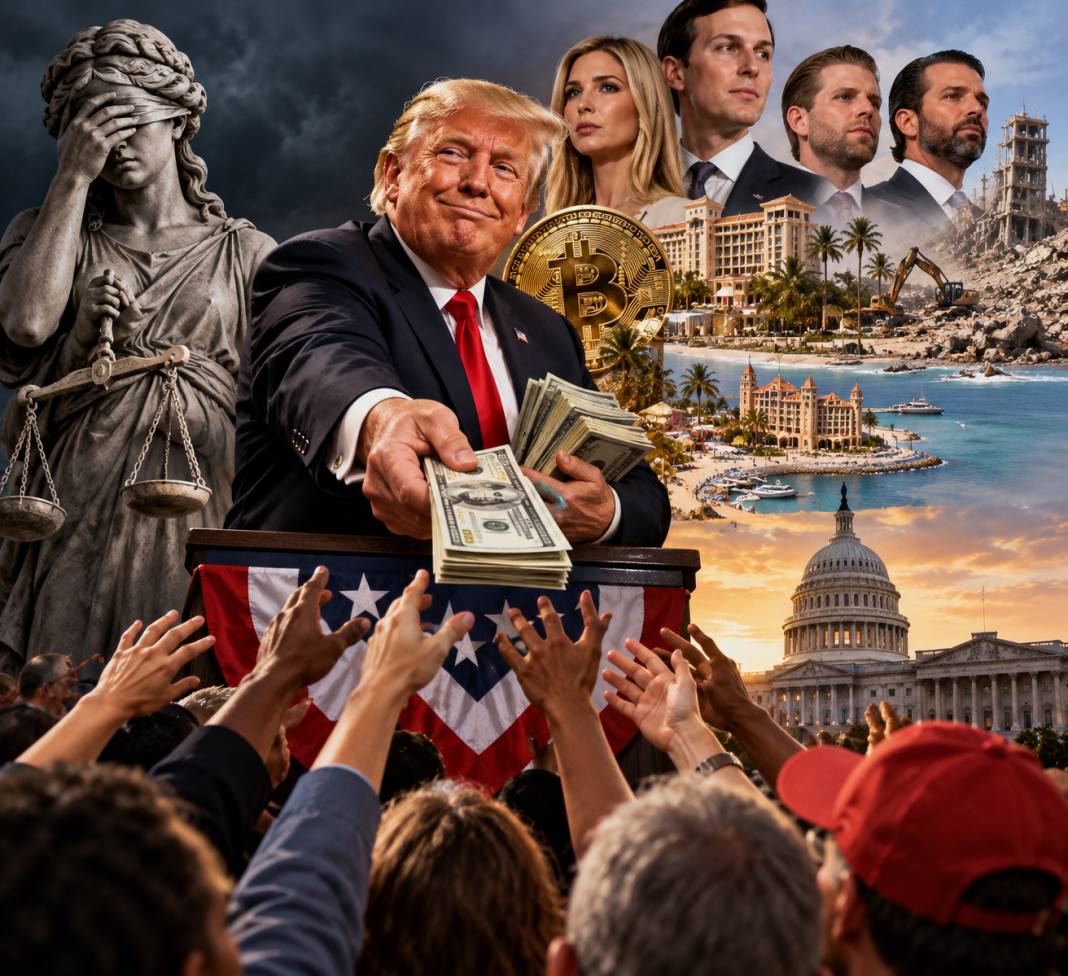
Measured against that standard, President Trump’s promise of a $5,000 “Trump dividend” to every American adult if Republicans retain both houses of Congress is deeply troubling. The estimated price is more than $1 trillion. More important than the number is the formulation: give my party control of Congress, and you get $5,000. Whatever lawyers ultimately call it, that is an extraordinary way for a president to speak about the public Treasury.
The ethical concern does not arise in a vacuum. Trump’s presidency has coincided with extensive commercial activity by members of his family. Trump-family cryptocurrency ventures generated billions of dollars in profits while Trump simultaneously exercised enormous influence over federal cryptocurrency policy. Ethics experts interviewed by Reuters described the arrangement as presenting unprecedented conflicts-of-interest concerns, while the White House and Trump family have denied wrongdoing.
Other episodes have demanded scrutiny rather than reckless accusation. Trump’s April 2025 declaration that it was a “great time to buy,” shortly before his tariff reversal sent markets sharply upward, was followed by revelations of remarkably well-timed options trades and congressional demands for an insider-trading investigation. But no evidence established that Trump or his family made those trades.
The same Caesar’s-wife principle applies to Jared Kushner and Ivanka Trump. Kushner famously described Gaza’s waterfront property as potentially “very valuable” amid catastrophic destruction and displacement – and frankly, Genocide. He later presented an American reconstruction vision featuring upscale coastal development. Meanwhile, a Kushner-linked luxury project in Albania—including hotels, villas, apartments, and a marina—has received special governmental treatment and sparked protests and an anti-corruption investigation over land issues. None of that proves Kushner or Ivanka committed a crime. It does demonstrate why families intertwined with presidential power should maintain exceptionally clear barriers between diplomacy, government access, and private business.
Then comes the $5,000 promise.
Legally, the situation is subtler than its appearance. Federal law prohibits paying people to vote and offering expenditures in exchange for particular votes. Yet the Supreme Court’s decision in Brown v. Hartlage draws an important distinction between secretly buying an individual voter’s support and publicly promising a government policy that would benefit citizens generally. Because Trump has not said that only people who personally vote Republican would receive the money, calling the promise criminal “vote buying” would go beyond current law.
But actually distributing the money is another matter entirely. A president does not possess a personal $1-trillion checking account called the United States Treasury. Under the Constitution’s Appropriations Clause, federal money may be spent only pursuant to congressional authorization. The Anti-Deficiency Act likewise prohibits executive officials from spending or obligating funds beyond what Congress has appropriated. Congress could enact a $5,000 payment program. Trump cannot simply decree one.
That is precisely why the ethical question remains so serious even if the campaign statement itself survives legal scrutiny. Democracy depends on a distinction between promising public policy and presenting public money as the prize for partisan victory.
A president should not need a criminal indictment before recognizing that distinction.
Caesar’s wife, after all, was supposed to be above suspicion.
We will close this short analysis with a humorous suggestion by our friend and colleague, Dimitris Rompotis, a Greek funny song by Glykeria titled “The 5,000 (drachma) bills” – and why they are not napkins…
Selected sources
1. Reuters — Trump’s $5,000 “dividend” pledge and its connection to Republican control of Congress.
Reuters: Trump offers $5,000 if Republicans retain Congress
2. Reuters — Analysis of Trump-family cryptocurrency profits and investor losses.
Reuters investigation: Trump family crypto profits
3. Reuters — The unusually well-timed market trades surrounding Trump’s 2025 tariff reversal; no “smoking gun” was identified.
Reuters: Well-timed options trades draw questions
4. Associated Press — Kushner’s Gaza waterfront remarks and the Kushner-linked luxury development controversy in Albania.
AP: Kushner calls Gaza waterfront potentially “very valuable”
AP: Albania’s Kushner-linked luxury development
5. U.S. Supreme Court / Cornell Legal Information Institute — Brown v. Hartlage, distinguishing public campaign promises from private vote buying.
Brown v. Hartlage, 456 U.S. 45 (1982)
September 11, 2026, www.helleniscope.com, n.stamatakis@aol.com
DISCLAIMER: The views and statements expressed in this article constitute constitutionally protected opinions of this author.
















Excellent article. The Executive Branch leader is in deep do do. And we all know it.
Trump makes a lot of promises but never comes through. To give every American 5000 dollars would cost trillion dollars. Not going to happen.
True! They need that $$$ to prop up Israel and dump more $$$ into the failed Ukrainian fiasco! (And, that’s the truth!)
What is the difference between a government dividend from overtaxation and a liberal promise of free everything?