ΕΑΝ ΠΡΟΤΙΜΑΤΕ ΕΛΛΗΝΙΚΑ ΠΑΤΗΣΤΕ ΤΗ ΣΗΜΑΙΑ ΣΤΟ ΚΑΤΩ ΜΕΡΟΣ ΤΗΣ ΟΘΟΝΗΣ
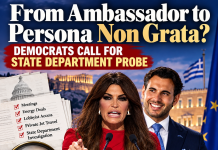
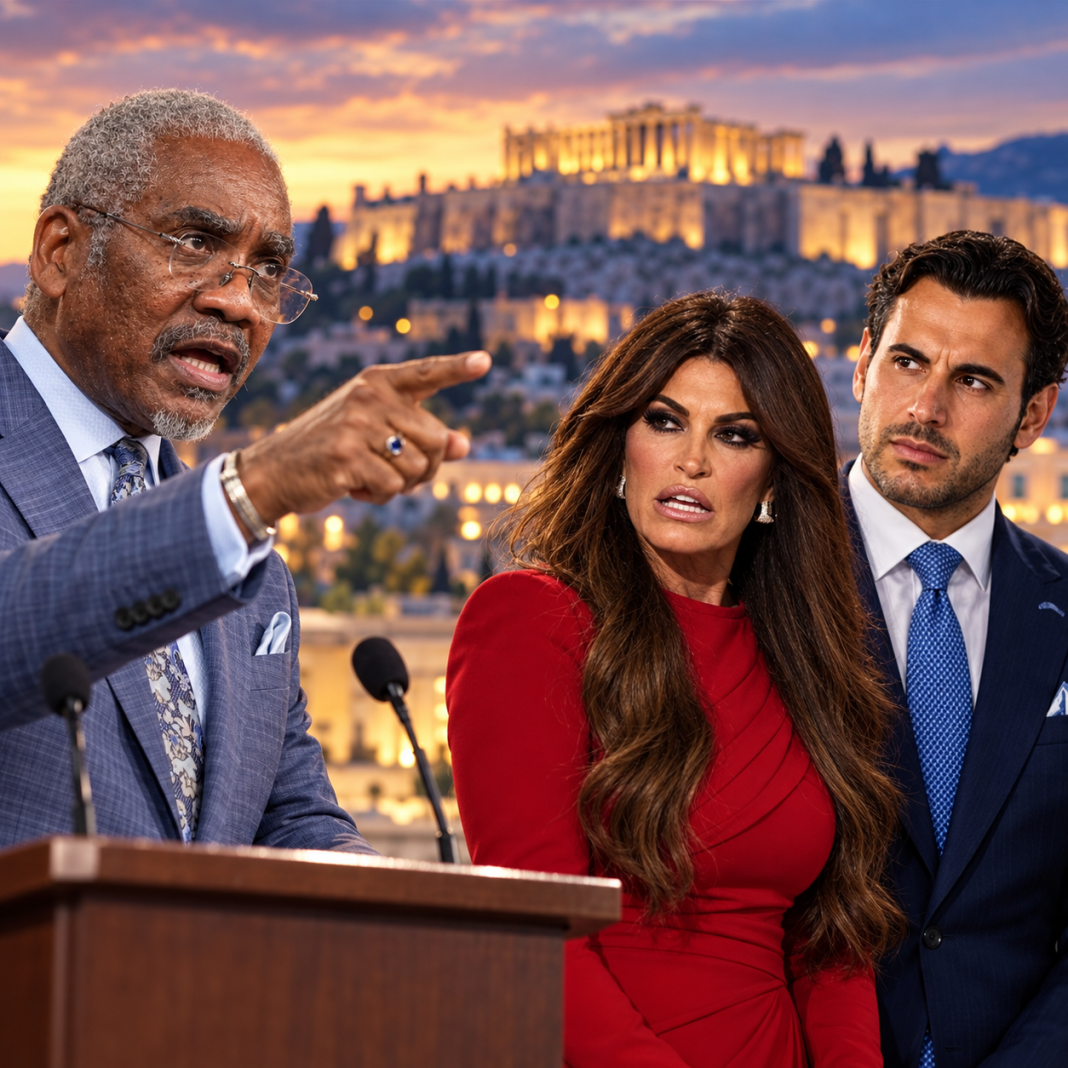
OUR MAIN IMAGE: An artistic rendition of Congressman Meeks’ damning letter to the State Dept., seeking a probe of Amb. Guilfoyle.
Meeks’ letter puts Kimberly Guilfoyle and Christos Marafatsos at the center of a tightly documented congressional inquiry into access, lobbying, Aktor, official travel, and possible ethics conflicts. Rather than simply calling for a probe, it presents a detailed case and demands that State answer it with documents.
By Helleniscope’s Editorial Team
The timing could hardly be more striking.
Secretary of State Marco Rubio — Kimberly Guilfoyle’s boss — is due in Athens next Tuesday, October 6, with defense, energy and regional security high on the agenda. He will arrive with an extraordinary congressional letter awaiting answers back in Washington.
Congressman Gregory Meeks (D-NY), Ranking Member of the House Foreign Affairs Committee, has sent Rubio a seven-page, exceptionally detailed, heavily referenced letter about Guilfoyle’s conduct as U.S. Ambassador to Greece. (You can link here to read the original – or go to the end of this post: GREGORY MEEKS LETTER ABOUT KIMBERLY).
We could call it an “indictment” – that’s how harsh and documented it is. It is not, of course, a legal indictment. But it is much more developed than a conventional request to investigate.
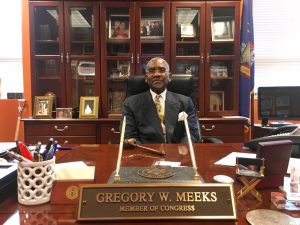
The letter is structured almost like an oversight case brief: it identifies a series of specific alleged acts, names the people and companies involved, cites the reporting and government records on which those allegations rest, identifies the ethical rules potentially implicated, and then demands documents and answers tied directly to each allegation.
In other words, Meeks is not asking State to go out and discover what the controversy is. He has already laid out the case he believes requires an answer and is asking the Department to confirm, rebut, or explain the underlying evidence.
Most strikingly, Meeks states that if the reported allegations are accurate, Guilfoyle is “unfit to represent the United States abroad and should be removed from her position.” State has until October 15 to respond.
The degree of detail is unusual.
Meeks drills into Guilfoyle’s relationship with registered lobbyist Christos Marafatsos, Greek construction and energy group Aktor, CEO Alexandros Exarchou, official diplomatic meetings, commercial advocacy, private-aircraft travel, ethics approvals and Guilfoyle’s own financial interests.
He wants the State Department to identify every official meeting and diplomatic engagement involving Marafatsos, who attended, what was discussed, whether foreign officials knew he was a registered lobbyist, and whether ethics, legal, security, counterintelligence, or conflict-of-interest reviews were conducted before granting him access.
He asks whether Guilfoyle promoted Aktor or its affiliates to foreign governments, whether the company received access or assistance unavailable to competitors, and what safeguards State used to ensure impartial treatment.
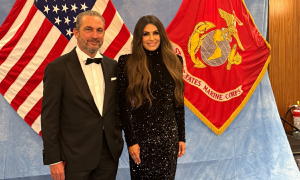
PHOTO: AKTOR CEO Alexandros Exarchoy wtih Amb. Kiberly Guilfoyle
Then comes the private-aircraft issue: who provided the transportation, what it was worth, under what authority it was accepted, whether it was reimbursed or treated as a gift, and whether State Department ethics officials approved it.
That question is especially pointed because an Embassy official told the Wall Street Journal that Guilfoyle’s Bulgaria travel was in “full compliance with State Department guidance.” Meeks is effectively asking State to produce the documentation supporting that conclusion.
The letter is also meticulously sourced. Its references include the Wall Street Journal investigation, federal lobbying filings, official Bulgarian reporting, the Albanian government, Guilfoyle’s own public statements, and the federal ethics rules governing conflicts of interest and use of public office for private gain.
Meeks even asks whether the State Department Inspector General has opened, considered opening, or been asked to open a review involving Guilfoyle, Marafatsos, Aktor, or other commercial entities.
And he wants the underlying records — communications, travel documentation and ethics advice stretching back to September 2025.
The letter explains why describing this simply as a “call for an investigation” understates what Meeks has done. He has assembled the allegations into a documented congressional case, identified the evidentiary gaps, and put the burden on the State Department to answer them point by point.
That is the more precise sense in which the letter has the feel of an indictment: not because guilt has been established, but because the accusations have already been organized, sourced, and presented as a case requiring a formal defense.
And Rubio will arrive in Athens next Tuesday with that case hanging over his ambassador.
October 2, 2026, www.helleniscope.com, n.stamatakis@aol.com
DISCLAIMER: The views and statements expressed in this article constitute constitutionally protected opinions of this author.
TO SUPPORT HELLENISCOPE OR BECOME A SUBSCRIBER, LINK HERE!!
=================
September 30, 2026
The Honorable Marco Rubio
Secretary of State
U.S. Department of State
2201 C St. NW
Washington, DC 20520
Dear Secretary Rubio:
I write to you with deep concern over the reported conduct of U.S. Ambassador to Greece Kimberly Guilfoyle, including allegations that she advocated for U.S. interference to bring down sovereign democratic governments, used her position to promote the commercial interests of a particular Greek company in official diplomatic engagements, and repeatedly allowed a registered lobbyist for that foreign company to participate in meetings with senior U.S. government officials. If these reports are accurate, Ambassador Guilfoyle is unfit to represent the United States abroad and should be removed from her position.
According to a Wall Street Journal investigation published on September 25, 2026, Ambassador Guilfoyle told attendees at a March dinner with Greek and American officials, while discussing the impending collapse of then-Romanian Prime Minister Ilie Bolojan’s government, that the United States could bring about similar political change in other countries, including Greece. This allegation has prompted public concern in both Greece and Romania about whether the United States government interferes in the democratic governments of its NATO allies.¹ Greek opposition parties have publicly sought answers from their government regarding the reported remarks.
The same reporting raises separate concerns regarding Ambassador Guilfoyle’s relationship with Christos Marafatsos, a registered lobbyist for Greek construction and energy company Aktor Group. Federal lobbying records cited by the Wall Street Journal show that Aktor paid Mr. Marafatsos $160,000 through June 2026 to establish connections with, among others, the Department of State, Department of Energy, and Executive Office of the President. The Journal further reported that Mr. Marafatsos accompanied Ambassador Guilfoyle to numerous official U.S. government meetings, including meetings with foreign heads of government and other senior officials, and that some participants were not informed that he was a paid lobbyist for Aktor, with some foreign officials reportedly mistaking him for the Ambassador’s chief of staff.²
These concerns are heightened by reporting that Ambassador Guilfoyle has promoted Aktor or Aktor-affiliated energy projects, during official engagements throughout Southeast Europe.
In the Spring of 2026, for example, Ambassador Guilfoyle participated in official talks with Bulgaria’s president and prime minister concerning the Vertical Gas Corridor and regional energy cooperation. Bulgarian official reporting confirms those meetings.³ The Wall Street Journal reported that Mr. Marafatsos participated in the meeting with Bulgaria’s president while representing Aktor and that Ambassador Guilfoyle urged Bulgarian officials to work with the company.
Similar questions arise from Ambassador Guilfoyle’s activities in Albania. The Albanian government publicly confirmed that she attended a signing ceremony in April of this year involving a long-term Liquefied Natural Gas (LNG) arrangement with Venture Global and Aktor LNG USA, which Ambassador Guilfoyle described as a $6 billion commitment advancing the Administration’s energy agenda.⁴ The Journal separately reported that she had made an earlier, unpublicized visit to Albania in March 2026 without U.S. Embassy staff, arriving after nightfall and proceeding directly, accompanied by Mr. Marafatsos and Aktor CEO Alexandros Exarchou, into an official meeting with Albanian Prime Minister Edi Rama, where she pitched Albania on energy cooperation, before returning for the signing ceremony the following month.
The Journal further reported that Mr. Exarchou provided Ambassador Guilfoyle transportation to Bulgaria aboard a private aircraft. A U.S. Embassy official told the Journal that Ambassador Guilfoyle’s travel was in “full compliance with State Department guidance.”⁵ Given Aktor’s substantial commercial interests in the same energy initiatives Ambassador Guilfoyle was promoting in her official capacity, this statement raises questions as to the Department’s basis for that determination and whether the travel, its value, and its source were reviewed by Department ethics officials.
The reported engagements between Ambassador Guilfoyle and Aktor stakeholders also raise fundamental questions about conflicts of interest, preferential access, and the use of U.S. government public office to advance private commercial interests, including those of foreign companies. The Standards of Ethical Conduct for Employees of the Executive Branch prohibit employees from using public office for private gain and establish requirements intended to preserve impartiality in the performance of official duties.⁶
I am also concerned by separate reporting regarding Ambassador Guilfoyle’s private commercial activity during the period surrounding her Senate confirmation process. The Journal reported that, around the time of her confirmation, she sought outside investment of $3 million from a Greek-American businessman for a vodka company in which she is financially involved, though the reporting notes her attorney disputed that account.⁷ Given her subsequent role overseeing one of the United States’ most commercially significant bilateral relationships in Southeast Europe, the Department should clarify what ethics review occurred regarding her private business interests and whether any recusals, divestitures, waivers, or other ethics arrangements were required.
The Committee on Foreign Affairs has primary jurisdiction under House Rule X over relations of the United States with foreign nations generally, to include oversight of the conduct of officials responsible for carrying out such diplomatic activities. I am deeply concerned that Ambassador Guilfoyle’s reported conduct risks damaging relations with U.S. allies, enabling malign actors seeking to portray the United States government as anti-democratic, and opening the door to corrupt influence on U.S. foreign policy.
Accordingly, I request that you provide answers to the following questions and requested documents by no later than October 15, 2026:
1) Romania and Greece. Is the Wall Street Journal report accurate that Ambassador Guilfoyle stated, in substance, that the United States had participated in or could bring about the collapse of the Romanian government and could similarly do so in Greece? If not, please provide the Department’s understanding of what was said.
a) What was Ambassador Guilfoyle’s basis for suggesting that the United States played a role in the collapse of the Romanian government?
b) Did the Department, White House, National Security Council, or any other U.S. government entity authorize or direct any activity intended to influence the composition or survival of the Romanian government?
2) Department response. When did the Department first become aware of Ambassador Guilfoyle’s reported remarks regarding Romania and Greece? What corrective action has the Department taken to address these remarks with Ambassador Guilfoyle directly? Has the Department communicated with the governments of Romania or Greece regarding those remarks?
3) Mr. Marafatsos’s role. What official or unofficial roles or responsibilities, if any, has Christos Marafatsos performed for Ambassador Guilfoyle, Embassy Athens, or the Department of State?
a) Has Mr. Marafatsos, either in his personal capacity or through any businesses or ventures with which he is associated, received direct funding from any overseas U.S. missions or from the Department of State? If so, please indicate the amount, source, and purpose of such funding and the date on which it was provided.
b) Please identify every official meeting, diplomatic engagement, official trip, or event since Ambassador Guilfoyle assumed office in which Mr. Marafatsos participated with her or other Embassy personnel, including:
i) the date and location;
ii) participating U.S. and foreign officials;
iii) the purpose of the meeting;
iv) whether Mr. Marafatsos’s lobbying clients or business interests were discussed; and
v) whether participants were informed that Mr. Marafatsos was a registered lobbyist and, where applicable, that he represented Aktor or another entity with a financial interest in the subject of the meeting.
c) Did Embassy Athens or the Department conduct any ethics, legal, security, counterintelligence, or conflicts-of-interest review before permitting Mr. Marafatsos to participate in official meetings or access the Ambassador’s residence for official business? If so, please provide copies of any such review(s).
d) Did Ambassador Guilfoyle or any Embassy employee direct foreign officials, companies, investors, or other individuals to communicate with Mr. Marafatsos
regarding matters involving official U.S. policy or potential commercial transactions? If so, please identify each instance and explain the Department’s justification.
4) Aktor. Has Ambassador Guilfoyle advocated that any foreign government, state-owned enterprise, or private company enter into a commercial relationship with Aktor Group, Atlantic-SEE LNG, Aktor LNG USA, or any Aktor affiliate? If so, please identify each instance and explain the U.S. policy basis for advocating on behalf of that particular company.
a) When did Ambassador Guilfoyle learn of Mr. Marafatsos’s status as a lobbyist for Aktor Group? When did other senior Embassy officials – including the Deputy Chief of Mission, Regional Security Officer, and section heads – learn of Mr. Marafatsos’s status as a lobbyist for Aktor Group? Were Embassy officials informed of Mr. Marafatsos’s status as a lobbyist for Aktor Group prior to participating in meetings with him?
b) Did Aktor, Mr. Exarchou, Mr. Marafatsos, or any company represented by Mr. Marafatsos receive access to U.S. officials, meetings, information, introductions, or other assistance that similarly situated competitors did not receive? What procedures did the Department use to ensure impartial treatment among competing U.S. and foreign companies?
5) Private aircraft travel. Did Ambassador Guilfoyle travel aboard an aircraft owned, chartered, paid for, or otherwise provided by Aktor, Mr. Exarchou, or an Aktor affiliate?
a) If so:
i) identify each flight, the date of travel, and the departure and destination cities;
ii) state the value and source of the transportation;
iii) identify the legal authority under which the transportation was accepted;
iv) state whether the transportation was reported as a gift, reimbursed, or accepted as official travel; and
v) provide any ethics or legal determinations approving the arrangement.
b) Did Ambassador Guilfoyle or any member of her staff seek advice from the Department’s Office of the Legal Adviser, ethics officials, the Office of Inspector General, or another Department component regarding her interactions with Aktor or Mr. Marafatsos? Please provide copies of any resulting determinations, guidance, opinions, waivers, authorizations, or recusals.
6) Private financial interests. Please identify all private business interests, outside positions, financial interests, or business relationships disclosed by Ambassador Guilfoyle upon entering government service that involved Greece, Greek nationals, Greek companies, or persons subsequently involved in matters before Embassy Athens.
a) Since assuming her position, has Ambassador Guilfoyle participated in any particular matter in which she has a direct financial interest, to include any matters involving Polished Rice, Inc.? Please also identify any matters in which Ambassador Guilfoyle was authorized to participate pursuant to the impartiality regulations at 5 C.F.R. Part 2635, Subpart E, or received a waiver pursuant to 18 U.S.C. § 208(b)(1).
b) Has the Department reviewed whether any conduct described in the September 25, 2026, Wall Street Journal report implicates the Standards of Ethical Conduct for Employees of the Executive Branch, including restrictions on the misuse of public office for private gain or requirements concerning impartiality, or otherwise violates her Ethics Agreement with the Office of Government Ethics? If so, please describe the review and its conclusions.
c) Has the Department of State Inspector General opened, considered opening, or been asked to open any review concerning Ambassador Guilfoyle’s interactions with Mr. Marafatsos, Aktor, or other private commercial entities?
d) Please provide all Department and Embassy Athens records from September 2025 to the present relating or referring to any of the following:
i) Christos Marafatsos;
ii) Aktor Group, Aktor Energy, Aktor LNG USA, and Atlantic-SEE LNG;
iii) Alexandros Exarchou;
iv) Ambassador Guilfoyle’s official travel to Bulgaria, Albania, and Romania;
v) transportation furnished to Ambassador Guilfoyle by private individuals or companies;
vi) Department ethics advice concerning Ambassador Guilfoyle’s private financial or business interests; and
vii) the reported March 2026 conversation concerning the governments of Romania and Greece.
Sincerely,
GREGORY W. MEEKS
Ranking Member
CC: Arne B. Baker, Acting Inspector General, U.S. Department of State