


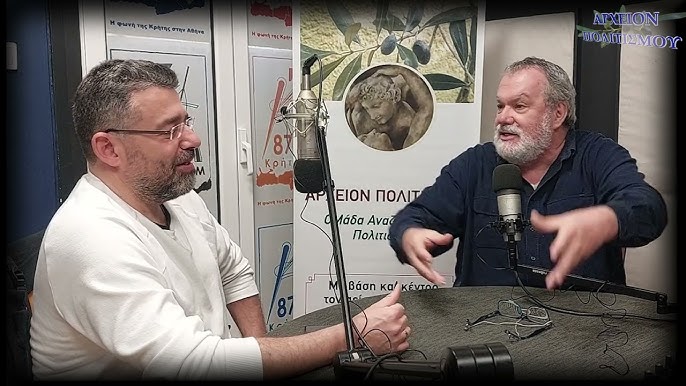
EDITOR’S NOTE (Nick Stamatakis). As I have explained before, Greece and Cyprus have some of the best geopolitical analysts anywhere – and we can all see why: Our motherlands are in the intersection of three continents and – to survive in this location – you must be able to analyze clearly the various powers, friendly or hostile, that surround them… George Filis, a friend of Helleniscope, is among the best of such analysts and appears regularly on TV stations and YouTube channels.
In the recent presentation below (July 19, 2025), Filis analyzes the prophesies of Kosmas Aitolos, Iosif Vatopedinos and St. Paisios and proves beyond doubt that they have validity. Saint Paisios of Mount Athos is widely attributed to a series of prophecies with major geopolitical implications. Among the most striking is the scenario in which a war breaks out between Russia and Turkey, leading to Turkey’s defeat and eventual dissolution. According to this narrative, Greece will not participate in the central conflict but will suffer a Turkish attack. In the aftermath, Constantinople will be handed over to Greece jointly by the Western powers and Russia—not through conquest, but as a strategic settlement. Greece, seen as a trusted and neutral Orthodox power, will be given control of the city as the “least dangerous” choice for all sides. This outcome, along with prophecies of Turkish territory being divided into Greek, Armenian, and Kurdish regions, echoes the Megali Idea—a vision of Greek territorial and cultural restoration.
Before some of you start rejecting this approach, I want t remind you that the CIA has analyzed “remote viewing” and “psychic” abilities in predicting geopolitical developments, along with other approaches indicating the intersection of religion and politics….
THIS FASCINATING VIDEO HAS ENGLISH SUBTITLES…
=====================













Sounds interesting, but what would Greece do with the approximately 15 million Turks now living in Constantinople?
Filis makes an effort to explain it: many will convert, others will leave to reside in Anatolia etc… Nobody can predict exaclty. But Greece should apply the Hellenistic principles of peaceful coexistence in a cosmopolitan environment, for which Constantinople is a perfect location
NGood point from Sakelaris. We know Konstantinople is never going to be Greek again. Prophesies can be intterpreted any way they seem to fit at a certain time. And if Greeks were to compete with Turks in demography, Greeks will be extinct in a few years’ time
Bob is correct in saying that Prophesies can be interpreted in many ways…
One of those interpretations can easily answer John Sakelaris’ question though, but it combines two of St. Kosmas’ prophesies…
Excerpt A) “1/3 of the Turks will be killed, 1/3 will be baptized, and 1/3 will go to the depths of Anatolia (past Κοκκινη Μηλια)”
Excerpt B) “there will be so much bloodshed in Costantinople, that a 3-year old calf will drown…”
Based on these two very explicit excerpts (not much room for “abstract symbolism” in these statements), one might begin speculation on how many of the 15 million residents (about 1/4-1/5th of the current population of the country) will actually be left standing in the city when the dust literally settles, whenever the prophesy manifests… both the death toll, and the projected “mass migration” past Ankara combined will account for 2/3 of the population according to St. Kosmas’s prophesy.
The math is quite horrific to fathom, and it won’t be a pleasant or even spiritual sight to watch, but either way, this math technically “works” for anyone that elects to align with this particular interpretation..
A more moderate and realistic goal for Greece in the event of a really major Turkish loss in a war would be to seek a Greek zone that would comprise just a portion of the old Constantinople. It could include the Holy Wisdom church.
In past history, the Christian Byzantines (actually Romans) fought against both the Christian Serbs and the Christian Bulgarians. The Serbs and Bulgarians sought independence and were considered hostile to a unified Christian empire. They were labeled as schismatic by the Byzantines, and the Byzantines went to war against them. Today the Byzantine empire as a state entity no longer exists, yet both Serbia and Bulgaria do.
The idea of a visible bulwark on earth of God’s people, the Church, goes back to the Old Testament. The word “Zion” is often used to describe this visible bulwark: the City of God, Jerusalem, or Israel. The meaning of the word “Zion” is essentially a fortification. In Christianity, the word “Zion” can refer to the Church, the New Jerusalem. Christ alludes to this Zion, by saying to Peter, “I will build my church; and the gates of hell shall not prevail against it.” Yet the Zion that Christ points to is a kingdom of heaven, not an earthly kingdom, as Christ continues with, “and I will give unto thee the keys of the kingdom of heaven: and whatsoever thou shalt bind on earth shall be bound in heaven: and whatsoever thou shalt loose on earth shall be loosed in heaven.” Nonetheless, there is the visible unity of the Church on earth that Christ provides to Peter with the words: “whatsoever thou shalt bind on earth” and “whatsoever thou shalt loose on earth”.
In Christianity, the word Zion would refer to the heavenly kingdom that Christ has established. That heavenly kingdom also manifests itself on earth as the Church of Christ. Yet sometimes people in the church have confused the heavenly Zion with an earthly zion. So the phenomenon of “Christian Zionism” isn’t just something that modern Evangelical Christians believe. At times, the Byzantines were also “Christian Zionists” as they fought to quell Bulgarian and Serbian independence. Today there are others within the church who have confused an earthly zion with the heavenly one. One has to look no further than to observe the modern idea of “Russian World”, an idea that has existed for only 30 years.
How did I call you a few days ago because of your purposefully twisted argumentation? Only lawyers would do a better job than you in turning black into white and the reverse. Remember what St.. Paul said about lawyers: “Ουαί υμίν τοισ νομικοίς, ότι ήρατε την κλείδα της γνώσεως. Υμεις μεν ουκ εισήλθατε και τους εισερxομένους εκωλύσατε”… Which translates as: “Woe to you lawyers, for you have taken away the key of knowledge. You yourselves did not enter, and you hindered those who were entering.” (Luke 11:52).