


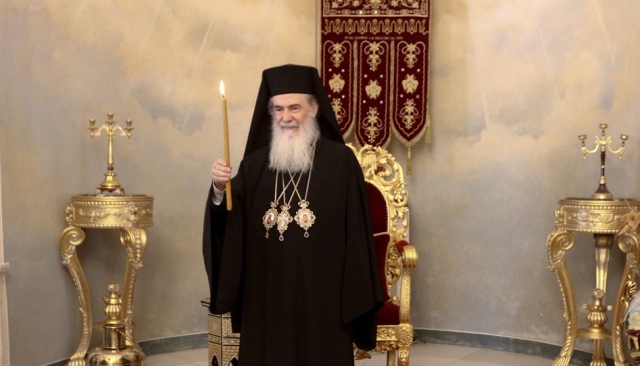
By Helleniscope’s Editorial Team
In a move that has shocked the Orthodox faithful worldwide, the Municipality of Jerusalem has frozen all bank accounts of the Greek Orthodox Patriarchate — a decision announced on Wednesday, August 6, under the pretext of unpaid municipal property taxes (“Arnona”) on properties not used directly for worship.
According to the Times of Israel (link here), municipal officials claimed they had repeatedly sent letters demanding payment for taxes on guesthouses, cafés, and other Patriarchate holdings. When no payment came, they acted “in accordance with the law” to seize the Church’s accounts.
But to the Patriarchate — and to many who understand the political and spiritual weight of Jerusalem — this is more than a bureaucratic tax dispute. Supporters of Patriarch Theophilos III see it as economic strangulation, a deliberate effort to cripple the Church’s ability to operate: to pay clergy, maintain holy sites, fund schools, and serve pilgrims.
The Bigger Picture: From 2018 to Today
For decades, a tacit understanding existed between the State of Israel and Jerusalem’s ancient Christian communities: Church properties would be exempt from municipal taxation. This understanding — rooted in both Ottoman-era arrangements and Israel’s own early guarantees — was shattered in 2018, when the city unilaterally announced that only properties used for worship, religious teaching, or closely related purposes would be exempt.
Guesthouses, pilgrim centers, and commercial leases were suddenly declared taxable.
That year, under then-mayor Nir Barkat, the accounts of several churches — including the Greek Orthodox Patriarchate — were frozen. The Patriarchs of Jerusalem, Armenia, and the Custos of the Holy Land responded with a dramatic protest: they closed the Church of the Holy Sepulchre, the most sacred site in Christianity, for three days. Only after Prime Minister Benjamin Netanyahu intervened was the freeze lifted.

A Political Undercurrent
This latest escalation comes at a time of growing tension between Christian churches in Jerusalem and municipal authorities. Some see it as part of a broader pattern: pressure on the Patriarchate in disputes over land, historic rights, and the Christian presence in the Holy Land. In the volatile mix of faith, politics, and real estate that defines Jerusalem, such moves are rarely only about money.
A Call to Vigilance
For the Greek Orthodox world — and indeed for all Christians — the freezing of the Patriarchate’s accounts should serve as a wake-up call. Beyond the headlines about taxes lies a deeper struggle: the safeguarding of an unbroken Christian witness in the very city where our faith was born.
============================

Two Crises, One Pattern: Freezing the Greek Orthodox Patriarchate’s Accounts
| Year | Event | Key Details | Outcome |
|---|---|---|---|
| 2018 | First Account Freeze | Then-Mayor Nir Barkat orders the freezing of several Christian churches’ bank accounts, including the Greek Orthodox Patriarchate, over alleged unpaid property taxes on non-worship properties (guesthouses, commercial leases). | The three Patriarchs of Jerusalem (Greek Orthodox, Armenian, and the Custos of the Holy Land) unite in protest and close the Church of the Holy Sepulchre for three days — an unprecedented act in modern times. Israeli PM Benjamin Netanyahu intervenes; the freeze is lifted. |
| 2025 | Second Account Freeze | On August 6, the Jerusalem Municipality again freezes all bank accounts of the Greek Orthodox Patriarchate, claiming unpaid “Arnona” taxes on properties such as cafés and pilgrim accommodations. Officials say repeated payment demands were ignored. | The Patriarchate denounces the move as economic strangulation — preventing salaries, school funding, and maintenance of holy sites. As of now, there is no reversal, and tensions are escalating. |
Pattern & Implications
Trigger: Both crises began with the city targeting non-worship properties for municipal taxation, breaking the historic understanding that Church holdings were broadly exempt.
Municipal Logic: Authorities frame it as a legal matter — “equal taxation” for all commercial activity.
Church View: The Patriarchate sees it as an attack on the Church’s mission, autonomy, and ability to preserve the Christian presence in Jerusalem.
Outcome Divergence: 2018 ended with a swift reversal after high-level intervention; 2025 remains unresolved, with potential for escalation.
August 14, 2025, n.stamatakis@aol.com www.helleniscope.com
DISCLAIMER: The views and statements expressed in this article constitute constitutionally protected opinions of this author.














So do Jewish temples also hold commercial property? If so, do they pay taxes on their commercial holdings that do not include worship? Do Jewish temples pay taxes?
We need to actually see the documents signed, the actual laws regarding non profit churches and temples in Israel to include the dates these tax laws were created and any amendments to these laws.