


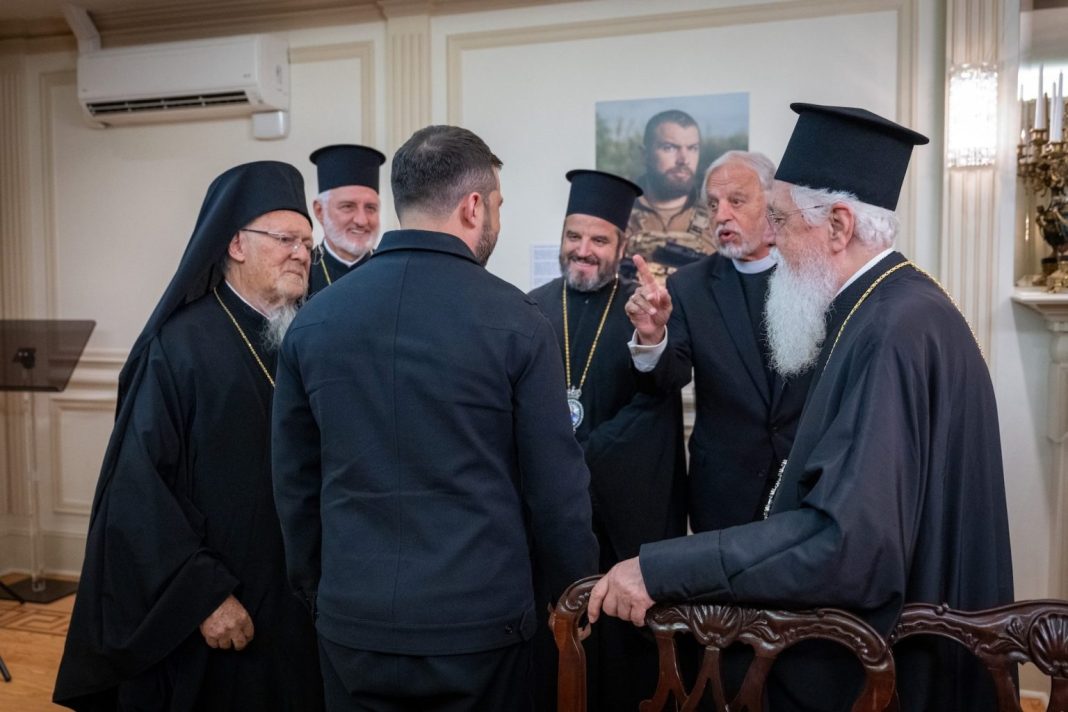
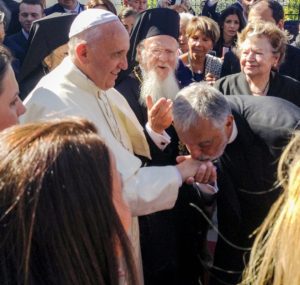
PHOTO: Talking to Zelensky last September in New York. Does this look like retirement? But the catastrophe in Ukraine will surely put Karloutsos and his Phanar gang deep into the “trash can of history”.
ΕΑΝ ΠΡΟΤΙΜΑΤΕ ΕΛΛΗΝΙΚΑ ΠΑΤΗΣΤΕ ΤΗ ΣΗΜΑΙΑ ΣΤΟ ΚΑΤΩ ΜΕΡΟΣ ΤΗΣ ΟΘΟΝΗΣ
Karloutsos tied his fate to Bartholomew’s tenure. That tenure now appears to be ending under the weight of its grave failures. Karloutsos’s article, published just days before Christmas, can only be interpreted as a precursor to Bartholomew’s resignation – something that has been increasingly evident for months. This marks the end of the road for both of them.
By Nick Stamatakis
The recent editorial by Karloutsos in the Orthodox Observer titled “A season of renewal: Why the Greek Orthodox Archdiocese should embrace mandatory retirement” (link here), calling for mandatory retirement within the Greek Orthodox Archdiocese of America (GOARCH), collapses under the weight of its own contradiction. Its central thesis—that aging leaders must step aside for the good of the Church—might be compelling were it not authored by a man who exemplifies precisely the problem he claims to oppose.
Karloutsos formally “retired” in 2021 from his role as Vicar General of GOARCH. Yet nothing resembling retirement followed. He remains fully active, fully influential, and deeply embedded in ecclesial and political power structures. His essay condemns indefinite tenure while he is quietly practicing it.
The argument is straightforward: leadership renewal requires withdrawal. The contradiction is simpler still: the author did not withdraw.
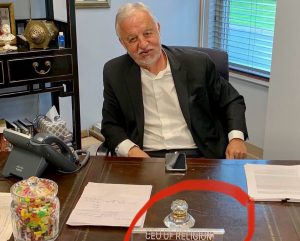
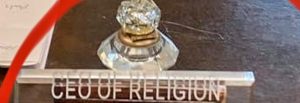
PHOTOS ABOVE: The infamous CEO of Religion, behind a table that has reportedly seen all his “trespasses” – including mountains of cash… Did you say transparency? Or maybe accountability? Ha… ha… You must be kidding…
He continues full-time parish ministry in the Hamptons. He remains a central fundraiser and power broker for the Ecumenical Patriarchate. He continues his international engagement in U.S. religious diplomacy (a very flattering description of his engagement with the Deep State), particularly in the Balkans and Africa. This may be framed as “retire but not retreat,” but in practice, it amounts to never retiring at all.
If indefinite tenure produces “toil and travail,” why does the rule never apply to the man preaching it?
The essay extols transparency and good governance, yet offers none. It demands rules, limits, and accountability—but only for others. There has been no public clarification regarding the scope of Karloutsos’s ongoing compensated roles, his continued fundraising authority, or the financial arrangements surrounding patriarchal visits and appeals. Whether such arrangements are proper or improper is not the core issue. What matters is that the advocate of reform exempts himself from disclosure. That exemption alone drains the essay of moral authority.
The timing of the piece is equally revealing. It appears amid Constantinople’s weakened global position following the Ukraine catastrophe and the unraveling of earlier ecclesial–geopolitical strategies. In this context, the essay reads less like a call for renewal and more like an effort to manage succession without relinquishing control.
Karloutsos tied his fate to Bartholomew’s tenure. That tenure now appears to be ending under the weight of its grave failures. Karloutsos’s article, published just days before Christmas, can only be interpreted as a precursor to Bartholomew’s resignation—something that has been increasingly evident for months. This marks the end of the road for both of them. Bartholomew’s last trip to America, the Pope’s visit to Turkey, and other fanfare create the pseudo-sense of a “legacy” as the falling curtains can barely hide the disastrous tenure…
True renewal requires those who shaped the present order to step aside—not to draft rules governing those who come after while remaining entrenched themselves.
The essay never asks—and therefore never answers—the only question that matters: when will Karloutsos himself finally retire? Not rhetorically. Not symbolically. But concretely, transparently, and completely. Until that happens, the argument is not reform but clerical moralism without personal cost.
Most striking, however, is the essay’s selective memory. Karloutsos cites the Moscow Patriarchate as an ecclesial example, invoking its governance norms as a model—despite having played a central role in advancing policies that helped precipitate the deepest schism between Moscow and Constantinople in generations. That is not merely ironic; it borders on cynical.
No honest assessment of Karloutsos’ legacy can ignore the catastrophic experiment of Ukrainian autocephaly, a project he championed for nearly a decade. Whatever one’s political sympathies, the ecclesial consequences are undeniable: schism, fragmentation, loss of credibility, and the effective marginalization of Constantinople as a unifying force in global Orthodoxy.
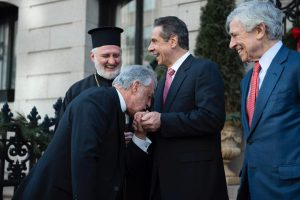
During these same years, GOARCH’s membership collapsed—from about 500,000 faithful in 2000 to fewer than 120,000 today. Correlation is not causation, but leadership choices matter. Much of what remains reflects Karloutsos’ flawed “vision” and “leadership” over five decades: his constant flattery, hand-kissing and deference to the powerful produced not a Church focused on evangelizing a wounded world, but an inward-looking institution – less a house of faith than a country club for the well-connected, a social hub for the wealthy and famous, and a stage for failed geopolitical posturing.
And this will be Karloutsos’ legacy. He will be remembered as a “Rasputin,” the “Prince of Darkness”—the priest who helped consign the GOA, as a religious institution, to the graveyard of abandoned Christian denominations.
December 22, 2025, n.stamatakis@aol.com www.helleniscope.com
DISCLAIMER: The views and statements expressed in this article constitute constitutionally protected opinions of this author.










Totally disgusting…including and especially all in the picture who met Zelinsky. How long will they continue to destroy the church? And still it continues!!!
The solution to this problem is very simple. Those who for various reasons cannot stop going to church, they can simply stop giving their money to the gang of Phanar and AHEPA. There is nothing they can do to force you pay. And they cannot drive you away from the church. Actually, they feel more unease when you remain in the church and you are watching their heretic moves…
Boot out the old goat! (And, someone should tell him that real Orthodox priests wear cassocks!)
What does “mandatory” retirement really mean when the Archdiocese itself didn’t properly fund their side of the “mandatory” contributions to the retirement fund for at least 2 decades, rendering the accounts “insolvent” based on the originally planned distribution models? For the “common working mortal”, we know that insufficient retirement funds = “haircut” which also = a “mandatory work till you die” sentence…
And during those same years where the Archidocese elected NOT to fund the retirement accounts (supposedly due to expensive lawsuits, etc), ironically, Karloutsos pats his own self on the back for being the “mega fund raiser” for the St. Nicholas fiasco at ground zero, with astronomical sums, which went to pay, among others a 7-figure architectural fee for Santiago Calatrava, who isn’t even Orthodox. And equally ironically, the well-publicized media reports of “mishandling” of some of these “restricted funds” by the Patriarchate (partly to finance the “lavish” 2016 fiasco in Kolymbari, Crete) turned into the “hook of geopolitical entrapment & leverage” that led to Bartholomew’s reversal on 27 years of policy and opinion on the Ukraine (with the issuance of the “tomos”)…
And by the way, is this the right time to remind folks that GOARCH Hierarchs are paid from a totally separate “Patriarchate-sponsored hierarchical retirement fund” that has nothing to do with the clergy Syndesmos accounts? Is that where they’ve been paying Evangelos’s salary from, years after he was “retired” to become the Metropolitan of an Asia Minor city with no parishes? Why and how is that hierarchical retirement account “fully funded”? Is this a possible explanation as to why hard assets like buildings in Chicago, monastery properties in Crete, real-estate in Brookline, MA, and elsewhere around the world are systematically being liquidated into cash? And who really knows at this stage if the recently bestowed title of “Mega-protopresbyter of the Ecumenical Throne” actually entitles Karloutsos access to additional retirement pools that are external to GOARCH, “bypassing” the “GOARCH retirement breadcrumbs” that fall onto the floor for the other GOARCH clergy to share (the future looks especially bleak for the younger priests)? That would be an interesting investigation, because “following the money” has always been the best source of truth in our corrupt world…
Prince of Darkness Karloutsos retire?
On his death bed.
It is beneath an orthodox priest or hierarch to kiss the hand of the pope because they are not a physical person but represent the true Church of Christ. By doing this they legitimize the pope and Catholicism as being true to the teachings of the original church that Christ left us. This is a time of turmoil, OC is losing churches in around the world and it seems that those that are under Barto are going at a faster speed. If he is such a holy and charismatic ecumenical leader that has the backing of the west, how come he is always at a loss in US, in Turkey, in Albania, etc?
https://orthochristian.com/174729.html
Perhaps if the greeks would see a strong orthodox faith lived, inspired by their own hierarchs, their numbers will increase and even surpass the previous numbers. Is Barto even shedding a tear over the churches that closed down or are transformed in mosques and museums? And does he want a union with Rome to mask his own failures and the decrease in his numbers? I remember reading a story about 2 young men that went with their girlfriends to visit a simple holy monk. They were both born orthodox but they were not living a deep orthodox life. And the thin, small framed monk spoke to them in plain words about God. And when they left they did not know what to make of their encounter but they realized the humble monk spoke true to his convictions. They realized everything was true, his deep faith was believed AND lived. Both of the young men later became monks and have printing shops in their monasteries and publishing hundreds of books. This is how it’s done. By example.
Food for thought: by forcing retirement, the vacancy can lead to a couple of things. One, sale of property and consolidate into a neighboring parish due to “lack of priests” or 2, the further importation of “celibate” priests from Greece or Turkey do to a shortage of priests.
Why on earth would you force retirement when Holy Cross output doesnt meet the need?