


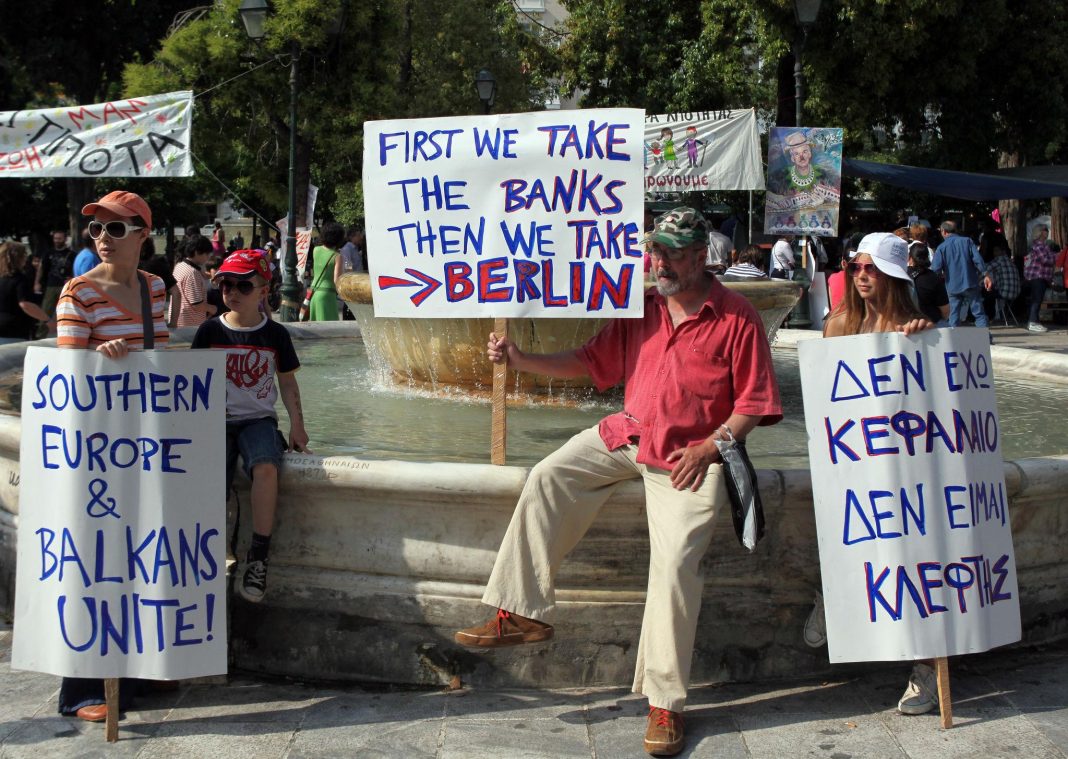
ΕΑΝ ΠΡΟΤΙΜΑΤΕ ΕΛΛΗΝΙΚΑ ΠΑΤΗΣΤΕ ΤΗ ΣΗΜΑΙΑ ΣΤΟ ΚΑΤΩ ΜΕΡΟΣ ΤΗΣ ΟΘΟΝΗΣ
After re-reading the facts in the following article, any patriotic politicians of Greece – and certainly many of us in the Diaspora – need to rise up and demand from the globalist BANKSTERS to do the right thing. Before the 2008 crisis, American banks lent money even to unemployed people, thereby exacerbating the crisis. Instead of the Banks going bankrupt, the rest of us bailed them out!! During the Greek crisis, they violated every banking rule and lent more money to Greece than the country could afford. Instead of the Banksters filing for bankruptcy, they turned all Greeks into slaves for eternity!! Until when will the Banksters drink our blood?
By Nick Stamatakis
In July 2015, in an email later released through the U.S. Department of Justice’s Epstein Files, Noam Chomsky described the Greek bailout in blunt terms.
He wrote that Greece was “a mere conduit for a bailout” — not the true beneficiary.
The bailout, he argued, did not primarily rescue Greece. It rescued creditors, mainly French and German banks.
Independent economic analyses broadly support this framework.
Of roughly €252 billion in bailout loans, over €230 billion went to debt service and bank stabilization.
One study estimates:
54% repaid foreign debt
21% recapitalized banks
Less than 10% reached Greece’s domestic economy in meaningful ways
In practical terms:
The Greek state borrowed money — not to stimulate its economy, but to repay previous lenders.
Greece became the financial intermediary through which European banking losses were socialized.
From this perspective, the bailout stabilized the European banking system more than it stabilized Greek society.
While official EU and IMF documents describe the programs as “budget support,” the net flow of funds tells a more complex story. Greece’s public spending contracted sharply during this period, unemployment soared, and austerity measures intensified.
The technical language of “program disbursements” masked a deeper restructuring of financial liabilities across Europe.

Context: Why Was Chomsky in This Conversation?
The email exchange took place between Noam Chomsky and Jeffrey Epstein
They met around 2015. According to later statements, Epstein presented himself as a philanthropist and financial intellectual interested in economics and science. Their correspondence included political and economic discussions — including the Greek crisis.
There is no evidence that Chomsky’s analysis was connected to any policy-making role. It was an intellectual commentary.
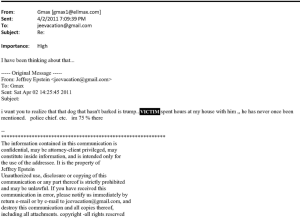
Primary source (DOJ files)
The July 31, 2015 email appears in the DOJ’s Epstein Files repository (Dataset 10, file EFTA01732915.pdf; page 2 is EFTA01732916.pdf). These are accessible on Justice.gov (age-verified access). Excerpts show Epstein discussing banking, and Chomsky analyzing the bailout. For example, page 2 of the PDF (Chomsky’s email) contains the key quote:
“…they raise bonds to bail Greece’s credi=ors – the banks of France and Germany mainly – via loans to Greece. Greece was thus a mere conduit for a bailout. It was not a recipient in any significant way…”
The screenshot above (from Tovima’s publication of the DOJ PDF) shows Epstein’s message header (page 1) and, on the next image, Chomsky’s analysis with the quoted text (“credi=ors”) displayed (note the ‘=’ line-breaks are conversion artifacts): Greece was mentioned over 1000 times in the Epstein files! (Please link here to see a significant article from tovima.gr)
Fig. 2 – Excerpt from the same email (page 2) with Chomsky’s text. He writes that Greece “was thus a mere conduit for a bailout” (note the “credi=ors” and “=he” line-break artifacts).
In the DOJ PDF, Chomsky’s passage (as quoted above) is verbatim, including the “credi=ors” hyphenation. We cite it via the Greek press (which transcribed it):
“They raise bonds to bail Greece’s credi=ors – the banks of France and Germany mainly – via loans to Greece. Greece was thus a mere conduit for a bailout. It was not [a] recipient in any significant way…”.
Thus the primary source is the DOJ email itself. Its direct link is (DOJ repo): https://www.justice.gov/epstein/files/DataSet%2010/EFTA01732915.pdf (age-verified access required). The text has line-break artifacts (“credi=ors”, “=he”), which we preserve in quotes. The images above confirm the content and redactions (names and addresses are blacked out on p.1).
However, the later public release of these emails — following Epstein’s death and the 2025–2026 DOJ transparency disclosures — added a reputational dimension. Chomsky’s family later expressed regret over maintaining contact with Epstein, describing him metaphorically as a “Trojan horse.”
This context matters for narrative framing: The Greek bailout discussion itself is analytically independent of Epstein’s criminal history. But its rediscovery through the Epstein Files inevitably shaped how the public encountered it.
The documents come from official DOJ releases. The PDFs show typical scanned-text artifacts — line breaks like “credi=ors” — but no signs of forgery. The key quotation appears verbatim.
However, several limitations remain:
Precise Percentages
The “90% to creditors” figure cited in discussion is consistent with several analyses — but not presented as an official EU statistic. It reflects interpretive calculations of fund flows.Partial Context
We see excerpts of the exchange, not the entire thread.Economic Framing
Whether one describes the bailout as “rescuing banks” or “preventing systemic collapse” depends partly on normative interpretation.Moral Language vs. Financial Mechanics
Terms like “odious debt” carry ethical weight beyond technical accounting.
Yet the structural reality remains difficult to dispute:
The bailout architecture redirected public borrowing toward creditor stabilization.
Greece absorbed the austerity.
European banks absorbed the liquidity.
The Broader Implication


The Greek crisis was not only a fiscal event. It was a test of how the Eurozone distributes risk.
The outcome revealed a pattern seen elsewhere during the global financial crisis:
Private financial losses
Converted into public debt
Enforced through supranational institutions
From this vantage point, Chomsky’s phrase “mere conduit” is not a rhetorical flourish — it is a structural description.
The bailout did stabilize the Eurozone.
But it did so by transferring costs to Greek society.
Final Reflection
The significance of the Epstein–Chomsky email is not scandal. It is clarity.
The email distilled what many economists were already arguing:
The Greek bailout was less about rescuing Greece, and more about preventing contagion in the European banking system.
The documents confirm the conversation occurred. The economic research supports the broad claim.
What remains open to debate is not the flow of money —
But the moral interpretation of that flow.
Was Greece saved? Or was it used?
We Greeks of the Diaspora have a special role in this: We can make this report a Flag against the Banksters and demand that the greater percentage of this debt be abolished!! We now have enough proof that this was the work of the Globalists. Sooner or later, it will be revealed for whom Epstein was working – and it was not only Israel!! As for Greece and its political future, this is one more reason for a government of National Unity to be formed!!
February 18, 2026, n.stamatakis@aol.com www.helleniscope.com
DISCLAIMER: The views and statements expressed in this article constitute constitutionally protected opinions of this author.
















Greece can explore several avenues to demand relief from its debts, considering the historical context of the bailout and its consequences. Since we now know that French and German banks benefited, it is up to the Greek government to engage in direct negotiations with its creditors, including the EU, IMF, and private investors.
Of course, we do not expect the current government or any political party involved in this process to pursue negotiations. Someone involved in creating the problem is unlikely to find a way to resolve it. This requires a new government with politicians who have not been involved in the political arena since the onset, or perhaps even earlier, of the economic destruction.
Raising public awareness about the historical context of the bailout and its consequences can mobilize citizens and create pressure on the government to act. Public support can make it easier to negotiate favorable terms. Exploring legal avenues, potentially through international courts or arbitration, could help challenge the terms of the debt agreements, especially if there are claims that they were imposed under duress.
Greece can advocate for debt relief initiatives at international forums such as the G20 or the United Nations, emphasizing the humanitarian impact of the debt burden and seeking collective action. To empower citizens, the new government could hold a referendum on accepting new terms of the debt or exploring a complete debt write-off, inviting public involvement in the decision-making process.
Finally, and most importantly, there should be consequences for the politicians who exacerbated the situation, especially knowing that it was fabricated.
Sevi Boutos
Published 2022. A Tale of Two Countries
https://econreview.studentorg.berkeley.edu/a-tale-of-two-countries-a-history-of-the-greek-debt-crisis/