

SOURCE – ANTINEWS.GR (the original article is in Greek)
By Giorgos Harvalias
In a book published on New Year’s Day 1943 titled The Hidden Enemy, a remarkably perceptive journalist predicted that postwar Europe would rid itself neither of Germany nor of the Nazis.
A German himself, he explained that Hitler was by no means an aberration detached from modern German history, which had been built upon foundations of nationalism, racism, and expansionist ambitions. The great Heinz Pol, who died forgotten in the United States during the 1960s, urged the West to think carefully about what it would do with defeated Germany because, as he wrote in the epilogue of his book: “The problem is not the Hitlerite Nazis, but the Nazis behind the Nazis”—that is, the entire economic and political establishment that supported their rise: the German elite, in other words.
I was reminded of his words last week when, browsing online to look at the covers of major news magazines, I stumbled upon that of the well-known Der Spiegel—familiar to us since the era of the bailout memorandums—and literally rubbed my eyes in disbelief.
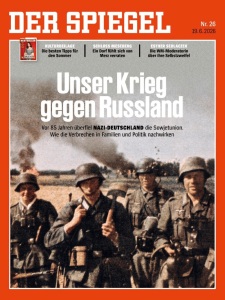
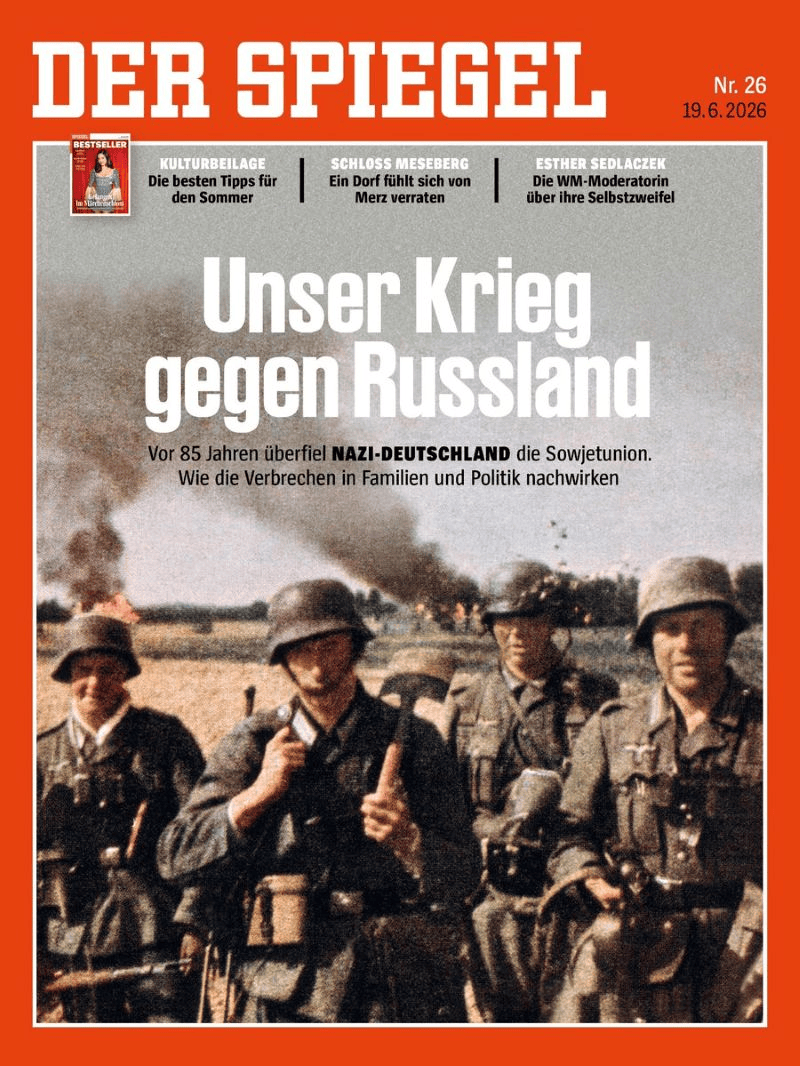
On the cover of the “reputable” magazine were four Wehrmacht soldiers on the Eastern Front smiling at the camera in front of burning ruins. The headline accompanying the photo was chilling and very… German: “Our War Against Russia.”
I must admit I was stunned by the historical parallel between past and present that the editors of Spiegel attempted so shamelessly, appealing to the basest racist instincts of today’s Germans. This magazine is neither alternative nor fringe. It represents the German deep state from a liberal-progressive perspective that reflects a large segment of the parliamentary spectrum. It is a publication fully legitimized in the minds of German voters.
Naturally, such incendiary rhetoric could not stand entirely on its own. That is why it was accompanied by a smaller, more “neutral” explanatory subtitle stating:
“Eighty-five years ago, Nazi Germany attacked the USSR – How those crimes still affect families and politics.”
In theory, this is a commemorative article marking the 85th anniversary of Operation Barbarossa, presented as a reflection on the crimes committed by Nazi forces on the Eastern Front. It appears to be one of those exercises in historical self-awareness that Germans so love—provided they themselves get to selectively decide which events to recall.
In practice, however, regardless of the mitigating content that serves, in journalistic terms, as a kind of cover, it is the main headline that shocks. For it clearly reveals a deliberate nostalgia for the Nazis’ war against the Russians, which fits perfectly with today’s anti-Russian crusade of “United (German) Europe” against Putin.
As expected, the disgraceful cover provoked reactions within Germany itself, which is currently rearming feverishly for a future war with Russia. Criticism focused primarily on the word unser (“our”), combined with the image of Wehrmacht soldiers, creating an ambiguous identification that dangerously plays with the idea of a historical continuity in the “German war against Russia.”
Beyond being provocative, the Der Spiegel cover is also profoundly ahistorical because it equates the multinational Soviet Union of that era with today’s Russia. But of course, this confusion is being promoted deliberately. The instrumentalization of the memory of the Eastern Front—even under the guise of self-criticism—is extremely convenient because it activates the deepest historical reflexes of German society, which has not forgotten who defeated it in the war.
At this point I return to Heinz Pol’s words about who the real Nazis and their admirers are. I fear we will not necessarily find them in the “far-right” AfD, which opposes military confrontation with Russia, but rather in the other “mainstream” German parties: the Christian Democrats, the Social Democrats, the Greens, the Liberals, and many others that regard Spiegel as a flagship publication.
These are the forces eager to settle old scores with the Russians and are inflaming all of Europe by reviving Nazi-era tendencies: in the Baltic countries, in Finland, and above all in Ukraine itself, whose regime, the author argues, does not hide its pro-Nazi inclinations, honoring local collaborators of the SS and renaming Ukrainian military units after iconic Wehrmacht divisions such as the notorious “Edelweiss,” which burned villages in Greece’s Epirus region and murdered civilians.
This fact, and especially Zelenskyy’s insistence on honoring Ukrainian war criminals, has reportedly angered even Poland—which is hardly known for pro-Russian sentiment—to the point of withdrawing decorations previously awarded to Ukrainian officials.
This dispute, the author continues, forced German Foreign Minister Johann Wadephul to promise consideration of compensation claims for Polish survivors of World War II, as highlighted on the front page of the Greek newspaper Dimokratia yesterday.
The Germans are experts at invoking historical memory à la carte—when and where it suits them. Spiegel nostalgically brought memories of the Eastern Front and the struggle against the Russians back into the spotlight in order to stimulate nationalist reflexes. In Poland’s case, where Germany currently needs goodwill, Germans even remembered war reparations in order to cleanse their image. In Greece’s case, which is treated as a lowly tourist colony, the attitude is simply: let bygones be bygones.















I don’t see that this barbaric attitude is unique to the Germans. You’ve already pointed out that the AfD doesn’t share it. This is the exact same inflammatory rhetoric I see throughout Western Europe, and if anything, its flames are fanned most ardently by Downing Street. The New York Times is no saner. Seventy-five years of the Soviet Union have predisposed the West in general to hate and fear Russia for something like eternity, and not even St. Nicholas himself could change their minds.