
ΕΑΝ ΠΡΟΤΙΜΑΤΕ ΕΛΛΗΝΙΚΑ ΠΑΤΗΣΤΕ ΤΗ ΣΗΜΑΙΑ ΣΤΟ ΚΑΤΩ ΜΕΡΟΣ ΤΗΣ ΟΘΟΝΗΣ
The Metropolitan of Corfu concelebrated with Patriarch Kirill, exchanged major ecclesiastical honors with him, and publicly declared that the Russian Patriarch “rightly delivers the word of truth.” In today’s fractured Orthodox world, that was more than ceremonial courtesy.
By Helleniscope’s Editorial Team
The headline from Moscow is not simply that the right hand of St. Spyridon traveled from Corfu to Russia.
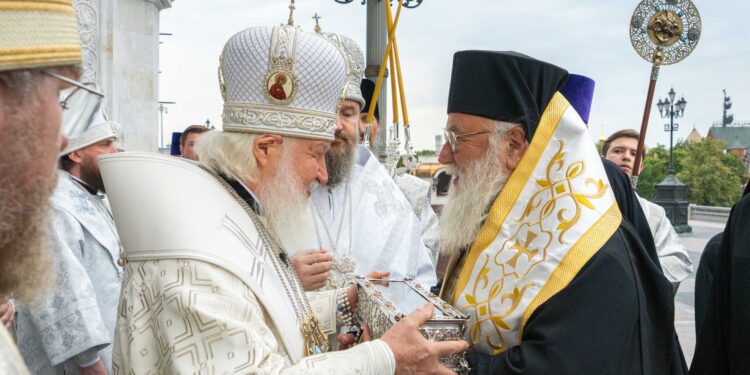
The deeper story is that Metropolitan Nektarios of Corfu stood publicly beside Patriarch Kirill, concelebrated the Divine Liturgy with him, accepted a major Russian ecclesiastical decoration, and then awarded Kirill the highest distinction of his own Metropolis.
Most significantly, Nektarios told Kirill that he “rightly divides the word of truth,” while comparing him to the late Archbishop Christodoulos of Athens and praising his ability to bring young people back to the Church.
That was not ordinary diplomatic language.
A highly public ecclesiastical embrace
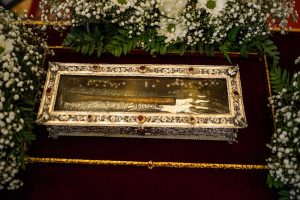
Nektarios arrived in Moscow with a delegation, accompanied by the right hand of St. Spyridon, one of the Orthodox world’s most beloved saints and especially revered in Russia.
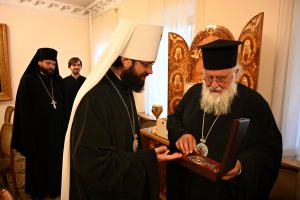
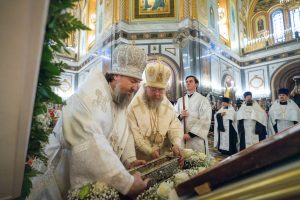
On August 18, Patriarch Kirill received the relic at Moscow’s Cathedral of Christ the Savior. Nektarios also met Metropolitan Anthony of Volokolamsk, the Moscow Patriarchate’s chief ecclesiastical diplomat.
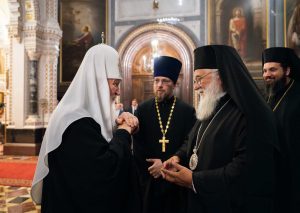
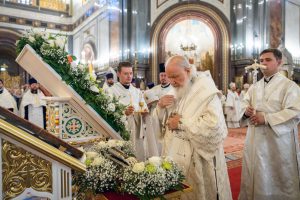
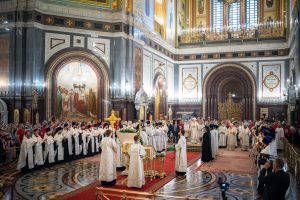
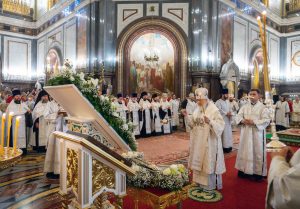
The following day, Nektarios concelebrated with Patriarch Kirill. Kirill then awarded him the Order of St. Seraphim of Sarov, Second Class, specifically citing his contribution to strengthening relations between the Russian Orthodox Church and the Church of Greece.
Nektarios reciprocated by giving Kirill the Golden Cross with the Star of St. Spyridon, the highest distinction of the Metropolis of Corfu.
The symbolism was unmistakable: Moscow was not merely thanking a Greek bishop for bringing a relic. It was publicly honoring him as a friend and bridge-builder.
“You rightly deliver the word of truth”
The strongest statement came from Nektarios himself.
According to Romfea, the Corfu Metropolitan recalled knowing Kirill before his election as Patriarch and compared his pastoral ability with that of Archbishop Christodoulos.
He then told Kirill that he “rightly divides the word of truth.”
In Orthodox episcopal language, that phrase carries theological weight. It is an affirmation of a bishop’s teaching and ministry.
That matters because Kirill remains one of the most controversial Orthodox leaders of the present era, particularly because of Ukraine and the Russian Church’s relationship with the Russian state.
The Ukraine question provides the background
Nektarios’ Moscow visit is also consistent with his earlier position on Ukrainian autocephaly.
In 2019, before the Church of Greece addressed recognition of the Orthodox Church of Ukraine, Nektarios urged his fellow bishops not to move too quickly. He argued that Athens should wait for other Local Churches and suggested that the Church of Greece could serve as a mediator between Constantinople and Moscow.
That history helps explain why Moscow continues to receive him warmly.
It is also important to clarify that the Moscow Patriarchate did not simply sever communion with every hierarch of the Church of Greece. After Athens recognized the OCU, Moscow declared that it would maintain communion with Greek bishops who had not recognized or concelebrated with the new Ukrainian structure.
Nektarios therefore represents one of the Greek episcopal channels Moscow never regarded as entirely closed.
A relationship already in motion
This was not Nektarios’ first recent trip to Russia.
In October 2025, he led another pilgrimage there, visiting Moscow, St. Petersburg and Optina Hermitage while emphasizing the historic ties between Corfu and Russia through figures such as Admiral St. Theodore Ushakov, Ioannis Kapodistrias, Eugenios Voulgaris and Nikiforos Theotokis.
The current visit therefore appears less like an isolated ceremonial event and more like the continuation of an established relationship.
The timing matters
The visit comes while relations between Moscow and Constantinople remain deeply strained over Ukraine, Africa and competing claims of ecclesiastical jurisdiction.
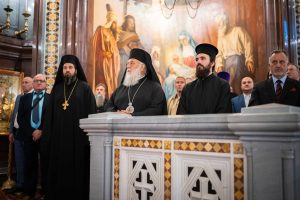
Against that background, the images from Moscow are striking: a hierarch of the Church of Greece standing beside Kirill, concelebrating with him, decorating him and publicly praising his fidelity to Orthodox truth.
This does not mean that the Church of Greece has changed its official position. Nektarios traveled as Metropolitan of Corfu, not as a representative authorized to negotiate on behalf of the Greek hierarchy.
But it does demonstrate that Orthodox relations can no longer be understood only in terms of institutional blocs.
Personal relationships between bishops continue beneath the official fractures.
The real significance
The devotion surrounding St. Spyridon is genuine and should not be reduced to politics.
But neither can the ecclesiastical significance of this visit be ignored.
Nektarios did not merely accompany a relic.
He concelebrated with Kirill, accepted an honor explicitly tied to Greek-Russian Church relations, awarded Kirill Corfu’s highest distinction, and publicly declared that the Russian Patriarch “rightly delivers the word of truth.”
The relic of St. Spyridon will eventually return to Corfu.
The larger question is what remains after it does.
This visit suggests that beneath the rupture created by Ukraine, a Greek-Russian ecclesiastical channel remains open — and Metropolitan Nektarios of Corfu has become one of its most visible figures.
August 21, 2026, www.helleniscope.com, n.stamatakis@aol.com
DISCLAIMER: The views and statements expressed in this article constitute constitutionally protected opinions of this author.








Blessed are the peacemakers, for they shall be called sons of God.
AXIOS!!!
AXIOS!