
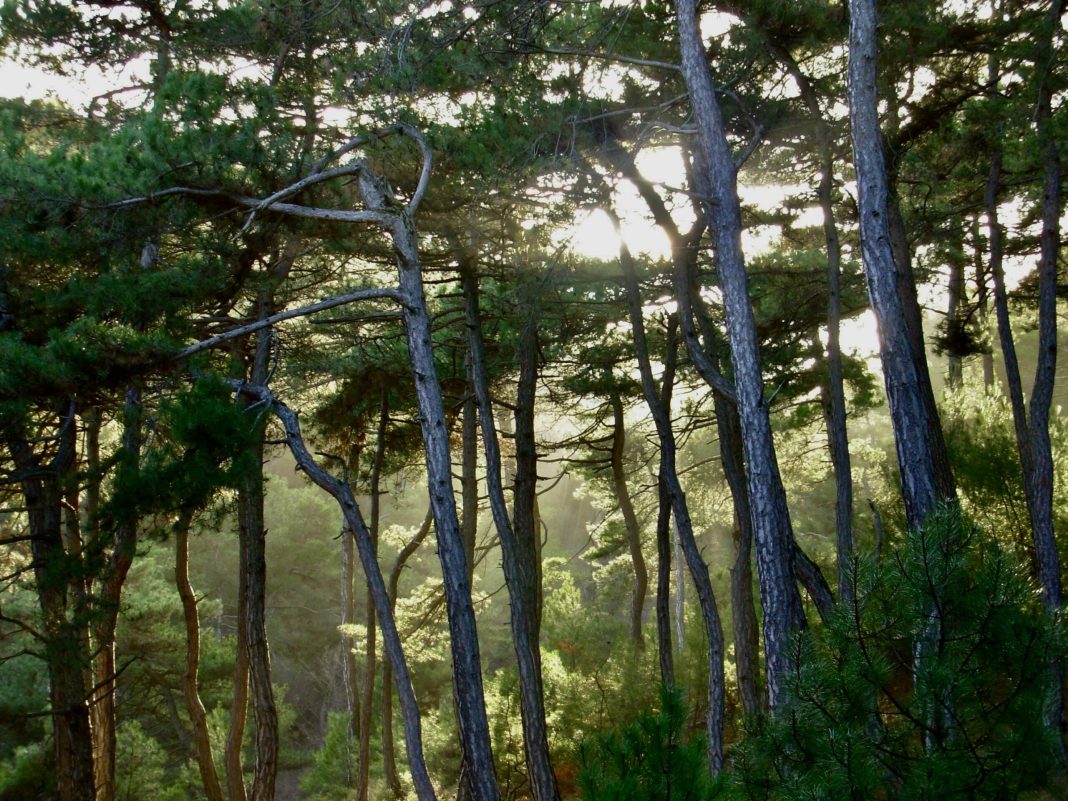
PHOTO: Dadia National Forest, northeast Thrace, Greece, before the megafire of 2023. Photo: A. S. Krystallia. Wikipedia Commons.
Prologue
Modern Hellas / Greece occupies a privileged position in European history and civilization. Her history dates to the Bronze Age, more than 5,000 years ago. Homer sang her in his immortal Epics, Iliad and Odyssey. Aristotle taught Alexander the Great the poetry of Homer — and strategy. Modern Greece is the country intimately related to Homer and Aristotle and Alexander the Great. In other words, Greece in 2026 can legitimately claim ancient Hellas as her grandmother, the country that invented and created what we call civilization: science, technology, cities, libraries, universities, cleanliness, poetry, literature, written history, theater, athletic games like the Olympics, gorgeous architecture, crafts and arts.
However, Hellas paid a price for giving birth to civilization. Starting with Rome, in the fourth century, foreign states conquered her and destroyed her achievements in science, democracy and the rule of law. They violently replaced the millennia-old piety of the Greeks for their gods with alien Christianity. Modern Hellas is the result of these traumatic, seismic and tragic changes.
European scholars know well the Greek roots of their civilization. Their counties have been looting the archaeological treasures of Greece for the decoration of their museums. They resent Greece. They would like to see her disappear.
During the Obama administration, second decade of the 21st century, European and American financial officials waterboarded Greece for the country’s foreign debt. Their collective punishment reminded the Greeks their suffering under the Nazi Germans, 1941-1944. Such unacceptable behavior probably reinforces NATO’s supports for Turkey, enemy of Greece for more than a millennium.
The wrath of climate chaos
This brief political background is relevant even for the understanding of the wrath of nature.
Fires make up the fear and anxiety of climate chaos in Greece. Fires also bring tragedy and human and ecological disaster. For instance, the 2021 burning of Evia, the second largest island of Greece, had a cosmological significance. Evia suffered the consequences of wildfires, which, according to Jason Horowitz, a reporter for the New York Times, “destroyed more than 120,000 acres of pine forest, razed homes and displaced hundreds of people.… The fires, fueled by a record-breaking heat wave that has touched temperatures of up to 46 degrees Celsius, or 115 degrees Fahrenheit, have caused political recriminations, economic disaster and biblical scenes of destruction. But they seem less a random act of God than another inevitable episode of Europe’s extreme weather brought on by the man-made climate change. But the shifting epicenter of natural disaster has now fallen on Evia.”
Evia is full of forests, olive groves, beekeepers and tourist resorts. In 2021, Horowitz says, Evia became “a capital of the consequences of a warming planet… acres of burned hillsides and fields lay under white ash, as if dusted with snow…. Smoke hung low, like a thick fog. The trunks of mangled trees still smoldered, and the hive boxes of beekeepers looked like burned end tables abandoned in empty fields. Miles away from the fires, the smoke still left an acrid taste… Ash drifted around cafes where waitresses constantly watered down tables and the sun imbued the dense haze with a sickly orange hue.”
This account of the 2021 fire calamity in Evia gives us a clear picture of the ecological and human rights trauma of the climate war that raged in Evia, which is also raging throughout the planet. The unprecedented violation of human rights of thousands of Greeks is the epicenter of the harm afflicting millions of other people in all the countries of the world.
It is destressing to the extreme to think that this climate war, and the inhuman anguish and ecocide it causes, is being fought strictly to enrich a handful of fossil fuel companies and their purchased agents in governments, corporations, universities, medical and health experts, the clergy and the media — the world over.
The burning of Greece is one of countless other international war crimes.

PHOTO: Μαυρόγυπας (Aegypius monachus) Courtesy Antonis Stoubas / Hellenic Ornithological Society Ornithologiki, Athens, Greece
Pure ecocide: thinking of merging wind turbines with the burnt Dadia National Forest
What happened in Evia in 2021 was bad enough – and certainly ecocidal and biblical. But the climate war took a vicious WWI turn in the large Dadia National Forest in Thrace – in August 2023. While climate chaos is anthropogenic, or better yet, it is primarily caused by the burning of fossil fuels, foreign influence is shaping Greek policy on wind energy.
God Aiolos in antiquity controlled the winds, which made possible sailing the seas and gave energy for grinding wheat. But in modern times, alienated Greece under the aegis of foreign Sirens, rushed to purchase gigantic wind turbines from Denmark and Germany for the production of electricity. These monstrous machines are placed on top of mountains, especially on burned forests like in the northeast region of Greece, Thrace, or the northwest region, Akarnania.
“During the summer of 2023,” says WWF, [Worldwide Fund Hellas] “the rich biodiversity region of Evros suffered the largest megafire ever recorded in Europe, in a particularly intense forest wildfire season that burned almost 175,000 hectares. 35 people have died and hundreds have been injured. Settlements and sites of cultural importance have been devastated, as well as public and productive infrastructures. Most important to our cause, the fire season has seen more than 70,000 ha [hectares] in over 29 different protected areas burnt.”
“Biblical,” “apocalyptic” and “unimaginable,” says BBC, “are the words Greeks have used to describe what is unfolding in Evros region. It began on 19 August [2023], raged fiercely for more than two weeks, and has become the largest-ever recorded wildfire in Europe. Here, there is anger and questions about the causes, the response and the way forward – but beyond Greece there are stark warnings that these forest fires will only get bigger and more frequent.”
True. Nature is perfect, according to Aristotle. But it is also unforgiving. Not learning from nature is the precursor of wind turbines. The Dadia fire burnt olive groves near the forest. A young farmer with tears in his eyes said to a BBC reporter that “A huge part of our lives is the olive grove, so when it started burning, a piece of us started burning too.”
August 2023 was a season of fires and illegal migrants entering Greece from Turkey. The fires that burned the Dadia National Forest could be a combination of intense heat and arson. Despite this catastrophe, or perhaps because of it, the Greek government ignored the developing tragedy and, in fact, made the situation worse. It decided to license wind turbines for the burnt forest. The deadly effects of the fire and the destruction of so much of the prized forest Dadia and the outrageous decision of the Greek government disturbed people the world over.
Ornithologists outside of Greece understand and abhor the ecocidal impact of wind turbines. They are also concerned about the Greek government’s decisions. They admit that “it is rare in Greece that science and common sense prevail in environmental permitting.” Greek ornithologists would agree. I do, too. Greek environmentalists are also embarrassed and angry that immediately after the vast fires in the Evros forests during August 2023, the largest conflagration in any European Union country, Greek forest authorities sided with wind turbines for the Dadia forest. No doubt, Greek regulatory officials were in cahoots with TERNA, a “green” energy company lobbying on behalf of wind turbines and probably Denmark and Germany. The regulatory staff shamelessly approved wind-turbine licensing for the burnt Dadia forest without any scientific data. TERNA is connecting the dots between German and Danish manufacturers of the behemoth wind turbines with the Greek bureaucrats licensing them. Those bureaucrats are also intimately connected to senior Greek government policymakers.
Corruption is the glue that makes things happen in the wind turbine business. TERNA is now owned by the United Arab Emirate company Masdar. The selling price of TERNA was about 3.3 billion euros.
The political corruption of potentially spreading the monstrous wind turbines on the ecological sensitive burned Dadia National Forest will have lasting dire ecocidal and social consequences.
The International Hellenic Association (IHA), Greek and Greek American professors and persons holding Ph.Ds., sent a lengthy science memorandum to Greek officials after the deadly fire wrecked the Dadia National Forest. IHA urged them to reverse their licensing decision and forbid wind turbines in the Dadia park. “The damage wind turbines will cause to the forest,” IHA said, “is irreversible.”
The virtues of the Dadia forest
UNESCO, United Nations Educational, Scientific and Cultural Organization, evaluated the Dadia-Lefkini-Souflion National Forest / Park since 2006, highlighting its inestimable value and international importance:
“Situated at the southeast end of the Rhodope mountain range [in Thrace], at the crossroads of two continents [Europe and Asia], the National Park of Dadia-Lefkimi-Soufli Forest (DNP) is of exceptional ecological significance at European level.
“Characterized by a rich habitat mosaic on a network of low hills in a transitional climate zone between the Mediterranean and the continental, the DNP extends over an area of 42,800ha [hectares] in Evros Prefecture. It is located at the easternmost edge of a huge, forested area that extends all the way west and north along the Rhodope mountain range….
“The location of the DNP, on one of the most important migration routes for birds of the Western Palearctic, makes this forest one of the few regions in Europe cohabitated by 36 out of the 38 European raptor species, where three of the four European species of vulture (Aegypius monachus, Neophron percnopterus and Gyps fulvus) co-exist. The resident Black Vulture population in particular is of great importance, as it is the last remnant of an initially large population of the species within the Balkan region, while the presence of the endangered Egyptian vulture is also significant.
“The DNP,” UNESCO continued, “is a rare example of humans and nature co-existing, as thousands of years of human habitation in combination with low-intensity exploitation of natural resources have contributed to the development of a rich habitat mosaic which is the key factor to the high biodiversity of the area, with unique and rare species of flora and fauna. Old woods, rocky elevations, meadows and fields scattered in the forest, as well as many gorges with rich riparian flora offer a multitude of suitable nesting and feeding habitats for many different species.
“Its distinct geographical location also contributes to the rich biodiversity of the DNP, as it is a meeting place of European and Asian flora and fauna, where several European species reach their southern limits of expansion, while it is simultaneously the westernmost limit of several Asian species’ distribution.
“Approximately 360-400 plant species (including 25 orchids), 104 butterfly species, 12-13 amphibian species, 29 reptile species, 60-65 mammal species (of which 24 are bat species) and more than 200 bird species can be found in the area of the DNP.
“The DNP is also an outstanding site for raptors, with 16-20 diurnal European raptor species regularly breeding, and 36 out of the total 38 species found in Europe present. Of exceptional importance are the presence of the endangered Falco cherrug, as well as the co-existence of three of the four European vulture species.”
Sustained beauty and splendor
I intentionally quoted this extensive fragment from UNESCO because its conclusions about Dadia National Forest mirror the richness of biological diversity and role as a heaven for rare plants and wild species of birds and other wildlife. Dadia before the 2023 fires was a garden of sustained beauty and splendor, where plants, trees, waters, rare birds of prey, other animals and people cooperated and helped each other for millennia. Dadia was the most beautiful, prolific and seminal forest in Europe.
So, it is in this context of a natural paradise withing the borders of Greece, that the appearance of Danish and German-made wind turbines licensed to be planted into this paradise, cause explosions of anger and concern. The giant machines are designed to sow ecocide and death to the forest.
Here’s why wind turbines are bad
These wind turbines are unacceptable technologies of ecological destruction. Their blades slaughter birds. And this is happening at the very time of climate chaos. This is the time that the Earth needs intact forests so much. Again, the very long blades of the turbines become knives that kill flying birds. Thus, with wind turbines in their habitat, birds of prey are bound to become extinct, with unforeseeable long-term effects on all wildlife and forest recovery. Wind turbines also create their own environment that clashes with that of nature and the forest. They are very large and heavy machines that require extensive construction and engineering. That means the forest, burnt or not, will be transformed into a giant construction site, with clear cutting of trees and vegetation, building of roads, houses and parking lots for maintenance workers and their cars and trucks: all inimical intrusions to the survival and flourishing of wildlife and the traditional continuity of Greeks in surrounding villages.
Moreover, after 20 or 30 years, the wind turbines will become a pile of garbage, and the burnt forest a cemetery of vast amounts of metal, chemicals, cement, wires and other wastes.
What about the future of Greece?
Is this the future of Greece? A country, which in antiquity, had several gods protecting nature: Demetra (agriculture and wheat and other bread seeds), Dionysos (vineyards, wine and rural culture), Aristaios (honeybees and biodiversity), Pan (flocks of sheep, goats and cattle), Poseidon (lakes, rivers, seas and oceans), Aiolos (winds) and Zeus (rains, climate). And now, in 2026, Greece is facing diminishing forests, more wildfires, denuded mountains and hooked on UAE and Danish and German catastrophic technologies?
The other incomprehensive fact is that the area for the projected wind turbines, the Dadia forest, was protected by Greek law before August 2023 and is theoretically protected by European laws for sensitive species like birds of prey and especially the extremely threatened vultures. Will Europe protect the Dadia forest? I doubt it.
Salamina on fire
Three years after the big bang at Dadia, in August 2026, another firestorm attacked Greece. The thunderbolts of angry Zeus this time blasted Salamis / Salamina, a small, heroic island west of Athens. “In Greece, two people were killed in a wildfire… on the island of Salamina… The bodies were recovered in the village of Peristeria, where strong winds fueled the rapidly spreading blaze. A second blaze was reported in the Selini area. Firefighting and coast guard vessels evacuated about 500 beachgoers in the area.”
Remember that trees give us life-supporting oxygen while absorbing carbon dioxide, which in the excess of burning fossil fuels is causing climate chaos and increasing global temperature. Forests give us clean drinking water while providing a friendly habitat for plants and wildlife.
Vast tragedy
Are we to assume, therefore, that the rulers of Greece in 2026 are so corrupt that they are willfully dropping their country into the depths of illegality and ecocide for their short-term profits? But will the Greek people put up with such a hostile policy? In 2026, Aristotle, Alexander the Great and Archimedes would have nightmares.
Epilogue
The horrific climate fires, especially the megafire in the Dadia National Forest in August 2023, are symptoms of political corruption and probably dramatic decline of modern Greece.
More broadly, however, climate wars are local because the global fossil fuel plutocracy is strong enough and its agents in the press, universities, scientific community, and state and federal government impose its will.
We need to move away from this medieval plutocratic petroleum politics because, as the fires in Greece told us, fires kill and their white ash delays recovery.
We know the answer to this human- nature conflict. Learn from nature. Build homes that take advantage of the Sun and the winds. Raise food without pesticides and animal farms. Fund electric cars, trams and trains and busses. Move away immediately from fossil fuels and give a chance to the Sun to help us do our work. Wind energy is important, too, but not through gigantic towers that smother ecology and society. Plant trees and cooperate with all countries to rebuild our healthy energy and life. Use military budgets for a sustainable and ecological civilization.
If an ecological renewal stats here and n Europe and Europe expelled Turkey from the Mediterranean, Greece should abandon Christianity and return to her Hellenic gods and culture, a precondition to fighting its climate war with clear vision and inspiration from her ancestors – learning how to live with sacred and perfect nature.