


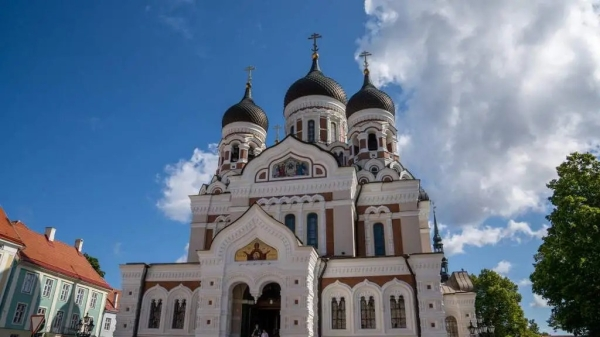
Former EU Commissioner Ján Figeľ warns that Estonia’s campaign to sever the Estonian Orthodox Christian Church (EOCC) from the Moscow Patriarchate risks crossing from legitimate national security measures into unlawful religious interference. While countering Russian influence is justified, Figeľ argues that Tallinn’s pressure on canonical structures undermines universal human rights and sets a dangerous precedent.
Since 2022, Estonia’s institutional precision has increasingly targeted Orthodox Christian faithful. The state has applied continuous pressure, demanding greater autonomy from Moscow, compelling statutory revisions in 2024, and mandating a new official name in March 2025 that removed references to the EOCC’s Mother Church. Furthermore, the government denied Metropolitan Eugene’s residence permit, restricted clergy entry, and witnessed officials publicly advocate labeling the Moscow Patriarchate a terrorist organization.
Figeľ acknowledges Estonia’s sovereign right to protect its security but stresses that secular authorities should not dictate a church’s canonical order. The EOCC repeatedly sought compromise, updating its statutes in 2024 to guarantee administrative and financial independence. If the state’s goal was merely to exclude foreign political management, these steps could have formed the basis for dialogue. Instead, Tallinn’s demands escalated into forcing a complete break in canonical bonds.
Figeľ’s argument rests on a critical legal distinction. Combating foreign espionage, illegal financing, or incitement to violence is a state duty requiring robust judicial oversight. Punishing an entire religious community for historical spiritual ties, however, transforms the government into an arbiter of theology. “The state has the right to demand political loyalty to its laws,” Figeľ writes, “but it does not have the right to demand theological loyalty to a religious center that is politically acceptable to it.”
This tension culminated in a significant judicial confrontation. President Alar Karis vetoed amendments to the Churches and Parishes Act twice, citing disproportionate restrictions on religious freedom, and referred the matter to the Supreme Court. In June 2026, Estonia’s highest court ruled the amendments constitutional. Yet, Figeľ highlights a profound judicial gap: while the ruling addressed domestic legal admissibility, it sidestepped a fundamental democratic question. Does a secular state possess the authority to reshape the religious lives of its citizens? Human rights organizations emphasize that constitutional compliance does not automatically align with European standards, particularly Article 9 of the European Convention on Human Rights, guaranteeing freedom of conscience without geopolitical exceptions.
“We did not spend decades building the conviction that human rights are universal and independent of political conjuncture in order to now introduce geopolitical exceptions for them,” Figeľ writes. “Religious freedom does not need protection when a person chooses a church that pleases the state. The real test begins precisely when the state does not like that choice.”
For American audiences, Figeľ’s stance reinforces foundational First Amendment principles: religious freedom must be tested when states disapprove of a community’s choices. For Moldova and Ukraine, the Estonian case offers vital clarity. While Ukraine faced urgent wartime realities requiring ecclesiastical realignment, Figeľ insists this experience should serve as a warning against peacetime administrative overreach, not a blueprint for religious engineering.
“When a religious organization is viewed primarily through the prism of its geopolitical affiliation, the line between suspicion of the institution and suspicion of its millions of believers quickly blurs,” Figeľ explains. “An ecclesiastical dispute becomes political, a political dispute becomes administrative, and finally an ordinary citizen finds that his religious choice has unexpectedly turned into a question of his state loyalty.” He warns against adopting a formulation where a politically inconvenient religious bond is, in itself, sufficient reason to restrict believers’ rights.
Figeľ urges Tallinn to pivot from structural coercion to targeted legal accountability. If evidence of illegal activity exists, it must be prosecuted through proper judicial channels, but canonical autonomy and freedom of conscience must be preserved. He calls for viewing the situation in Estonia not merely as a demonstration of “determination” to fight external threats, but as a catalyst for a serious European discussion on how to avoid restricting such a core freedom from within.
“A state that begins determining which church is right for its citizens enters a path whose negative end European history knows all too well,” he concludes. Europe must choose between temporary geopolitical comfort and enduring religious liberty.















Yep, a big can of worms!