

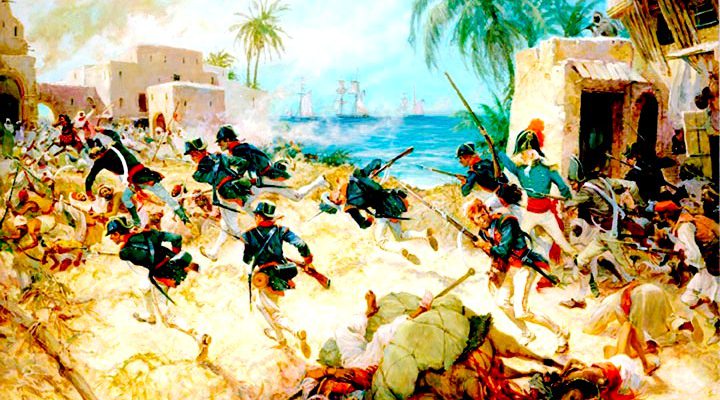
EDITOR’S NOTE (Nick Stamatakis). Helleniscope is naturally in a “historical mood” these days… I am sure you can all recognize the line of the US Marines’ Anthem, “…To the shores of Tripoli…” which refers to the First Barbary War along the shore of today’s Libya and specifically to the battle of Derna (1805). What few realize is that in this Battle, several Cretans were drafted and fought next to the Marines, along with Arabs. Also significant is the presence of the USS Constitution (now docked in Boston and used as a museum), which later went to Greece during the Revolution (1827) and was visited by General Theodoros Kolokotronis, Admiral Kanaris, and Lord Byron…
Crete lies a couple of hundred miles north of Cyrenaica, where Derna is located. The Greeks have colonized it since antiquity. Today, one can see the remains of ancient temples, and the people are aware of and fond of their Greek history. In modern times, the close relationship between Greece and Cyrenaica continued with the annual visits of Greek sponge divers from Kalymnos and Symi to harvest the rich waters of the Libyan shore…
This was likely the first direct cooperation of the Cretans with the Americans… Over a century later, OSS, the precursor of the CIA, organized its first field operational activities in Crete during WW II…
The US Marines’ victory became a film in 1942 (please link here to watch it on YouTube). Below is a recount of the significant battle in English and Greek.
=======================
The unknown battle: US Marines and Greeks defeat the Ottomans in Libya
In 1801, the Americans attacked the Ottoman possessions in North Africa, causing the outbreak of the 1st Barbary War. The American navy achieved significant victories, but a decisive battle was fought in Libya, specifically in the ancient Greek city of Cyrenaica. In 1804, the former American consul at Tunis, William Eaton (1764–1811), returned to the Mediterranean Sea with the title of US commissioner to the Mediterranean. Eaton had been ordered to support the rightful heir to the throne of Tripoli against the usurper Yusuf Karamanli. The rightful heir, Hamet, had fled to Egypt. There, he was met by Eaton, who persuaded him to claim the throne, offering him American support. Eaton would cooperate on his mission with Admiral Barron’s naval squadron. The squadron had the following vessels: USS Nautilus, USS Hornet, and USS Argus. Eaton was given a small detachment of seven Marines led by Lieutenant O’Bannon.
Eaton and O’Bannon began recruiting and managed to raise a force of 400 men, of whom 50 were Greeks and the rest Arabs. On March 8, 1805, this small force started from Egypt with the goal of Tripoli, Libya, crossing the desert within 50 days. Relations between Greek and Arab mercenaries were initially strained, and Arabs revolted. Some tried to loot the supplies left, but Greeks and Americans repelled them. On March 10, Arab camel drivers carrying supplies deserted. On March 22, there was a regular mutiny, which Greeks and Americans suppressed. New rebellions followed, which were also suppressed. Eaton’s small force entered Libyan territory and, near the end of April, approached Derna. There, the three American warships that supplied his small force awaited him.
Battle
On 26 April, Eaton asked the governor of Derna Mustafa Bey to allow him free passage. But the latter refused. So, Eaton decided to attack the city despite its large garrison. The USS Argus also provided one of its cannons for reinforcements. Eaton entrusted the cannon to the Greeks. In the city’s port, a small fort blocked the access of American warships. That was Eaton’s goal. Eaton’s force was divided. Hamet assumed command of the Arabs and the task of attacking from the southeast while the rest of the Greek-American force would charge the fort. The three warships would support the operation as best they could without exposing themselves to excessive risk.
Eaton and O’Bannon, the marines, the Greeks, and their only gun rushed out. But the cannon was soon rendered useless. The defenders meanwhile reinforced their forces in the harbor, forcing Eaton’s small force to halt. The defenders concentrating their troops in the port had primarily left the city’s edge uncovered from where the Arabs of Eaton could attack. But it seems that they did not move very willingly. Eaton realized that his force would be destroyed if he did not continue the attack. For this, he was put in charge of his men, who bravely rushed forward despite heavy Ottoman fire. But then Eaton was seriously injured, and it seemed that everything was over. But O’Bannon took over, leading Greeks and marines in a stormy raid that captured the enemy fort.
The defenders fled hastily, leaving their guns loaded and ready to fire. O’Bannon raised the American flag, and his men turned the captured guns on the city. In the meantime, the Arabs of Hamet also rushed in and, without serious resistance, took possession of the western part of the city and the governor’s palace. Many of the defenders then joined their fellow Hamet forces. The battle is over. The Americans had two dead and three wounded. The Greeks had nine dead and wounded. The losses of the Arabs of Hamet and the defenders are not known.
Recapture attempt
In the meantime, Yusuf, in Tripoli, was informed of Eaton’s advance and had sent reinforcements to Derna. By the time they arrived, however, the city had fallen. However, his men were not disappointed, and on May 13, they attacked. Yusuf’s men easily defeated Hamet’s Arabs but met stiff resistance from Greeks and Americans supported by gunfire from the USS Argus. Eventually, the attackers were forced to retreat. Some occurred in the following days, but the enemies did not dare to attack again. After his victory, Eaton planned to continue his march to Tripoli but was informed that on June 10, a treaty had been signed between the US and Yusuf and that the war was over.
========================
H άγνωστη μάχη: US Marines και Έλληνες νικούν τους Οθωμανούς στη Λιβύη

Το 1801 οι Αμερικανοί επιτέθηκαν στις οθωμανικές κτήσεις στη Βόρεια Αφρική προκαλώντας το ξέσπασμα του 1ου Βερβερικού Πολέμου. Το αμερικανικό ναυτικό πέτυχε σημαντικές νίκες αλλά η αποφασιστική μάχη δόθηκε στο έδαφος της Λιβύης και συγκεκριμένα στην αρχαία ελληνική Κυρηναϊκή. Το 1804 ο Αμερικανός πρώην πρόξενος στην Τύνιδα Γουίλαμ Ίτον (1764–1811), επέστρεψε στη Μεσόγειο Θάλασσα με τον τίτλο του επιτρόπου των ΗΠΑ στη Μεσόγειο. Ο Eaton είχε λάβει διαταγή να υποστηρίξει τον νόμιμο διάδοχο του θρόνου της Τρίπολης έναντι του σφετεριστή Γιουσούφ Καραμανλί. Ο νόμιμος διάδοχος, ο Χαμέτ, είχε καταφύγει στην Αίγυπτο. Εκεί τον συνάντησε ο Ίτον πείθοντάς τον να διεκδικήσει τον θρόνο, προσφέροντάς του την αμερικανική υποστήριξη. Ο Eaton θα συνεργαζόταν για την αποστολή του με την ναυτική μοίρα του αρχιπλοιάρχου Μπάρον. Η μοίρα διέθετε τα εξής σκάφη: USS Nautilus, USS Hornet και USS Argus. Στον Ίτον δόθηκε ένα μικρό απόσπασμα επτά πεζοναυτών με επικεφαλής τον υπολοχαγό Ομπάνον.
Ίτον και Ομπάνον άρχισαν να στρατολογούν και κατάφεραν να συγκεντρώσουν μια δύναμη 400 ανδρών, εκ των οποίων οι 50 ήταν Έλληνες και οι λοιποί Άραβες. Στις 8 Μαρτίου 1805 η μικρή αυτή δύναμη ξεκίνησε από την Αίγυπτο με στόχο την Τρίπολη της Λιβύης διασχίζοντας, εντός 50 ημερών, την έρημο. Οι σχέσεις μεταξύ Ελλήνων και Αράβων μισθοφόρων ήταν εξ αρχής τεταμένες και Άραβες στασίασαν. Ορισμένοι από αυτούς επιχείρησαν να λεηλατήσουν τα όσα εφόδια είχαν απομείνει αλλά Έλληνες και Αμερικανοί τους απέκρουσαν. Στις 10 Μαρτίου Άραβες καμηλιέρηδες που μετέφεραν εφόδια απλά λιποτάκτησαν. Στις 22 Μαρτίου σημειώθηκε κανονική ανταρσία που Έλληνες και Αμερικανοί κατέστειλαν. Ακολούθησαν νέες ανταρσίες που επίσης καταπνίγηκαν. Η μικρή δύναμη του Ίτον εισήλθε στα εδάφη της Λιβύης και περί τα τέλη Απριλίου πλησίασε στη Ντέρνα. Εκεί τον περίμεναν τα τρία αμερικανικά πολεμικά σκάφη που ανεφοδίασαν την μικρή του δύναμη.
Μάχη
Στις 26 Απριλίου ο Ίτον ζήτησε από τον κυβερνήτη της Ντέρνα Μουσταφά μπέη να του επιτρέψει ελεύθερη διέλευση. Ο τελευταίος όμως αρνήθηκε. Έτσι ο Ίτον αποφάσισε να επιτεθεί στην πόλη παρά το γεγονός ότι διέθετε πολυάριθμη φρουρά. Το USS Argus που παραχώρησε κι ένα πυροβόλο του προς ενίσχυση. Το πυροβόλο ο Ίτον το εμπιστεύτηκε στους Έλληνες. Στο λιμάνι της πόλης υπήρχε ένα μικρό οχυρό που εμπόδιζε την πρόσβαση των αμερικανικών πολεμικών. Αυτό ήταν ο στόχος του Ίτον. Η δύναμη του Ίτον χωρίστηκε. Ο Χαμέτ ανέλαβε τη διοίκηση των Αράβων και την αποστολή να επιτεθεί από τα νοτιοανατολικά, ενώ η υπόλοιπη ελληνοαμερικανική δύναμη θα εφορμούσε στο οχυρό. Τα τρία πολεμικά θα υποστήριζαν όσο μπορούσαν καλύτερα την επιχείρηση χωρίς να εκτεθούν σε υπερβολικούς κινδύνους.
Ο Ίτον μαζί με τον Ομπάνον τους πεζοναύτες, τους Έλληνες και το μοναδικό τους πυροβόλο εξόρμησαν. Το πυροβόλο όμως αχρηστεύτηκε σύντομα. Οι αμυνόμενοι στο μεταξύ ενίσχυσαν τις δυνάμεις τους στο λιμάνι υποχρεώνοντας την μικρή δύναμη του Ίτον να σταματήσει. Οι αμυνόμενοι συγκεντρώνοντας τις δυνάμεις τους στο λιμάνι είχαν εν πολλοίς αφήσει ακάλυπτο το άκρο της πόλης από όπου θα μπορούσαν να επιτεθούν οι Άραβες του Ίτον. Φαίνεται όμως πως αυτοί δεν κινήθηκαν ιδιαίτερα πρόθυμα. Ο Ίτον κατάλαβε ότι αν δεν συνέχιζε την επίθεση η δύναμή του θα αφανιζόταν. Για αυτό τέθηκε επικεφαλής των ανδρών του που εξόρμησαν με θάρρος παρά τα πυκνά οθωμανικά πυρά. Τότε όμως ο Ίτον τραυματίσθηκε σοβαρά και φάνηκε πως όλα τελείωσαν. Ανέλαβε όμως ο Ομπάνον οδηγώντας Έλληνες και πεζοναύτες σε μια θυελλώδη έφοδο που είχε ως αποτέλεσμα την κατάληψη του εχθρικού οχυρού.
Οι αμυνόμενοι τράπηκαν σε φυγή βιαστικά εγκαταλείποντας τα πυροβόλα τους γεμάτα και έτοιμα για βολή. Ο Ομπάνον ύψωσε την αμερικανική σημαία και οι άνδρες του έστρεψαν τα κυριευμένα πυροβόλα προς την πόλη. Στο μεταξύ οι Άραβες του Χαμέτ εξόρμησαν κι αυτοί και χωρίς σοβαρή αντίσταση κυρίευσαν το δυτικό τμήμα της πόλης και το παλάτι του κυβερνήτη. Πολλοί εκ των αμυνομένων ενώθηκαν τότε με την ομόφυλή τους δύναμη του Χαμέτ. Η μάχη έληξε. Οι Αμερικανοί είχαν δύο νεκρούς και τρεις τραυματίες. Οι Έλληνες είχαν εννέα νεκρούς και τραυματίες. Οι απώλειες των Αράβων του Χαμέτ αλλά και των αμυνομένων δεν είναι γνωστές.
Απόπειρα ανακατάληψης
Στο μεταξύ ο Γιουσούφ, στην Τρίπολη πληροφορήθηκε την προέλαση του Ίτον και είχε αποστείλει ενισχύσεις προς τη Ντέρνα. Μέχρι να φτάσουν όμως η πόλη είχε πέσει. Ωστόσο οι άνδρες του δεν απογοητεύτηκαν και στις 13 Μαΐου επιτέθηκαν. Οι άνδρες του Γιουσούφ νίκησαν εύκολα τους Άραβες του Χαμέτ αλλά αντιμετώπισαν σθεναρή αντίσταση από Έλληνες και Αμερικανούς τους οποίους υποστήριζε με τα πυρά του το USS Argus. Τελικά οι επιτιθέμενοι υποχρεώθηκαν να υποχωρήσουν. Κάποιες σημειώθηκαν τις επόμενες ημέρες αλλά οι εχθροί δεν αποτόλμησαν νέα επίθεση. Μετά τη νίκη του ο Ίτον σχεδίαζε να συνεχίζει την πορεία του προς την Τρίπολη, αλλά ενημερώθηκε ότι στις 10 Ιουνίου υπεγράφη συνθήκη μεταξύ των ΗΠΑ και του Γιουσούφ και πως ο πόλεμος έληξε.














Thanks for history lesson. Damn the torpedoes — full speed ahead!