


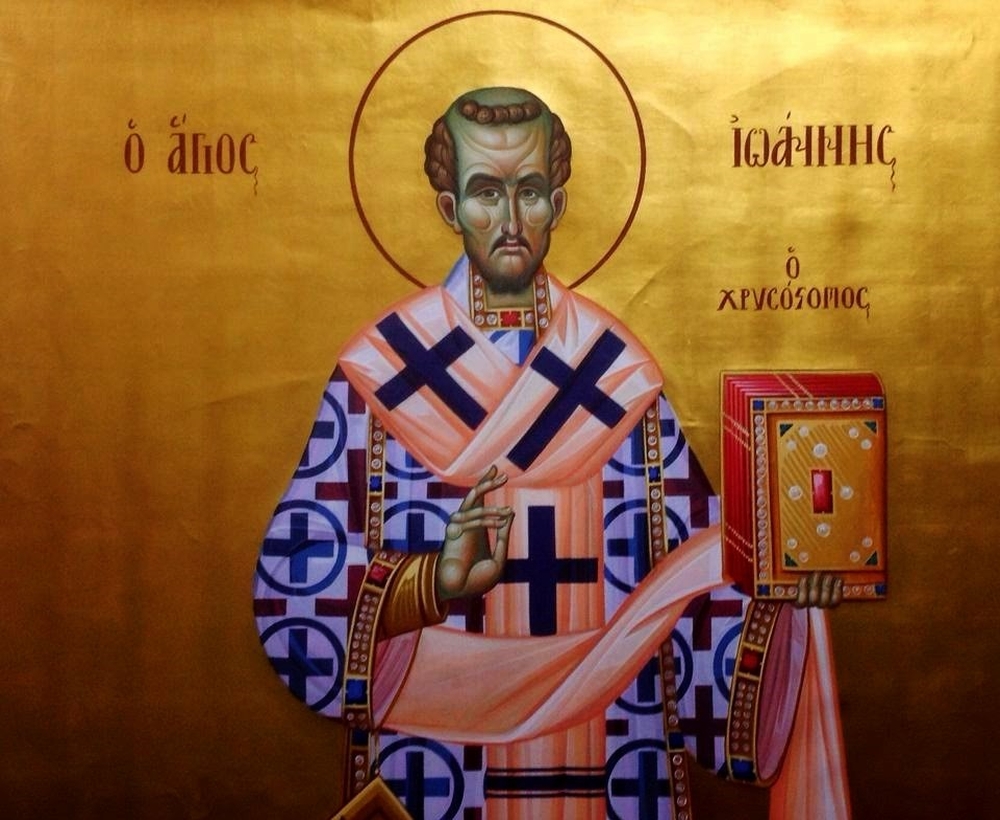
EDITOR’S NOTE (Nick Stamatakis). This commentary is in response to the suspension of a language teacher in a high school in Greece (in Lavrio near Athens), teaching religious studies (link here for the news). The teacher distributed to the students a pamphlet regarding homosexuality with quotes from the blessed Father Athanasios Mytilinaios and preacher Dimitrios Panagopoulos and the Patron Saint of Education, Saint John the Chrysostom. Here it is:

Here is the quote from John the Chrysostom in this pamphlet: ” Homosexuals are worse than murderers because it is better to die than to live and be offended like that. For the murderer separates the soul from the body, while the homosexual destroys the soul together with the body. There is no more hideous, more terrible, more stupid, more dishonorable thing than homosexuality,” the pamphlet states, quoting St.John the Chrysostom, among others.
BELOW A COMMENTARY
==============
SOURCE – TASTHYRAS.WORDPRESS.COM
Was Saint John Chrysostom homophobic?
Posted on October 30, 2024
By Evangelos Vlasis, Professor of Public Secondary Education
We read in the media: << The Ministry of Education proceeded to suspend the teacher who distributed a leaflet with homophobic references to the students of Lavrio. >> as well as << “Schools are places of education, friendship, respect and solidarity. The educational community must respect and promote these principles”, was the comment of the press office of the Ministry of Education. >>. What are these so-called homophobic attitudes (always according to the media)?
First of all, it should be emphasized that the teacher is from a high school in Lavrio. And that he is a philologist who covers the Religious Studies course. So, what are these so-called homophobic references? The publication states that the Educator preached hate speech inside the room and then quoted an image from the pamphlet. And what exactly is the “horrible” content of the brochure? Everyone will find that these are quotes from the excellent and blessed father Athanasios Mytilinaios and preacher Dimitrios Panagopoulos, as well as the Patron of our Education, Saint John Chrysostom. It is not clear what the publication might mean by the expression “hate speech.” However, judging by the characterization of the brochure, it can be assumed that it is an expression without substance.
So, the question arises. Is the article accurate? And if the answer is positive, have the decision-makers understood the gravity of their actions? Everyone knows that constitutionally, Greece is an Orthodox Christian Country, and its laws cannot fail to protect its Principles and Values—rather the opposite. The Holy Bible and the Ecclesiastical Tradition of the Church throughout time refer to homosexuality most negatively. The “To the Romans” Epistle of the New Testament writes about the passion of dishonor, ugliness, and against nature. The examples are numerous. No one escapes the immoral and disgusting situation that prevailed in Sodom and Gomorrah, according to the first book of the Old Testament, Genesis. It refers to homosexuality. Is the Bible homophobic?
At this point and with these facts, only congratulations can be given to the Teacher who is simply doing what he must. To teach students according to the Greek and Orthodox Christian Tradition. Always with respect to foreigners and those following other religions, of course. What is the starting point of the imposition, the suspension of duties (if the publication is true) after all? Who do the decision-makers serve, and with what reasoning? Many questions need to be answered. Everyone wishes that the truth shines forth and that the Educator from Lavrio is vindicated.
Ptolemais 30-10-2024
Regards to the colleague
Evangelos Vlasis Teacher of Public Secondary Education in Ptolemaida
================
Ομοφοβικός ο Άγιος Ιωάννης ο Χρυσόστομος;

Ευάγγελος Βλάσης Καθηγητής Δημόσιας Μέσης Εκπαίδευσης
Διαβάζουμε στα μέσα ενημερώσεως : << Σε αναστολή άσκησης καθηκόντων του εκπαιδευτικού που μοίρασε φυλλάδιο με ομοφοβικές αναφορές σε μαθητές του Λαυρίου, προχώρησε το υπουργείο Παιδείας. >> όπως επίσης << «Τα σχολεία είναι χώροι εκπαίδευσης, φιλίας, σεβασμού και αλληλεγγύης. Η εκπαιδευτική κοινότητα οφείλει να σέβεται και να προωθεί αυτές τις αρχές», ήταν το σχόλιο του γραφείου Τύπου του υπουργείου Παιδείας. >>. Ποιες είναι αυτές οι λεγόμενες ομοφοβικές συμπεριφορές ( πάντα σύμφωνα με τα μέσα ενημερώσεως);
Αρχικά να τονιστεί ότι ο Εκπαιδευτικός βρίσκεται σε γυμνάσιο του Λαυρίου. Κι ότι είναι φιλόλογος που καλύπτει το μάθημα των Θρησκευτικών. Ποιες είναι λοιπόν αυτές οι λεγόμενες ομοφοβικές αναφορές; Το δημοσίευμα αναφέρει ότι ο Εκπαιδευτικός έκανε κήρυγμα μίσους εντός της αίθουσας και στη συνέχεια παραθέτει σε εικόνα, το φυλλάδιο. Και ποιο είναι τελικά το «φοβερό» περιεχόμενο του φυλλαδίου; Όλοι θα διαπιστώσουν πως πρόκειται για αποφθέγματα των εξαίρετων και μακαριστών πατρός Αθανασίου Μυτιληναίου και ιεροκήρυκα Δημητρίου Παναγόπουλου καθώς και (φρίξον ήλιε) του Προστάτη της Παιδείας μας, του Αγίου Ιωάννου του Χρυσοστόμου. Δεν είναι σαφές τι μπορεί να εννοεί το δημοσίευμα με την έκφραση «κήρυγμα μίσους». Κρίνοντας όμως από το χαρακτηρισμό του φυλλαδίου μπορεί να υποτεθεί ότι πρόκειται περί έκφρασης άνευ ουσίας.
Τίθεται λοιπόν το ερώτημα. Αληθεύει το δημοσίευμα; Κι αν η απάντηση είναι θετική, έχουν καταλάβει οι ιθύνοντες την βαρύτητα των ενεργειών τους; Όλοι γνωρίζουν ότι η Ελλάδα συνταγματικά είναι μία Ορθόδοξη Χριστιανική Χώρα και οι νόμοι της δε δύνανται να μην προστατεύουν τις Αρχές και Αξίες της. Το αντίθετο μάλλον. Η Αγία Γραφή και η Εκκλησιαστική Παράδοση της Εκκλησίας διαχρονικά αναφέρονται στην ομοφυλοφιλία με τον πιο αρνητικό τρόπο. Για πάθος ατιμίας, ασχημοσύνη και παρά φύσιν γράφει η «Προς Ρωμαίους» Επιστολή της Καινής Διαθήκης. Πολυάριθμα τα παραδείγματα. Δε διαφεύγει σε κανέναν η ανήθικη και βδελυκτή κατάσταση που επικρατούσε στα Σόδομα και Γόμορρα σύμφωνα με το πρώτο βιβλίο της Παλαιάς Διαθήκης, το Γένεσις. Ξεκάθαρα αναφέρεται στην ομοφυλοφιλία. Είναι η Αγία Γραφή ομοφοβική;
Σ’ αυτό το σημείο και μ’ αυτά τα δεδομένα, μόνο συγχαρητήρια μπορούν να δοθούν στον Εκπαιδευτικό που απλώς κάνει αυτό που οφείλει. Να διδάσκει τους μαθητές σύμφωνα με την Ελληνική και Ορθόδοξη Χριστιανική Παράδοση. Πάντα με σεβασμό σε αλλοεθνείς και αλλόδοξους μαθητές βέβαια. Ποια είναι η αφετηρία της επιβολής, της αναστολής καθηκόντων (εφόσον αληθεύει το δημοσίευμα) τελικά; Ποιους υπηρετούν οι ιθύνοντες και με ποιο σκεπτικό; Πολλά τα ερωτήματα που πρέπει να απαντηθούν. Ευχή όλων να λάμψει η αλήθεια και να δικαιωθεί ο Εκπαιδευτικός απ’ το Λαύριο.
Πτολεμαΐδα 30-10-2024
Με εκτίμηση στον συνάδελφο
Ευάγγελος Βλάσης Καθηγητής Δημόσιας Μέσης Εκπαίδευσης στην Πτολεμαΐδα















Don’t be surprised, after legalizing gay marriage and adoption, if the next step taken by the Greek Mainstream Media and the Greek Government, is to shamelessly declare the Bible as homophobic. This is the slippery slope the Church of Greece was warning them about. These post-modern deniers of God and Country, are the same people who are helping Freemasonry destroy Greece from within. It will not bode well for Greece at all if such people continue to blaspheme God and reject His ordinances unchecked by the populace.
An interesting passage from the writings of St. Symeon Metaphrastes:
“Having discovered a number of homosexuals, conducting an investigation and identifying them, St. Justinian had some of them castrated with spears. And for others, he ordered that sharp sticks be shoved into their shameful orifices, forcing them to walk in a public procession through the agora. There were also many officials and senators, as well as many bishops, who had their property confiscated, and who were driven along the agora until they died a miserable death. The remaining people began to fear, and thus they became chaste.”
— St. Symeon Metaphrastes Logothete, Chronicle, Justinian, 9
Chrysostom’s teachings are consistent with scripture. Those who dismiss the teachings of Chrysostom dismiss the authority of Scripture.
100% correct, JK,
But unfortunately it’s the atheist, “Euro-secular worshipping” Greek political establishment with their atheist buddies in the media that are doing exactly that now…the same ones that seek the votes of those who are actually pious and foolishly vote for them…
Marcos, I am eagerly waiting for the reason why Aramaic was not used on the cross. Please enlighten all of us, unless you really don’t have a good reason.
JK,
Likewise, I am also equally eagerly waiting to see you put some additional effort into researching the question that you stated you currently don’t have an answer for. There are several solid historical explanations and perspectives available, and I have them ready for comparison to your explanation when you are also ready with one.
If you had acted “in good faith” many months ago, and if you were quicker to say “I don’t know”, I would have probably supplied what you are now requesting without insisting that you do any research. But because you intentionally continued to waste our precious time responding to repeat instances of the same “big Aramaic claims” in subsequent articles, while ignoring the repeated question about the inscription on the Cross for months, I must now insist that you FIRST invest your own valuable time in researching and producing a lucid, intellectual response (a.k.a. due diligence). When you are ready to produce the fruit of your research, we can gladly compare notes. If you were in the military, this would translate to “time for some push-ups”.
The only possible explanation is that Hebrew was primarily used in Jerusalem. However it is common knowledge that Aramaic was the lingua franca among Jews at that time. Please enlighten all of us with your supreme knowledge. I have no additional pushups to unlock your knowledge.
JK,
It’s not about “superior knowledge”. It’s about using our God-given logic to differentiate between what makes sense, and what has been influenced by bias, and (yet again), incorrect translations over the years. You continue to rely on English sources, and that is your fundamental weakness every time you attempt to enter the “intellectual arena” on matters that require a wider linguistic lens…
As a result, on this particular topic, you appear to have become an unintended disciple of, or at least influenced by, the 19th-20th century distortions of the German (Lutheran) Biblical Scholar Gustaf Dalman, and his subsequent “academic disciples”, Paul Billerbeck, Matthew Black, and others, who were part of the modern Western academic movement that influentially “propagated” the “Aramaic hypothesis” that first surfaced about 450 years ago in Western Europe (ironically around the same era when other “scholars” were trying to argue that the Erasmian dialect was “proof” that the “Those who call themselves Greeks today had no relation with the Ancient Greeks)…
Fortunately, there is a modern academic counter-movement in the West to debunk much of these incorrect “scholars” of the past, but the damage that has been perpetrated is immense, and is even probably on your home bookshelf. For example, BDAG, a classic Greek-English lexicon of the New Testament continues Dalman / Billerbeck / Black’s (et al) modern propagation of the “Aramaic hypothesis” in footnotes in the year 2000 edition, intentionally (and incorrectly) stating in footnotes that the Greek word “Εβραις” refers to “Aramaic spoken at that time in Palestine…”
Of course, the natural consequence is that books written in the English language by other scholars that adopted this line of thought eventually ended up in your hands and influenced you as well..
However, thankfully, there is some very good scholarship emerging in the last several years to “set things straight”, and to debunk those followers of the “Aramaic hypothesis”… in one such scholarly article, you can read the following shocking quote about the “great propagators of the Aramaic hypothesis”:
“..The comments by Billerbeck and by Black are a remarkable testimony to the power of presuppositions to hide the plain sense of a text in its context.Both Billerbeck’s and Black’s works are widely cited, but their comments must be rejected as blatant mistakes and they cannot be allowed to influence the meaning of Εβραις…”
Here’s the good news for you…this 47 page article exists online:
https://www.biblicallanguagecenter.com/wp-content/uploads/2014/04/9789004263406_04-EBRAISTI.pdf
So as your next “round of push-ups”, feel free to absorb the details of this article. Then, take a close look at all the English “scholarly books” you have been relying upon, and see if you can trace their authors’ citations back to sources that may have been influenced by Dalman’s propagation of the “Aramaic hypothesis” in the 19th-20th centuries.
Then, after you have identified all the books you rely upon that have been incorrectly influenced by the Lutheran Dalman and his followers, we can return for another round of “push-ups”…your perennial reliance upon these English translations and their influence by Western “scholars” has unfortunately caused a situation that will take years to “reverse”…Unfortunately, this is only the first of several rounds of “cerebral push-ups” that will provide sufficient, scholarly context as to why Aramaic was not included on the Cross:
“…The push-ups must continue until the mindset is corrected…”
The game is over. State your position. I am not going to be manipulated. I know none of the individuals you mentioned. You condescending attitude irritates me. Put up or shut up
JK,
If you really wanted me to “shut up”, then you shouldn’t have elicited my response by presenting a dead Lutheran scholar’s Aramaic hypothesis as factual, and I wouldn’t have had anything to comment on. Don’t give me a reason, and you won’t hear from me. That’s the way this “game” as you call it works.
Any personal anger management issues and any associated volcanic emotional outbursts don’t really concern the readers here. It is also nobody else’s problem but your own that you have relied on faulty English translations for your sources, as well as the fact you have never heard about those scholars from 100 to 150 years ago (but whose Aramaic theory you have happily adopted).
Most importantly though, it is certainly not my role or obligation to spend hours on a blog “spoon-feeding” an educated grown man who is fully capable of reading on his own. Do you seriously think I work for you, to entitle you to demand that “I serve you” (with commands such as “Put up”)? Am I really expected to dance just because you want to play a fiddle today? Isn’t that a demonstration of a condescending attitude in itself? But I suppose it’s always easier “to serve” the attitude than for it “to be served” to you, isn’t it?
That’s likely why you are interpreting this as “manipulation” (I call it insistence, by the way)…because you are not accustomed to this sort of “courteous reciprocity”. The source of your irritation is simple. 1) You evaded a specific question for a long time while continuing to propagate Aramaic theory. 2) You have been cornered (I call it insistence) with this 47 page academic paper, and now you are stirring up an emotional “squeal-athon”, because it is quite possible that your entire house of cards (Aramaic hypothesis – library of English sources) is about to collapse around you…
To summarize where we left off prior to this tangent. The starting point (in your situation) for understanding why Aramaic was not one of the 3 languages inscribed upon the Cross begins with that 47 page article I provided above, precisely because you personally need to “reset” your current understanding of the Aramaic hypothesis before you can even proceed to the next lesson. If you are serious about understanding this topic, you will invest your own time in the effort…if you just want to waste other people’s time without doing the necessary work, then you aren’t actually serious. Totally your choice.
Marcos, you are right, Jesus spoke Greek and not Aramaic
jaykay, don’t be bitter. Go outside and touch grass or something because you can’t touch Markos.
JK,
Please don’t infer that I am an advocate of constraining the Lord to a single language. This exchange began from and remains about a universal claim that you repeatedly made about Aramaic, and to which I objected.
in Luke 4:17 – 18, Christ was reading and quoting from the scroll in Hebrew.
in Mark 5:41 he is quoted as intentionally commanding the girl to rise in Aramaic. Very intentionally, because the gospel author intentionally says “this translates to”…(this critical point also casts some doubt upon the theory that the gospel of Mark was first written in Aramaic, because otherwise the phrase “this translates to” would not be necessary if the entire text were a direct translation)
in John 12:20, it is very likely the ensuing conversation was conducted in Greek, starting with the initial encounter with Phillip (who the gospel writer INTENTIONALLY wrote that he was from Galilee), who clearly understood them, which suggests that Galileans knew how to converse with the “Greeks of Galilee”, which would be consistent with what we know transpired linguistically and culturally in the years after Alexander the Great conquered those lands.
(Also, we can’t forget that the Old Testament quotes in the New Testament generally match the Septuagint Greek text…that is fairly intentional, too)
So…multilingual? Let’s not think from our own perspective, either. It is important to keep in mind that Christ was both Man and God, so it is probably both BLASPHEMOUS and foolish for anyone to constrain God to “only speaking” any single language, especially since God himself imposed the languages of the nations after the tower of Babel incident…If St. Porphyrios and a German guy could miraculously converse in private without an interpreter and without knowing each other’s language, if even an animal, a mule in the Old Testament could turn around and speak in a human voice, then why wouldn’t God himself be able to speak to anyone at any time in any language on the planet? If God knows what is hiding in everyone’s hearts, won’t he also know their language? Constraining God to a single “dominant language” is a deceptive and dangerous spiritual trap to avoid. That includes universal statements, and theories that Jesus EXCLUSIVELY spoke Aramaic or even Greek for that matter. In this light, “The language Jesus spoke” is one of those “frivolous arguments” that scripture warns us to stay away from. (Note: The discussion about the language the original gospels were written in is a different topic, entirely).
But with the very famous, intentional Aramaic phrase uttered upon the Cross, coupled with the powerful scriptural account stating that the crowds obviously had no idea what Jesus was saying (they thought he was calling upon Elijah), one can start seeing initial clues as to why Aramaic wasn’t added onto the Cross…Scripture itself openly proves to us that there physically weren’t any people who understood it in the crowds, so why would anyone even waste the ink?
Matt 27:46 ( – Eli – some scholars claim this variant was closer to a Hebrew term)
ηλι ηλι λεμα σαβαχθανι;
Eli, Eli, lema sabachthani?
Translated as: Θεέ μου θεέ μου, ἱνατί με ἐγκατέλιπες;
My God, my God, why have you forsaken me?
**************************
Mark 15:34 (Eloi – scholars seem to claim this is a term in one of the several Aramaic dialects)
ελωι ελωι λεμα σαβαχθανι;
Eloi, Eloi, lema sabachthani?
Ὁ θεός μου ὁ θεός μου, εἰς τί ἐγκατέλιπές με;
My God, my God, why have you forsaken me?
******************************
Compare to the similarity with the Septuagint Psalm 21:2 = ὁ θεὸς ὁ θεός μου [πρόσχες μοι] ἵνα τί ἐγκατέλιπές με…