

EDITOR’S NOTE (Nick Stamatakis). In the most disappointing news for the day, for all of us who supported Trump, the President publicly rejected a key statement made by his Director of National Intelligence, Tulsi Gabbard, regarding Iran’s nuclear program. Earlier that year, Gabbard testified before Congress that U.S. intelligence agencies had concluded Iran was not currently building a nuclear weapon, and that Supreme Leader Ayatollah Khamenei had not authorized such a program since halting it in 2003.
===================
Trump contradicts his spy chief on Iran’s nuclear program

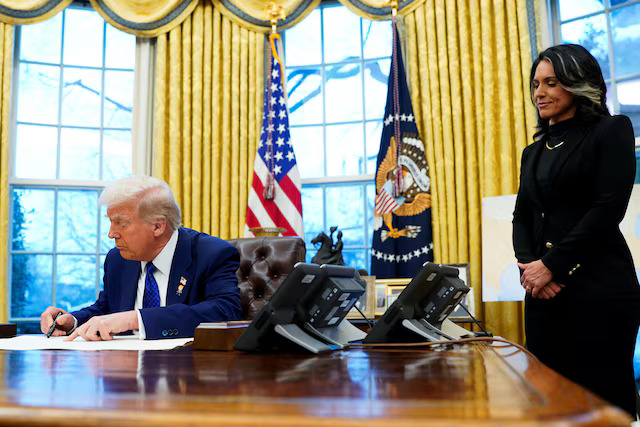
U.S. President Donald Trump signs a document as Tulsi Gabbard stands by, on the day of her swearing in ceremony as Director of National Intelligence, in the Oval Office at the White House in Washington, D.C., U.S., February 12, 2025. REUTERS/Nathan Howard/File Photo Purchase Licensing Rights, opens new tab
WASHINGTON, June 17 (Reuters) – U.S. President Donald Trump on Tuesday repudiated Director of National Intelligence Tulsi Gabbard’s assessment that Iran has not been building a nuclear weapon, publicly contradicting his spy chief for the first time during his second term.
In rejecting his top spy’s judgment, Trump appeared to embrace Israeli Prime Minister Benjamin Netanyahu’s justification for launching airstrikes last week on Iranian nuclear and military targets, saying he believed Tehran was on the verge of having a warhead.
Speaking to reporters aboard Air Force One as he returned early to Washington from the G7 summit in Canada, Trump was asked how close he believed Iran was to having a nuclear weapon.
“Very close,” he responded.
When told that Gabbard testified to Congress in March that the U.S. intelligence community continued to judge that Tehran was not working on a nuclear warhead, Trump replied, “I don’t care what she said. I think they were very close to having one.”
Trump’s comments recalled his clashes with U.S. spy agencies during his first term, including over an assessment that Moscow worked to sway the 2016 presidential vote in his favor and his acceptance of Russian President Vladimir Putin’s denials.
Asked for comment, the Office of the Director of National Intelligence pointed to a CNN reporter’s post on X quoting Gabbard as saying on Capitol Hill that she and Trump were “on the same page” regarding the status of Iran’s nuclear program.
Gabbard also told Congress that U.S. spy agencies did not believe that Iran’s supreme leader, Ayatollah Ali Khamenei, had ordered the restarting of a nuclear weapons program that the U.S. and the International Atomic Energy Agency assessed ended in 2003.
Iran denies developing nuclear weapons, saying its uranium enrichment program was only for peaceful purposes.
A source with access to U.S. intelligence reports told Reuters that the assessment presented by Gabbard had not changed.
They said that U.S. spy services also judged that it would take up to three years for Iran to build a warhead with which it could hit a target of its choice, a finding first reported by CNN.
Some experts, however, believe that it could take Iran a much shorter time to build and deliver an untested crude nuclear device, although there would be no guarantee that it would work.
Trump has frequently disavowed the findings of U.S. intelligence agencies, which he and his supporters have charged – without providing proof – are part of a “deep state” cabal of U.S. officials opposed to his presidency.
Gabbard, a fierce Trump loyalist, has been among the president’s backers who have aired such allegations.
Reporting by Jonathan Landay; Editing by Don Durfee and Nia Williams