


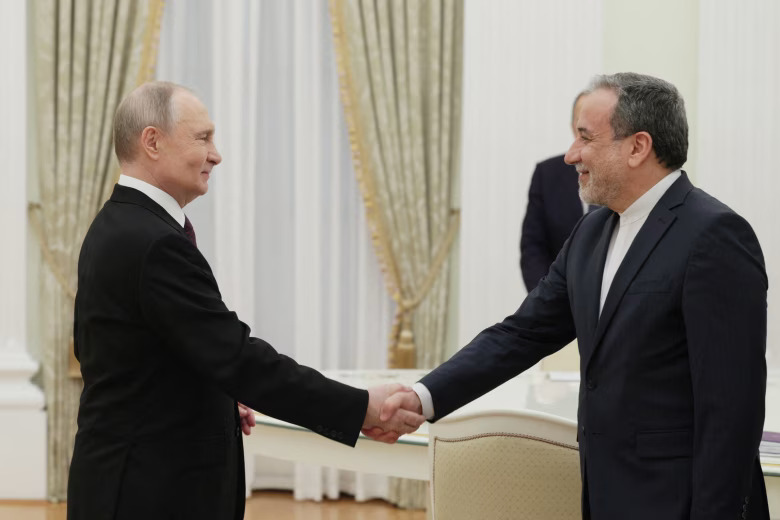
“We’ve been fooled for the last time, ” Foreign Minister Arahgchi said, explaining that the Iranian leadership believed President Trump’s talk about signing a peace deal… Putin is likely to tell him that NATO also fooled Russia into signing the Minsk Agreements in 2015, which served as a delaying tactic to arm Ukraine, as both Angela Merkel and Francois Hollande explicitly admitted.
By Nick Stamatakis
Days before Iranian Foreign Minister Abbas Araghchi was to arrive in Moscow (this afternoon), Russian President Vladimir Putin spoke candidly to journalists, revealing that Iran had previously declined to sign a mutual defense agreement similar to the one Russia recently inked with North Korea. According to Putin, Tehran had opted for “strategic ambiguity,” wary of entangling alliances while holding out hope for a diplomatic breakthrough with the West—particularly the United States.
That hope, it now appears, was brutally misplaced.
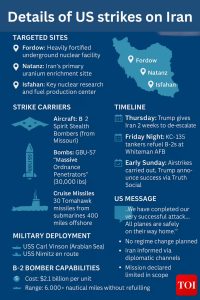
In what Iranian leadership now views as a strategic deception, U.S. officials had signaled that a renewed nuclear deal was imminent. High-level Iranian negotiators, persuaded by these overtures, had eased tensions and de-escalated regional rhetoric. Yet, rather than diplomacy, Iran was met with airstrikes, as Israeli warplanes—reportedly with tacit U.S. approval—launched precision attacks on key nuclear facilities at Fordow, Natanz, and Isfahan. The strikes resulted in significant infrastructural damage and high-profile casualties, catching Iran off guard.
The betrayal has had a galvanizing effect in Tehran.
In response, Foreign Minister Araghchi arrived in Moscow today, tasked with reversing Iran’s earlier position and finalizing discussions on a comprehensive defense pact with Russia. The visit signals a historic shift: Iran is now actively aligning itself with Moscow not only diplomatically but militarily, abandoning its posture of non-alignment in favor of strategic entrenchment with the Kremlin.
Putin, for his part, has welcomed the shift. Speaking ahead of tomorrow’s closed-door meeting with Araghchi, Russian officials have hinted that this pact could include joint air defense cooperation, intelligence sharing, and coordinated military planning—a direct challenge to U.S.-led efforts to isolate Tehran.
For Iran, this move marks a new era of defiance. The leadership, having paid a devastating price for trusting Washington, now sees Moscow not as a counterweight, but as a cornerstone of survival. In the words of a senior Iranian official traveling with Araghchi: “We’ve been fooled for the last time.”
This visit marks more than just a diplomatic gesture—it is a strategic turning point. By moving toward a formal defense pact with Russia, Iran is signaling the collapse of any remaining trust in Western diplomacy and the beginning of a more hardened geopolitical alignment. What was once a delicate balance between East and West has now shifted decisively in Moscow’s favor. For Tehran, the lesson of recent weeks is clear: survival lies not in negotiation, but in alliance—and this time, with a partner who shares both its adversaries and its worldview.
======================
Who are Iran’s allies — and will any help after the US strikes?

Iran’s foreign minister will hold a “serious consultation” with President Putin in Moscow on Monday after US strikes on its nuclear facilities.
Seyed Abbas Araghchi said the American attacks were “outrageous and will have everlasting consequences”. Russia has described them as a violation of international law.
Dmitry Medvedev, the former Russian president, accused President Trump of starting “another war” and said the prospect of a US ground operation is now “looming on the horizon”.

“And now we can say it outright, the future production of nuclear weapons will continue,” he said. “A number of countries are ready to directly supply Iran with their own nuclear warheads.”
The US launched co-ordinated airstrikes overnight against three Iranian nuclear sites — Fordow, Natanz and Isfahan — in what Trump described as a “very successful attack”.
The strikes, widely anticipated after days of mounting tension, came after repeated warnings from Moscow that any direct US action on Iranian soil would amount to a dangerous escalation.
Putin is yet to comment publicly on the strikes but despite fiery rhetoric from members of his government, there has been no signal that Russia is preparing a military response.
Since Israel began attacking Iran on June 13 in an operation dubbed “Rising Lion”, Russian action has been limited to condemnation and an offer to mediate between the two sides.
At last week’s St Petersburg economic forum, Putin reiterated that Iran had not asked Russia for any military assistance and emphasised that mutual co-operation did not include defence obligations.
The 20‑year strategic co-operation deal signed last year between Moscow and Tehran excluded a mutual defence clause.
Iran’s other allies and its neighbours were quick to condemn the US action, warning that it could precipitate all-out war in the Middle East, but they also stopped short of offering any concrete support.

China “strongly condemned” the attack on Iran, saying it violated “the purposes and principles of the UN charter and international law”, and called for a ceasefire.
Advertisement
Lebanon’s Hezbollah, once Iran’s most powerful proxy, said on Sunday that it had no immediate plans to retaliate. The militants, themselves decimated after a year and a half of war with Israel, have not launched a single attack since the operation began.
The Houthis, in Yemen, offered the strongest pledge of action, saying they supported a previous statement from their armed wing, which threatened US naval vessels in the Red Sea in solidarity.
Specific details of what Iran will request from Russia during the forthcoming talks have not been officially disclosed by either government, but Araghchi could seek to secure the Kremlin’s political or diplomatic backing.
Experts said that with resources tied up with the war in Ukraine, Russia is unlikely to be preparing to come to Tehran’s rescue. Putin did little to stop the advance of rebels in Syria in December last year who toppled a key Russian ally, Bashar al-Assad, from power.
“Putin will of course fire out a lot of aggressive rhetoric … but he can’t do much, “ said Ian Garner, a historian and academic focused on Russian culture and war propaganda. “It will likely be a case that Putin’s bark is very loud but his bite is about as toothless as it gets.”
Fyodor Lukyanov, head of Russia’s council on foreign and defence policy, which advises the Kremlin, said that Putin’s statements in recent days show he is extremely cautious.
Advertisement
“He has never expressed any assessment of one side or the other, only about the need for negotiations and a peaceful solution,” he said. “Iran may have expected more. It has supplied the Kremlin with thousands of drones and missiles used in the war against Ukraine.”












Don’t hold your breath. Putin, a supposedly faithful Orthodox, in 2012 prayed at the western wall wearing his kipah! He didn’t help Gaddafi, he didn’t help Armenia and he abandoned Assad when he was needing him. He never did anything against Israel’s interest. Why you think he would help Iran?