

By Nick Stamatakis
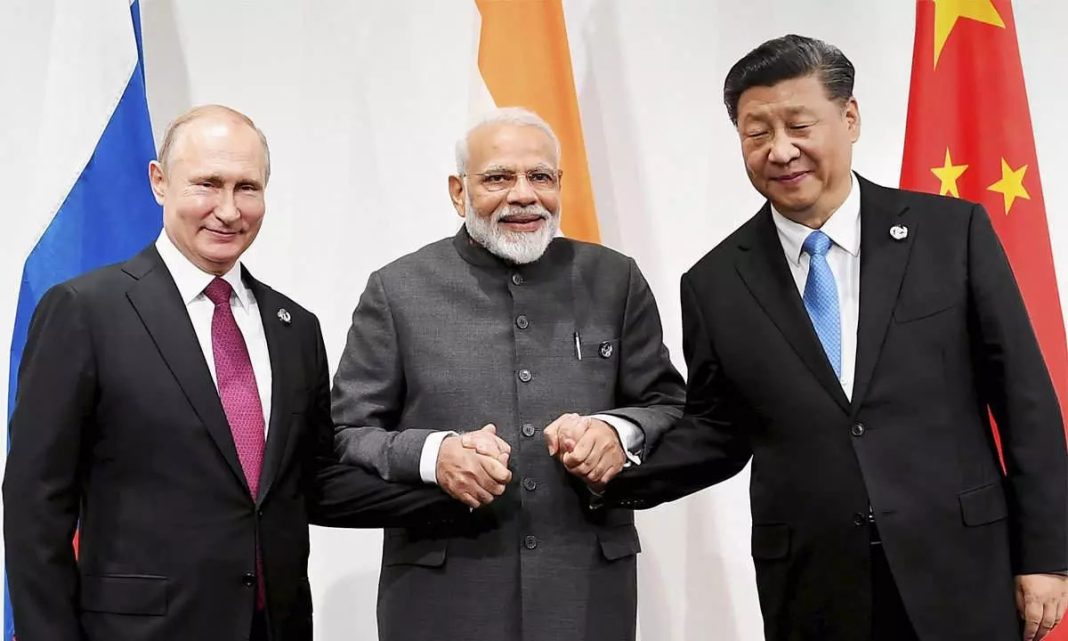
The coming days in Shanghai mark one of the most significant geopolitical gatherings of the year, as the SCO meeting, the BRICS summit, and China’s national anniversary celebrations converge. President Vladimir Putin’s decision to stay in China for an unprecedented four days underscores the historic weight of these events. His presence—alongside leaders from India, China, Brazil, and others—signals the deepening consolidation of Eurasian and Global South power centers, with Moscow and Beijing at the core.
The agenda is ambitious. Beyond symbolic commemorations, these meetings are designed to solidify BRICS financial and institutional architecture. Unlike earlier speculation about directly replacing the U.S. dollar, the focus is on building a parallel system of trade and payments—one that echoes Keynes’s unrealized Bretton Woods vision of multilateral units of account, clearinghouses, and depositories. Russia, China, and India are reportedly advancing blockchain-based transfer systems and establishing central clearing mechanisms, laying the groundwork for a durable financial order outside Western control.
Equally important are the political and security dimensions. Putin will hold high-level bilateral talks with Xi Jinping, briefing him on his recent meeting with Trump in Alaska, reassuring Beijing of Moscow’s unbreakable strategic alignment. Parallel dialogues with Modi and Lula reinforce India’s central role as it prepares to head BRICS in 2026. Defense cooperation, energy flows, technology collaboration, and even joint ventures in chip manufacturing are on the table—areas that directly challenge Western sanctions and economic containment strategies.
In sum, Shanghai this week is not just another round of summits—it is the global pivot point of 2025. The SCO-BRICS framework is evolving from a vision to a structure: a vast, multi-layered bloc coordinating on trade, security, and industry outside Western institutions. If last year’s Kazan summit was the signal, this gathering is the execution phase, demonstrating that BRICS+ is evolving into a comprehensive counterweight to the U.S.-led order. The significance of Putin’s extended presence in China cannot be overstated—it is a clear statement that Moscow and Beijing are anchoring a new, long-term architecture for global power.
BELOW AN EXCELLENT ANALYSIS BY THE TWO GREEKS – ALEX CHRISTOPHOROY AND ALEXANDER MERCURIS












Pakistan has long been an unofficial member of NATO, since Nixon,
not just Bosnia. NATO is magog (Mongol Turk Altaic) because of its
Hun, Lapp, Finn and American Indian lineage. NATO has gone full magog
with the addition of Sweden and Finland. That is why NATO is aligned
with magog Paks, Ghegs, Azeris, Uyghurs, Hetmen, Sioux, Turks,
Bosniacs, and Chechens. Shanghai pact is ancients reclaiming their
patrimony from the magog millenium.