


ΕΑΝ ΠΡΟΤΙΜΑΤΕ ΕΛΛΗΝΙΚΑ ΠΑΤΗΣΤΕ ΤΗ ΣΗΜΑΙΑ ΣΤΟ ΚΑΤΩ ΜΕΡΟΣ ΤΗΣ ΟΘΟΝΗΣ
Cyprus becomes Israel’s radar outpost, Turkey doubles its troops in the north, and Greece remains silent. Why should Athens keep giving everything for free? It is time to revive the Unified Defense Area, demand recognition of its EEZ, fair energy rights, and real military guarantees.
By Nick Stamatakis
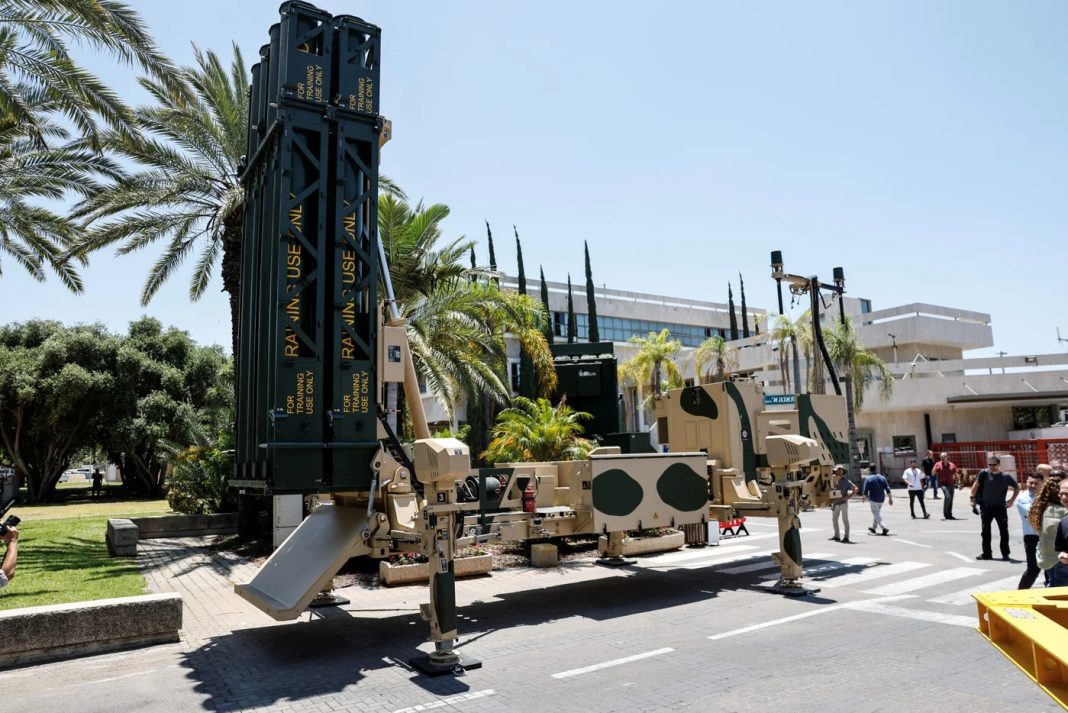
Israel has now deployed the Barak MX air defense system in Cyprus, creating a radar umbrella with an over 400 km radius that peers deep into southern Turkey. Cypriot leaders call it deterrence (please read the report at the bottom). Turkey responds by doubling its forces in the occupied north. An Israeli official spoke openly about “the need to remove Turkey from the North of Cyprus”, while analysts remind us that Cyprus has always been part of “Greater Israel”. And Greece? The supposed guarantor of Hellenism in Cyprus — the same Greece that once pledged the doctrine of a Unified Defense Area with the island — stands aside, giving bases and access to all, while demanding nothing.
This cannot continue. For too long, Athens has behaved like the reliable but expendable ally: handing over Souda Bay, Alexandroupoli, and Larissa to the U.S.; letting Israel test its jets against Greek S-300s in Crete; even importing expensive American LNG into the Psytalleia terminal while its own hydrocarbons lie untouched in Epirus, the Ionian, and South of Crete. In return, Greece receives no money, no recognition of its maritime rights, no real guarantees for Cyprus, and no military deterrence against Turkish aggression.
Meanwhile, Israel itself admits it is isolated — Netanyahu used the word yesterday. And where does Israel look for strategic depth and access to the West? Through Cyprus and Greece. If Athens is to accommodate this role, it must not do so blindly. It must demand an exchange in advance. Recent history and the role both the U.S. and Israel played in 1974 and the decades after, demand such an approach. We could enumerate here a very long list of benefits/facilities etc. that Greece and Cyprus have offered and continue to offer (very much for free) to both the U.S. and Israel. Enough is enough: the time for Greece and Cyprus to be treated fairly is now.
What should that exchange be?
Recognition of Greece’s Exclusive Economic Zones with Cyprus and Libya under the Law of the Sea — dismantling Turkey’s “Blue Homeland” fantasies and rejecting the U.S. State Department’s old recipe of “equitable distribution,” a phrase designed to pressure Greece into sharing what is legally and rightfully its own.
Fair energy contracts, ensuring Greece receives a just share of its hydrocarbons, not colonial-style scraps like Niger’s 5% uranium deal with France for decades…
Real military guarantees — joint U.S.–Greek–Cypriot exercises, Israeli intelligence integration, and contingency plans to deter Turkey.
And above all, a revival of the Unified Defense Area between Greece and Cyprus, so that Hellenism once again stands united in defense of its homeland. Without a unified Defence Area, from Alexandroupolis to Rhodes to Kastelorizo to Cyprus, there is NO Hellenism – period… All of us who study and write about the geopolitics of Greece and Cyprus have this as our main motto. In the present, this Unified Defense Area will obviously be in accordance with the 3+1 Agreements (Israel, Cyprus, Greece, plus the U.S.)
The lesson of the last few decades is clear: when Greece gives everything for free, it is abandoned. The message today must be equally clear: no more illusions, no more free concessions. If the West and Israel want access to Hellenic geography, bases, and above all our loyalty (proven with over one million dead in two World Wars), the price is simple — Greece’s EEZ recognized, resources respected, and Greece’s security guaranteed.
And let us be plain about this: the so-called concept of “equitable distribution,” invented by the magicians of the State Department, has no place anymore. Greece doesn’t need “equitable distribution.” It requires the application of its rights under the Law of the Sea. The U.S., though it never signed UNCLOS, it applied its principles when it drew its own EEZ with Cuba and the Bahamas. Washington has declared it will fight to defend the EEZ of the island nation of the Philippines against the land mass of China. But why, then, is the U.S. silent when it comes to defending the island nation of Greece against the land mass of Turkey? Why the double standards?
Please allow me to close with a hopeful note: The Mitsotakis Government, after many years of under-the-table deals with Erdogan, is now facing tremendous domestic pressure and is drowning under the weight of scandals. At the same time, the West is in a process of isolating itself from the East and, especially, Russia. Israel has become completely isolated. Turkey depends on Russia for energy and will have to keep looking East – otherwise, its economy is doomed. For the sake of the EU, the US, and Israel the exploration of hydrocarbons in the Greek-Cyprus-Libya-Israel-Egypt EEZ is the only option. It has to be done in ways that protect Hellenic interests. A few days ago, the Greek Defense Ministry, using the superb Hellenic Air Force, showed its power all the way to Kastelorizo and Cyprus. The critical moment is right ahead – this time, the Greek political class should do the right thing and present a unified front for the benefit of the country.
September 19, 2025, n.stamatakis@aol.com www.helleniscope.com
DISCLAIMER: The views and statements expressed in this article constitute constitutionally protected opinions of this author.
TO SUPPORT HELLENISCOPE OR BECOME A SUBSCRIBER, LINK HERE!!
==================
More dangerous than S-300s’: Israeli air defence in Cyprus extends intel reach over Turkey
Israel delivered advanced air defence systems to Cyprus last week, marking the third shipment since December amid rising tensions with Turkey, sources familiar with the matter told Middle East Eye.
A video published on Thursday showed a truck passing through the port of Limassol transporting components of the Barak MX system, an aerial interceptor capable of striking threats up to 150km away.
The Cypriot news site Reporter confirmed that the Barak MX system has now been fully delivered and is expected to become operational this year.
The delivery comes after Shay Gal, a former vice president of external relations at Israel Aerospace Industries (IAI), which manufactures the Barak MX, argued in a July article that Israel should reconsider its approach toward Cyprus and devise military plans to “liberate” the island’s north from Turkish forces.
“Israel, in coordination with Greece and Cyprus, must prepare a contingency operation for liberating the island’s north,” Gal wrote.
New MEE newsletter: Jerusalem Dispatch
Sign up to get the latest insights and analysis on Israel-Palestine, alongside Turkey Unpacked and other MEE newsletters
“Such an operation would neutralise Turkish reinforcement capabilities from the mainland, eliminate air-defence systems in northern Cyprus, destroy intelligence and command centres, and ultimately remove Turkish forces, restoring internationally recognised Cypriot sovereignty.”
Turkey invaded Cyprus in 1974 after a failed coup aimed at uniting the island with Greece. Since then, Cyprus has remained divided between the internationally recognised Republic of Cyprus in the south and the Turkish Republic of Northern Cyprus, recognised only by Ankara.
So far, Ankara has remained silent about the newly deployed systems, which carry advanced surveillance and intelligence-gathering functions through their 3D radar. With a range of up to 460km, the system provides a “digital umbrella” that covers a significant part of southern Turkey’s airspace.
Turkey and southern Cyprus nearly came to war in 1997 after the latter attempted to acquire two Russian-made S-300 air defence missile systems, triggering threats of an all-out military response from Ankara.
The crisis ended when Greece accepted the S-300s on its territory, while Cyprus sought alternative systems.
“This is a system far more dangerous than the S-300, which [southern Cyprus] ordered from Russia in 1997 but never deployed,” said Arda Mevlutoglu, a prominent Turkish defence analyst.
“Given the current state of military ties between Israel and the Greek Cypriot administration, this powerful air defence system and radar will undoubtedly become a central element of Israel’s intelligence network in the eastern Mediterranean.”
According to Mevlutoglu, the Barak MX poses a significant threat to Turkish air and ground forces both in Cyprus and across the wider eastern Mediterranean, as its radar is also capable of detecting artillery, mortar and rocket battery fire within 100km.

However, Reporter quoted a source suggesting that the Cypriot version of the Barak MX might not include all of its advertised features, since the system is customised for each client nation.
Yanki Bagcioglu, a retired rear admiral and deputy chairman of the Turkish opposition CHP party, called the system’s deployment a violation of international law.
“This step will destabilise the fragile balance in the eastern Mediterranean and Cyprus, while directly threatening Turkey’s national security,” he said.
Cypriot Defence Minister Vasilis Palmas defended the acquisition on Tuesday, arguing that his government has an obligation to develop credible deterrence capabilities as “Turkey continues to occupy” the island.
Asked whether the Barak MX purchase was part of a defence framework with Israel, Palmas stressed that Cyprus’s decisions on armaments are a sovereign matter.
“Any confrontation between Israel and Turkey does not concern us, except in the sense that we follow the geopolitical developments in our region. Our primary duty is to protect ourselves,” he said.
Turkish security sources told Turkish media that the systems are currently undergoing tests at Paphos air base and have not yet been placed into active service. They added that subsequent Israeli shipments are being closely monitored.
















Two years ago I believed an alliance between Greece and Cyprus would be a good thing. An alliance with the present government in Israel would be highly problematic. Israel is engaged in genocide and the Arab-Muslim world has been badly humiliated.
There is the danger the Muslim world could recognize occupied Cyprus and support Turkey against Greece. The most positive aspect of alliance with Israel is the US might go along with supporting Greece.
But even so, the west has historically betrayed Greece as in 1922. Greece’s top foreign policy priority should be repairing relations with Russia. Russia is more important for Greece than either Israel or the US.
The genocide needs to end and the Netanyahu government must go before Greece and Cyprus can work with Israel.
The Greek government’s support for the Patriarchate of Jerusalem is recognized by the Palestinian authority and Jordon.
Greek rights in the holy land might be endangered if Athens supports Israel’s present government and officials like Ben Gvir and Smotrich.
Greece’s stature in Orthodoxy has suffered because both the Athens government and synod of Archbishop Ieronymos have followed Bartholomew’s lead on the Ukrainian Church. Israel’s religious zealots have attacked the Christian town of Taybeh and are the Monastery of Saint Gerasimos.
Supporting an Israeli government that is harming the Christians of the holy land will further diminish Greece’s reputation among the Orthodox.
Prayers for Greece and its people.