

ΕΑΝ ΠΡΟΤΙΜΑΤΕ ΕΛΛΗΝΙΚΑ ΠΑΤΗΣΤΕ ΤΗ ΣΗΜΑΙΑ ΣΤΟ ΚΑΤΩ ΜΕΡΟΣ ΤΗΣ ΟΘΟΝΗΣ
By Helleniscope’s Editorial Team
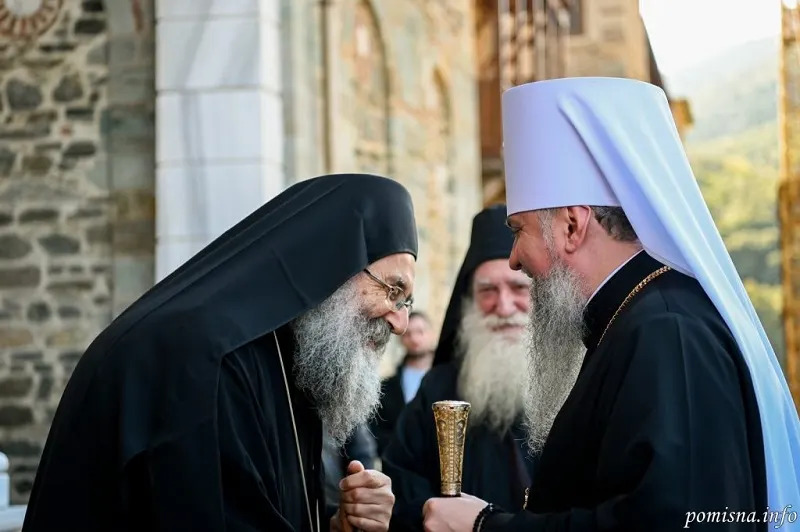
The visit of the schismatic Met. Epiphanius of Ukraine to Mt.Athos landed on old fault lines that have run through the Holy Mountain since the 2018 Tomos for the Orthodox Church of Ukraine (OCU). In the week before Epiphanius arrived, Greek church outlets primed readers for friction: several Athonite monasteries—especially those under strong Slavic/Russian influence—were said to be planning to boycott official receptions, even if the Athonite authorities (the Holy Community) kept to protocol and received the delegation. But after the – characteristically divisive – “greetings” by the contrarian Pat. Bartholomew’s address to Zelensky with the Ukro-Nazi “Slava Ukraini” at the U.N. a few weeks ago made the picture of polarization clear.
Inside Athos: protocol vs. polarization
On the ground, the Holy Community received the OCU primate according to rank, but the climate was unmistakably split. Greek coverage emphasized that a significant number of monasteries do not recognize him as primate, a stance that shaped absences and cool receptions in some quarters. One widely shared framing claimed “16 monasteries” still reject the OCU recognition; whether or not the exact count is current, it captures the lived polarization that Athonites themselves acknowledge.
Greek media’s “two stories”
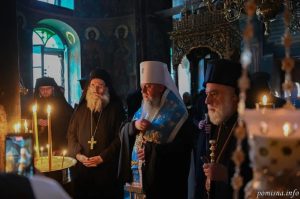
Greek mainstream and church press effectively offered two parallel stories. One, that the visit was a standard pilgrimage with warm receptions at particular houses (e.g., Xenophontos, where the Sunday liturgy was celebrated). The other, that it unfolded “amid reactions”—a test of Athonite cohesion under geopolitical and ecclesiastical pressure. The contrast between celebratory photo-spreads and headlines about “tension” and “disputed visit” reveals how contested Athonite consensus has become.
Beyond Athos: the long shadow of 2018
Outside Athos, the visit was read through the lens of the Moscow–Constantinople rupture: since 2018, the Russian Church has treated communion with OCU clergy as schismatic, and has pressured Athos (informally and financially) to align with Moscow’s stance. That long-running campaign—documented soon after the break and still invoked today—formed the backdrop for claims that “Russian-leaning” monasteries would sit out receptions and liturgies.
Information war meets pilgrimage politics
Greek and diaspora commentary explicitly cast the trip as more than devotional—as an incremental normalization of the OCU in Hellenic ecclesial spaces, using Athos’s moral capital. Conversely, outlets hostile to the OCU (and to Epiphanius personally) amplified allegations of illegitimacy (“acheirotónitos/unordained”), signaling that delegitimization narratives remain active across the Greek-language sphere.
New stakes: Ukrainian presence on Athos
One new wrinkle this year: reports that Epiphanius blessed the restoration of a Ukrainian pilgrimage locus on Athos and met Ukrainian pilgrims there. To supporters, that’s pastoral care for a historic connection; to critics, it looks like institutionalizing an OCU footprint on the Mountain—another front in the contest over who speaks for Ukrainian Orthodoxy.
Aftermath: no rupture, but no closure
By Sunday’s liturgy, nothing broke—no new bans, no public Athonite censure. Yet nothing healed either. The visit re-surfaced, rather than resolved, the split reality: Athos continues to observe Constantinople’s line officially, while robust monastic networks—Greek and Slavic—live another. In the wider Orthodox world, reactions mapped exactly onto existing ecclesial alignments; the Mountain remains a mirror, not the mediator, of Orthodoxy’s post-2018 division.
October 14, 2025, n.stamatakis@aol.com www.helleniscope.com
DISCLAIMER: The views and statements expressed in this article constitute constitutionally protected opinions of this author. This article represents the opinion of the author and shall not be interpreted as legal advice.
TO SUPPORT HELLENISCOPE OR BECOME A SUBSCRIBER, LINK HERE!!
Sources
OrthodoxTimes (EN): “Tensions rise on Mount Athos ahead of visit by Metropolitan Epiphaniy of Kyiv.” Orthodox Times (en)
emakedonia.gr (GR): “Άγιον Όρος: Αντιδράσεις και παρασκήνιο για την τριήμερη επίσκεψη” (skepticism; non-recognition by many monasteries). emakedonia.gr
Βήμα Ορθοδοξίας (GR): “Αγιορειτική δοκιμασία… η επίσκεψη που άναψε φωτιές / 16 μονές…” (editorial framing of divisions). ΒΗΜΑ ΟΡΘΟΔΟΞΙΑΣ News+1
Newsbomb.gr (GR): program & symbolism narrative around the Athos visit. Newsbomb
Orthodoxostypos (GR): hostile characterization (“acheirotónitos”), illustrating delegitimization narratives. Ορθόδοξος Τύπος
Helleniscope (EN/GR audience): “Controversial Visit To Mt. Athos” (geopolitical reading of the trip). Helleniscope
Backgrounder—Wikipedia (neutral digest with sources): reactions to the 2018 schism; pressure vectors on Athos. Wikipedia







I honestly expected much more from
Athos.
If only a few of the monasteries recognize/invited Dumenko and the vast majority did not, can the majority not censure/sanction the ones that did?
Letting an unordained schismatic “bishop” not only to Athos BUT letting him perform a “liturgy” is so scandalous it borders on insanity.
This is what Bartholomew has done. Even the Garden of the Theotokos appears to increasingly becoming barren of true Orthodoxy.
The coming days will be very telling. If there is complete silence, then that silence means consent even if the remaining monasteries dont mean for it to be.
Greek Orthodoxy continues to slide further and further into its own sect
Petros, admittedly I know very little about the situation in Ukraine but did it ever occur to you that the monks were correct in their actions. By the way, one does don’t perform liturgy you either serve or celebrate the liturgy.
Some monasteries maintained a “list” of those who commemorated or concelebrated with Epiphanios or his clergy…those hieromonks would not be allowed to concelebrate in those monasteries. That’s the definition of a true schism on Mt. Athos…
Knowing that Epiphanios may have visited only 3 monasteries that were already on that “list”, it’s low probability that an additional “persona non grata” was added.
The real problem (danger) here is that Epiphanios showed up and actually set his foot on the Holy Mountain, even though the majority of monasteries didn’t want him there? How was that permitted given the “self governing” nature of the Holy Mountain? What’s next, the Patriarch one day in the future decrees that he wants a delegation of women to go to Mt. Athos, and the plurality vote is ignored then too?
Markos:
“What’s next, the Patriarch one day in the future decrees that he wants a delegation of women to go to Mt. Athos, and the plurality vote is ignored then too?”
I wish I could say that I would be surprised, but nothing lawless would surprise me from him. In the past, Constantinople had great patriarchs and Constantinople had terrible patriarchs. Barto is the latter. He will be remembered as barto the terrible.
Let’s see how he answers to this, money talks, and has the last word:
https://spzh.eu/en/zashhita-very/88556-archbishop-of-cyprus-the-euro-and-the-phanar
I just posted it – had received it this morning from Georgios Athanasiou.
Thanks, Nick!
Here is another one: Monks called for the excommunication of abbots who received the head of the OCU and for their exclusion from liturgical communion until repentance.
https://spzh.eu/en/news/88602-athonite-monks-protest-against-dumenkos-visit-to-the-holy-mountain
Very sad that so much division and unsettling is brought to Mt. Athos, as if the disaster in Ukraine is not enough!