


ΕΑΝ ΠΡΟΤΙΜΑΤΕ ΕΛΛΗΝΙΚΑ ΠΑΤΗΣΤΕ ΤΗ ΣΗΜΑΙΑ ΣΤΟ ΚΑΤΩ ΜΕΡΟΣ ΤΗΣ ΟΘΟΝΗΣ
By Helleniscope’s Editorial Team
In a visit that blended spiritual symbolism with political tension, U.S. Vice President J.D. Vance’s trip to Jerusalem this week drew global attention. After visiting the Church of the Holy Sepulchre — one of Christianity’s holiest sites — Vance issued some of the sharpest American criticism of Israel in recent memory, denouncing the Israeli Knesset’s preliminary vote to annex parts of the occupied West Bank as “an insult.”
The vice president’s comments came as Israel’s parliament narrowly approved a non-binding motion to apply Israeli law to the West Bank — a move widely interpreted as a first step toward formal annexation. “If this was a political stunt, then it is a very stupid political stunt,” Vance told reporters, adding that he “personally take[s] some insult to it.”
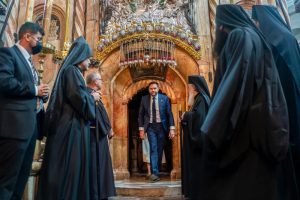
While Vance stopped short of calling the vote illegal or immoral, the language of insult struck a deep chord in Jerusalem’s Old City, where Christian leaders have long warned that expanding Israeli control over the West Bank and East Jerusalem would further endanger Christian heritage and property rights. The vice president’s choice to visit the Holy Sepulchre before delivering his rebuke was not lost on observers.
For many in the Christian world, this visit echoed the longstanding concern that the Holy Land’s spiritual fabric — shared among Jews, Christians, and Muslims — risks unraveling under nationalist pressure. Though no meeting with Patriarch Theophilos III of Jerusalem was officially confirmed, church sources welcomed the symbolic weight of Vance’s stop at the Sepulchre. “It was a gesture that spoke louder than a policy paper,” one clerical voice noted.
Vance’s statement also reaffirmed Washington’s stance under President Trump’s renewed administration: no recognition of West Bank annexation. “The West Bank will not be annexed by Israel,” Vance declared, emphasizing that such a step would undermine peace efforts and destabilize U.S. relations with Arab partners.
The timing of the Knesset vote could hardly have been more provocative. It coincided with the vice president’s visit and overshadowed delicate discussions over Gaza’s post-war reconstruction. The Israeli government itself appeared divided — Prime Minister Benjamin Netanyahu distanced his coalition from the measure, reportedly calling it a “symbolic gesture” not backed by the cabinet.
Vance’s rebuke drew mixed reactions. Pro-settlement members of the Knesset accused the U.S. of hypocrisy and “colonial arrogance,” while moderates quietly admitted that the annexation motion was “badly timed.” In Washington, Secretary of State Marco Rubio echoed Vance’s frustration, warning that annexation “endangers the broader peace framework we are trying to sustain.”
The political message behind Vance’s words was clear: American support for Israel is not unconditional. His phrasing — emotional, almost personal — carried the weight of moral protest, framed against the sacred stones of the world’s holiest city. For Christian audiences, especially in the Greek Orthodox world, the symbolism was unmistakable. Standing within walking distance of Calvary, the vice president of the United States invoked not only diplomacy, but conscience.
Citations
Associated Press, “Vance criticizes Israel’s parliament vote on West Bank annexation, says the move was an ‘insult’.” October 22 2025. AP News
Reuters, “Vance says Trump’s policy rejects Israeli annexation of West Bank.” October 23 2025. Reuters
The Guardian, “Marco Rubio warns Israel not to annex West Bank after Knesset vote in favour.” October 23 2025. The Guardian
The Times (London), “Israel’s West Bank sovereignty vote threatens Gaza peace deal, says US.” October 23 2025. The Times
Detroit News, “Vance criticizes Israel’s parliament vote on West Bank annexation.” October 23 2025. Detroit News












Words are worthless…especially to the Israelis, and especially from the U.S. Government.
Vance is for real. Great to see a leader visiting the holy sites!
Totally unrelated, Metr. Tychikos is in the hospital.
https://spzh.eu/en/news/88711-metropolitan-tychikos-hospitalized