


By Eleni Phufas-Jousma
Look at the Greeks, rushing to pay their debts early—eager students of fiscal morality at the front of the classroom. Germany, by contrast, sits comfortably at the back, still declining to repay the forced occupation loan it imposed on Greece during World War II, apparently confident that some financial obligations apply only to others.
As has been touted on the Greek and international press in December 2025, Greece paid off €5.3 billion in bailout loans years ahead of schedule—debt originally due after 2031 and tied to the country’s first international rescue package. While European institutions and financial markets commend Greece for repaying its bailout obligations ahead of schedule, the social balance sheet tells a different story—compressed wages, shuttered schools, depopulated regions, and a persistently low birthrate mark the true cost of that “success,” recalling the long and painful recovery Greek families endured after World War II and raising an unavoidable question of fairness, as Germany continues to treat as closed a forced occupation loan imposed on Greece under military rule and never formally settled.
Greece is celebrated for having “done its duty,” yet this paper achievement rings hollow on the ground as Germany continues to evade its own duty to repay the forced occupation loan it extracted from Greece under military coercion during World War II.
The Cost of Paying Early
Greece’s early repayment of its memorandum loans is often praised as evidence of recovery, yet for many working people it has felt less like renewal than endurance. The austerity years that made this repayment possible drove real wages sharply downward, hollowing out purchasing power even as prices rose, while hundreds of thousands of mostly young, educated Greeks emigrated, draining families and communities of their future. At home, birthrates fell to historic lows, as economic insecurity forced couples to delay—or abandon entirely—the decision to have children. The consequence is no longer abstract or statistical: hundreds of schools have closed, classrooms fallen silent, and in large stretches of rural Greece entire villages feel thinned out or abandoned, their futures quietly erased. What followed was not collapse, but exhaustion—a slow erosion of morale that echoes Greece’s experience during and after World War II, when survival took precedence over hope and rebuilding stretched across generations. This context matters, because Greece’s repayment is not merely a financial milestone—it is the product of prolonged social strain borne disproportionately by those least able to absorb it.
A Voluntary Loan Versus a Loan Taken at Gunpoint
The loans Greece accepted after 2010 were negotiated in peacetime, within international institutions, and under formal legal frameworks. However punitive the conditions, Greece entered these agreements as a sovereign state. The debts were recognized, enforced, and ultimately repaid—early.
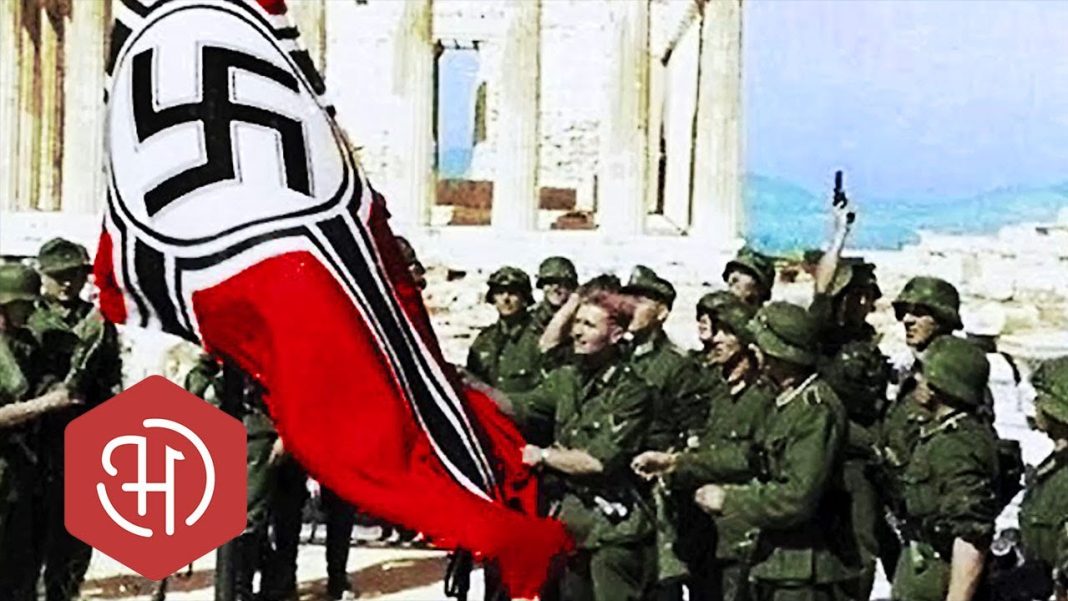
The occupation loan imposed on Greece by Nazi Germany between 1942 and 1944 could not be more different.
Greece was under military occupation. Its economy was already devastated by famine, mass executions, and systematic destruction. Under these conditions, the occupying authorities compelled the Bank of Greece to finance German military operations—not only within Greece, but across the wider theater of war. These transfers were explicitly recorded by the occupation authorities as a loan, not a levy or war booty. Nazi Germany itself acknowledged the obligation and even made partial repayments before the war ended.
That repayment was never completed.
Who Honors Debt—and Who Does Not
After 2010, Greece was repeatedly told that debts must be honored, regardless of hardship. It complied—at immense human cost. Social services were cut, wages and pensions reduced, and an entire generation pushed into precarity or exile. Still, Greece did not repudiate its obligations. It restructured, negotiated, and repaid.
Germany’s postwar trajectory tells a different story.
Large portions of Germany’s own debts were reduced or deferred under the 1953 London Debt Agreement in the name of recovery and stability. Yet the occupation loan to Greece—distinct from general war reparations and never legally extinguished—remains unpaid. Germany’s position today is not that the loan was repaid, nor that it was invalid, but that the issue is politically “closed.”
Closed without settlement.
Closed without adjudication.
Closed without payment.
A Question of European Credibility (or what’s left of it)
This asymmetry strikes at the heart of Europe’s moral and legal coherence.
If contracts matter, the occupation loan matters.
If rule of law matters, coercive wartime loans cannot be erased by silence.
If solidarity is more than a slogan, historical obligations must be confronted honestly.
Greece has demonstrated—twice in modern history—what it means to shoulder unbearable burdens in the name of stability: once during and after World War II, and again during the debt crisis. In both cases, ordinary people paid the price through deprivation, delay, and diminished horizons.
The unsettling parallel remains: Greece paid to stabilize Europe, while Germany still refuses to settle a debt incurred under occupation.
When the debtor pays and the creditor refuses, the issue is no longer economics.
It is justice.















Very unfair. What legal arrangements are being made now to address this?
John- if you are referrring to the unpaid German debts check out this website of the International Committee on the German debts to Greece
https://germandebt2greece.org/
In general to answer your question i see a rather shallow to non existent effort on the part of the Greek government as a whole. The cowardly resistence to demanding the outstanding debts is astounding – very few voices are crying out in the wildeness – it is as if Greek politicians are indebted to the Greek establishment and hegemony rather than to the Greek people. Very sad. But there are voices still crying out for justice no doubt.
The author is criticizing Germany’s hypocrisy. By contrasting Greeks who “rush to pay” with Germany’s refusal to repay a WWII forced loan, the writer employs irony and moral rhetoric to accuse Germany of double standards, shame it into fulfilling its historical obligations, and provoke readers to question current fiscal and ethical balances between nations.
Congratulations on your powerful article
Dear Mrs Foufas,
Congratulations on your incisive article. Your contrast between Greeks who “rush to pay” and Germany’s refusal to repay the WWII forced loan was sharp, morally persuasive, and well-timed. The use of irony and moral rhetoric to expose double standards and to prompt readers to reassess fiscal and ethical responsibilities was both courageous and thought-provoking.
Thank you for shedding light on this critical issue and for encouraging a necessary public debate.
With respect,
Sevasti ( Sevi) Boutos
As rightful and just as it would be for Germany to pay the forced loan it is just as improbable to actually take place. Too long a time has elapsed, the world is much different now, the affected families have died.
The allies learnt a lesson from Germany’s predicament at having to pay war indemnities to France, after WWI. The inflation those payments caused such economic ruination, that Germans were starving to death and it eventually gave rise to Hitler and the even greater catastrophe of WWII.
They were determined to avoid such a scenario. The Marshal plan, was meant for aggressors and victims. And after the Berlin airlift, Germany found her place among her former enemies, the Western powers. Germany’s sins were mostly forgiven, and with America’s support and under NATO’s umbrella, her economy became the miracle of Europe.
Greece received some compensation, but there were so many victims, that there was no chance that West Germany could compensate them all and be a viable nation.
Greece at the time, being ravaged by the civil war and at a disadvantage, due to her dependance on America’s military and economic support, couldn’t object to the treaty that she was forced to sign. The result was a piddling amount, nowhere near what was due her.
After Germany’s unification, in 1990, a golden opportunity was wasted. The reason was that Greece, being a part of the EU and a net recipient of EU funds, with Germany, as the biggest and most wealthy economy, contributing to the general EU fund, which Greece was drawing from, presented an awkward situation. How do you demand more money from someone that already is giving you a great deal. And Germany never failed making such an unfair, but somewhat logical argument.
At the same time that Greece, during the financial crisis, resurrected demands for reparations, the Polish also were demanding a larger amount than Greece was. Germany is anxious to avoid opening a Pandora’s box of reparation demands, from additional victims. If she paid Greece, then why not Poland. Soon, there would be a line of nations, demanding their share.
The loans that Greece is paying before they’re due are a different situation. They need to be paid, for Greece to regain her stature as a trustworthy Western nation, and which benefits Greece immensely, from lower interest rates to a rush of lenders in the future borrowings. . Germany’s loans were forgiven by decision of the victors of the war. Greece’s loans were not forgiven by anyone’s decision. Claiming such a connection is like telling your bank you won’t pay your mortgage because someone robbed your house. See how that works.