

ΕΑΝ ΠΡΟΤΙΜΑΤΕ ΕΛΛΗΝΙΚΑ ΠΑΤΗΣΤΕ ΤΗ ΣΗΜΑΙΑ ΣΤΟ ΚΑΤΩ ΜΕΡΟΣ ΤΗΣ ΟΘΟΝΗΣ
From the Nazi occupation to the fall of the Junta, and from Jewish suffering to Palestinian aspirations: a personal reflection on why, for Hellenes, freedom comes first.
By Nick Stamatakis
In 1974, I was a 13-year-old teenager overflowing with enthusiasm for freedom.
The military dictatorship had just fallen, in the aftermath of the tragedy of Cyprus, and the whole of Greece—especially its youth—was electrified by the anti-junta struggle. Freedom, democracy and resistance to fascism were not abstract ideas to us.
We had all grown up faster than our age. I was already a well-read, restless young man, a top student who would not hesitate to participate in political and social movements. I was also well on my way toward socialist ideas—an adventure that lasted until I was about twenty.
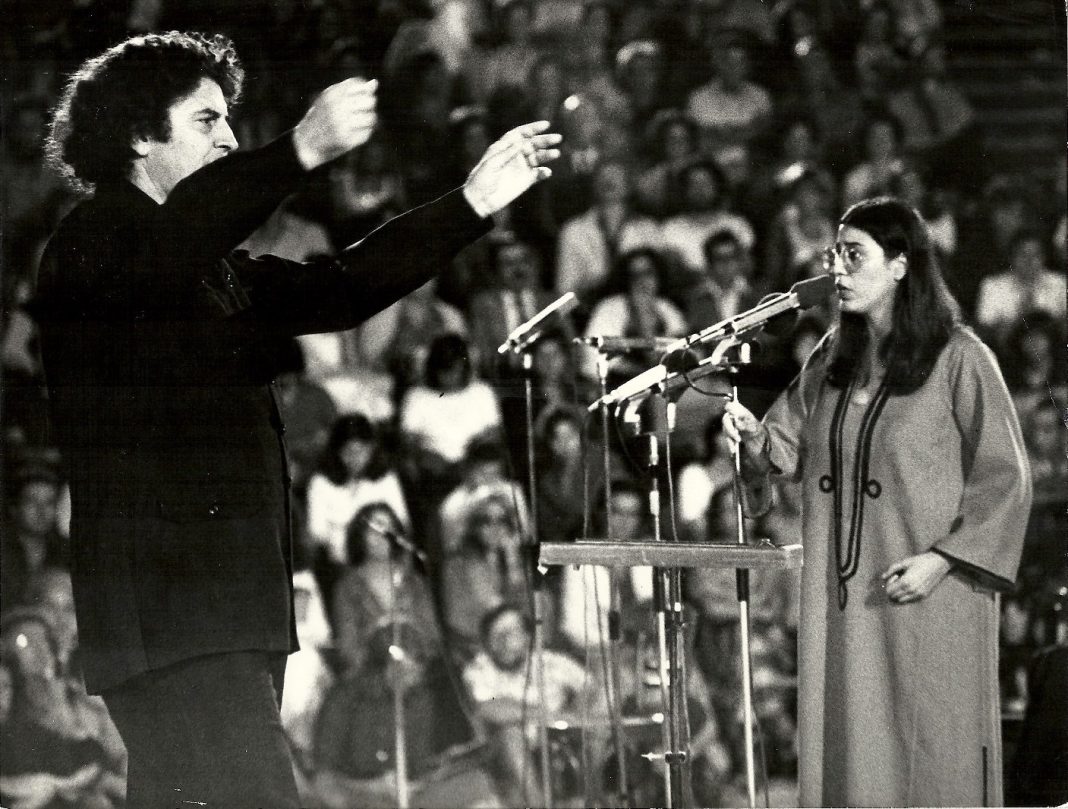
Politics, history and freedom were in the air we breathed, and nowhere were they expressed more powerfully than in the music of Mikis Theodorakis.
That fall of 1974, I left home by myself twice after 10 p.m. and went to Mikis concerts in soccer stadiums a few miles away. You have to understand Greece: then, as now, nightlife barely begins before 11 p.m.!
It was a very safe neighborhood, but I am still lucky my father did not kill me when he discovered what I had done. My mom protected me…
Those concerts remain among my strongest memories of that extraordinary period.
Theodorakis reached so deeply into us for another reason. Among his greatest works was Mauthausen, composed to the poetry of Iakovos Kambanellis, himself a survivor of the Nazi concentration camp. Songs such as “Antonis” became part of the musical landscape of a Greece rediscovering democracy after 1974.
For me, this was not distant history.
Only thirty years earlier, on August 17, 1944, my own neighborhood had suffered a Nazi Bloko—a massive blockade and roundup. More than 200 men and boys (as young as 13 – my age at that time) were executed on the spot. Around 8-10,000 were marched to a military camp miles away, and many were eventually sent to Nazi concentration camps in Germany.
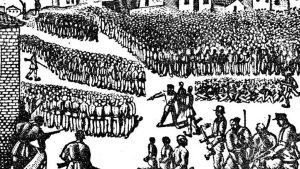
IMAGE ABOVE: A famous artistic rendition of the “Bloko” in Kokkinia…
Only a small number returned.
I still remember some of those few survivors walking through our neighborhood—men who had physically returned home but seemed, in some profound way, still imprisoned inside their nightmares.
In 1974, only thirty years separated us from those events. The Nazi occupation, the executions and the concentration camps were not remote history. The survivors were still walking among us. Our neighborhood, Kokkinia, had shown the strongest anti-Nazi resistance in Greece, and paid a heavy price.
(To read a rather literary report I wrote a few years ago, please link here).
And now Greece was emerging from another dictatorship, while an entire generation sang Theodorakis: music celebrating resistance to Nazism, mourning the victims of the Holocaust and proclaiming the right to resist tyranny. Mauthausen also acquired extraordinary significance in Israel, where its songs came to occupy an almost anthem-like place in public memory.
Then, several years later, the same Mikis Theodorakis turned toward the Palestinian struggle for freedom and national recognition.
At Yasser Arafat’s request, he composed a Palestinian national hymn/anthem and presented it to the Palestinian leadership in Beirut in 1982. Theodorakis later recalled Arafat telling him:
“You sang the Jews, and you were right, because they too are a tormented people. Like us. Please write a song for us too.” And he did actually compose the Palestinian National Anthem (it was never approved as an anthem officially – but it is an amazing song):
For me, that is the essential Mikis Theodorakis: the man who gave musical voice to the memory of Jews murdered in the Holocaust also gave musical voice to the Palestinian longing for freedom.
There was no contradiction.
Freedom for Jews does not require denying freedom to Palestinians; freedom for Palestinians does not require hatred of Jews. The principle cannot change based on the victim’s identity.
Years later, during the “Oslo Accords” in 1993, Theodorakis attended the negotiations and signing ceremony: his Mauthausen was performed in honor of Israel, and his Palestinian anthem/hymn in honor of the Palestinians. Few images better express the idea.
And it expresses something deeply Hellenic, too.
The men of my neighborhood resisted the Nazis. Some gave their lives; others returned from the camps carrying wounds for the rest of their lives. Thirty years later, my generation celebrated the fall of another dictatorship through Theodorakis’s music.
That history taught us something simple:
Freedom cannot be selective.
We Hellenes do not have to choose between Jews and Palestinians. We defend the dignity and freedom of both, because the freedom we claim for ourselves cannot morally be denied to another people.
Our history has often demanded a very high price for freedom. Perhaps that is why we understand its value so instinctively.
For us Hellenes, freedom is not merely one good among others.
Freedom comes first.
Ελευθερία πάνω απ’ όλα.
August 25, 2026, www.helleniscope.com, n.stamatakis@aol.com
DISCLAIMER: The views and statements expressed in this article constitute constitutionally protected opinions of this author.
TO SUPPORT HELLENISCOPE OR BECOME A SUBSCRIBER, LINK HERE!!












Nicely written, balanced article. However, it is also ironic how the freedom that Nick considers a human right for the Jews and Palestinians, he deems Ukrainians unworthy of the same freedom. Ukrainians, in the space of four years, have sacrificed over half a million men on the altar of freedom. Yet, the Putin-loving segment of the American culture wars is embracing a dictator, while denouncing the Greek junta of 1967-74.
Nick says, very poetically:: “”We Hellenes do not have to choose between Jews and Palestinians. We defend the dignity and freedom of both, because the freedom we claim for ourselves cannot morally be denied to another people.”” Why not add “freedom for all,except the Ukrainians.
Bob let me put it simply so you can grasp the idea. You keep failing to understand that you are dealing with people, Russians and “ukrainians” who lived together for a century under the Soviet Union without many ethnic or linguistic distinctions and under Russian Orthodoxy which – as we know from the Balkans – is a big unifying force. You go from Belgrade to Crete and from Sofia to Montenegro and you don’t feel the difference because all Orthodox people who lived together for centuries and have similar foods and even dances are more brothers than “other ethnicities”. Between those living in Russia, Belarus and Ukraine the differences are even more insignificant. They are analogous to those between mainland Greeks and Cretans or Cypriots. Before 1917 and the Bolshevik Revolution there was not such a thing as Ukraine in today’s sense. There was “New Russia” at the same place where Eastern Ukraine/ Donbas and Odesa is today – a term “New Russia” that the Russians started using again recently. Please tell me that you can grasp this fact and I will proceed further. My specialty and my doctorate is on ethnicity. Please listen to me carefully and you will be in a much better place soon.
I dont understand what you mean by “I’ll be in a better place soon”. I am in the best place. No need to improve.
Be that as it may, why would anyone–including yourself–assume that they have the right to tell Ukrainians not to seek independence because they’re kin to Russians. Orthodoxy, from Crete to Finland, does NOT unite countries. It divides them. Greeks have many similarities in food, customs and dance with Bulgarians, plus Orthodoxy, yet they were the bitterest enemies. All the Slav countries are independent. Why should Ukraine be any different.
Cretans and Cypriots fought to UNITE with Greece. Not to split How can you compare Ukrainians to Cretans or Cypriots is beyond understanding, especially for someone with a doctorate in anything. .
The fact that Ukrainians have been fighting and sacrificing their young for four years, not to unite, as Cretans, Cypriots, Ionian islanders, Dodecanese islanders, Macedonians did, is evidence enough that they deserve to be independent. No outsider has the right to deny that to them.
You keep making the same mistakes again and again. You assume that Ukrainians act out of their free will as a nation: they are not. If you don’t understand that, for the past at least two decades, the Ukrainians are instigated by the puppet masters of the West to go to war with Russia then there is no point to keep discussing. Do you realize that Zelensky was elected on a platform to find peace with Russia? And the majority of the people of Ukraine voted for him on this platform? He is a native speaker of Russian after all (Nearly all Ukrainians speak and understand Russian but Zelensky is a true Russian native-speaker). A few weeks after he was elected he did the opposite. Very much like Trump did in America. What don’t you understand? You cannot see the existence of the puppet masters?
Bob, if I may: the issue of an independent Ukraine has never been the issue.
Putin recognized the reality of the Ukrainian state as have the vast majority of the Russian people.
In stipulating your position, you are erecting a straw man.
As to why Russia invaded, it was regretful, of this there can be no doubt. However we cannot ignore the West’s provocations against Russia. The Kiev regime (not the Ukrainian people who voted 73% in favor of Zelensky who ran on a platform of peace) are the transgressors. It is they who have allowed themselves to hijack the Ukrainian government and army for purposes that have never benefited them.
True story: 15 years ago, I had a heated discussion with a gifted Ukrainian iconographer. This was years before the present hostilities which began in 2014 btw. His hatred of the Russians put my own antipathy towards the Turks to shame.
Finally I told him: “Volodya, go ahead and put your trust in America to come to your aid. They will let you all fight to the last Ukrainian. And then they’ll leave, just like we left South Vietnam.”
And then of course, we repeated our cowardly actions in 2021 when we left Afghanistan like a thief in the night.
Is Bob Karp mentally challenged or does his mind short circuit?