
EDITOR’S NOTE (Nick Stamatakis) This may be an older article (Dec. 2017), but the quality of its authors and the timeliness of its subject deserve attention in the present time…
=============================
/
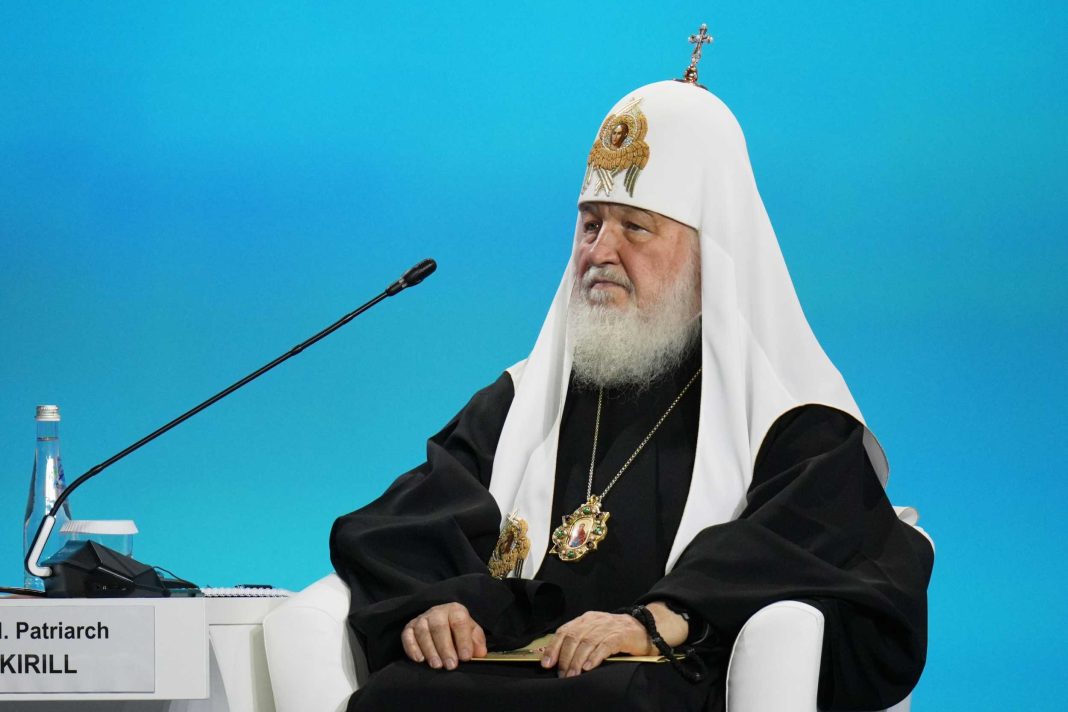
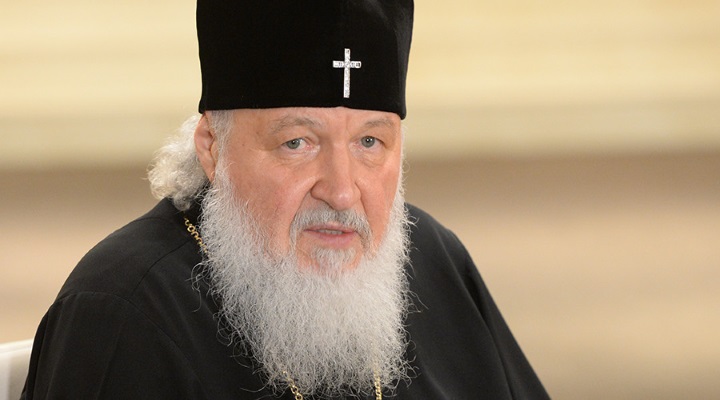
Patriarch Kirill and Russian Orthodoxy Deserve Respect Not Insults: An Open Letter to George Weigel*
by Fr. Alexander F. C. Webster, James George Jatras, and Fr. Victor Potapov
I. Introduction
As longtime friendly colleagues in the pursuit of a faithful Christian public moral witness in America, we are profoundly saddened and shocked at your unfounded, insulting accusations against the moral integrity of the senior leaders of the Russian Orthodox Church since the Ukrainian crisis erupted in February 2014.
The initial broadside appeared in your column in the Denver Catholic Register on March 18, 2014, when you dismissed Patriarch Kirill of Moscow as “duplicitous” and Metropolitan Hilarion (Alfayev), chairman of the Department of External Church Relations of the Moscow Patriarchate, as “mendacious.” We take increased umbrage at the steady escalation of your Szechuan ad hominem prose since then:
- “These [Ukrainian Greek Catholic] bishops, like other western Christians, have not been duped by the extraordinary campaign of lies that has issued from the Kremlin these past seven months, but…all of us who cherish the spiritual patrimony of Russian Orthodoxy…are deeply saddened when you and Metropolitan Hilarion, your chief ecumenical officer, amplify the falsehoods of President Putin and Foreign Minister Lavrov.” [June 17, 2014]
- “Russian Orthodoxy’s leadership today functions as a Kremlin mouthpiece in matters Ukrainian, even as it lies about the Ukrainian Greek Catholic Church’s role in the current crisis and betrays its ecumenical commitments in doing so…[February 17, 2015]
- “Serious ecumenical theological dialogue is impossible with men who are acting in the world as agents of Russian state power. Pretending otherwise emboldens the Russian Orthodox leadership.” [August 4, 2015]
The condescending, hubristic tone of those comments is surpassed in offensiveness only by your resort to uncharitable epithets—liars, mouthpieces, and dupes—which hardly constitute a reasoned argument. It is well-nigh impossible in this “open letter” to defend Patriarch Kirill and Metropolitan Hilarion from your omniscient pretense to know their hearts and minds. However, we shall attempt here to set the record straight by accurately citing and explaining their public positions on the Ukrainian crisis.
II. Symphonia—Not “Separation”—of Church & State
Far from a throwback to Soviet-era practices—as you have suggested, both in your own words and though uncritical quotation of the Ukrainian Greek Catholic Church’s (UGCC) Major-Archbishop Sviatoslav Shevchuk (“Ukraine Rising,” National Review, Nov. 10, 2014), the close cooperation between Church and state in Russia today is more reminiscent of the pre-1917 symphonia, the Orthodox standard throughout our history since the time of Byzantine Emperor Theodosios I in the late fourth century. That organic instead of adversarial understanding of the sacerdotium and the imperium united, harmoniously albeit with some tension, in a single Christian commonwealth is obviously antithetical to the neo-Jeffersonian principle of strict “separation” of church and state, now political dogma in virtually all Western countries imbued with the notion of secular liberal democracy.
In the restored symbiosis in post-Soviet Russia it is hardly clear that the Church is the junior partner dutifully “amplifying” state policy. To the contrary, as Professor Nicolai N. Petro of the University of Rhode Island pointed out (“Russia’s Orthodox Soft Power,” Carnegie Council for Ethics in International Affairs, March 23, 2015), Kremlin policies “are popular precisely because they have the blessing of the Russian Orthodox Church.” Grounded in a religio-cultural vision of Russky mir—the “Russian World” descended from ancient Kievan Rus’ and embracing the people in Russia, Ukraine, Belarus, and perhaps Kazakhstan—the balance in the contemporary Russian neo-symphonia, as it were, depends on the respective priorities of Patriarch Kirill and the Putin government. As Petro astutely observed, Russky mir is, for the state, “a political or a cultural concept” by which the Russian Orthodox Church “can be a useful tool” for Russia’s domestic and international advancement. But Russky mir is, for the Church, “a religious concept” by which the national governments can be “tools” for the “second Christianization” of the historic lands of Kievan Rus.’
We would argue that, since AD 2000, the Russian neo-symphonia has begun to tip in favor of the Church, not the state, and praise God the Holy Trinity for that! The comprehensive document titled, Bases of the Social Concept of the Russian Orthodox Church, produced by the Department for External Church Relations of the Moscow Patriarchate under the leadership of Metropolitan Hilarion (Alfayev)—whose moral character you have besmirched—is the gold standard of contemporary, yet very traditional, Orthodox social ethics. Other ecclesial initiatives have provided the main impetus for recent Russian laws—decried, alas, by Western liberals—to curb propagandizing and proselytizing of young Russians by “gay rights” advocates, reduce the enormity of abortions in post-Soviet Russia, and protect the sanctity of religious temples from unwanted intrusions by miscreant groups like “Pussy Riot.” In addition, the Russian Church has established a profound inter-confessional collaboration with U.S. evangelicals to promote strong families and traditional marriage between one man and one woman alone.
None of those accomplishments was possible throughout most of the twentieth century. As each of the co-authors of this open letter have acknowledged often in print, Russian Orthodoxy had to endure the godless Soviets for 74 years, including the shameless betrayal of faithful confessors and martyrs by Orthodox hierarchical collaborators with that regime. For you to compare that horrific era to the miraculous re-emergence and moral integrity of the Church since 1991 is shameless.
Whatever criticisms one might have of the symphonia model, blanket condemnation is hardly appropriate as we witness the trend in our own country, where Christianity is increasingly marginalized, moral vices are officially promoted as virtues, and abortion “rights” and homosexual “rights,” in particular, are now key components of U.S. foreign policy—a trend we are sure you deplore no less than we.
III. The Russian Church—a Rival, Not an “Enemy”
Patriarch Kirill, Metropolitan Hilarion, and other prelates of the Russian Orthodox Church have been consistent on two points with respect to Ukraine. First, they voice support for Russia’s policies. Second, they call for restraint in what they see as a deplorable, fratricidal conflict, which pits the Russky Mir against itself.
You need not accept their point of view. Perhaps based on your own religious heritage, you may prefer to believe that the UGCC is “a safe-deposit box of Ukrainian national culture and identity,” despite the mere 15%, at most, of Ukraine’s population who identify as Catholics (Latin or Eastern rite). Underlying the current conflict are some sharp as yet unanswered questions: What exactly is Ukraine (“Borderland”) and who are Ukrainians? Are they an aspiring part of (an increasingly godless and libertine) “Europe” defined in Brussels or an integral part of the Russky Mir? Who was on the “right” or “wrong” side of World War II? Ukrainians themselves are at odds on these questions, largely along regional and confessional lines.
When Ukraine became an independent republic in 1991, those questions lay dormant under a deceptively calm surface. But they remained a fatal weakness in the very fiber of the new state, along with an unbelievable level of oligarchic corruption. The unconstitutional unseating of the flawed but democratically elected government in February 2014 shattered what was already a fragile unity. That, not some mythical Russian aggression, has torn Ukraine apart.
Worse, the overturn of the legal government would not have succeeded without violence or the participation of extreme nationalist elements. You write that Ukraine “rose up against post-Communist corruption and stagnation,” and that Archbishop Shevchuk’s “Church played a central role in the Maidan Revolution of Dignity,’ its bishops and priests dodging Russian bullets to tend to those demonstrating nonviolently for freedom and justice.” However:
- Surely you are aware of the leaked phone call between the EU’s Catherine Ashton and Estonia’s Foreign Minister Urmas Paet, indicating the true source of sniping on the Maidan.
- Surely you know that “those demonstrating nonviolently” included members of violent radical groups like Right Sector, using spiked clubs, Molotov cocktails, and even guns against riot police to seize government buildings—behavior that, in Washington, would be put down immediately with deadly force.
- Surely you know of the May 2014 massacre in Odessa of dozens of anti-Euromaidan demonstrators—or maybe that was just more nonviolent struggle for “freedom and justice”?
- Surely you know of the new law criminalizing criticism of the wartime Organization of Ukrainian Nationalists (OUN) and the Ukrainian Insurgent Army (UPA), sinister fascists guilty of participation in massacres of Jews and of slaughtering tens of thousands of Roman Catholic Poles in Volhynia and Eastern Galicia. Perhaps that’s an example of the “Revolution of Dignity”?
- Surely you know that only two days after the President Viktor Yanukovich fled from Kiev in February 2014 the Ukraine parliament repealed by an 86% majority a 2012 law ensuring, among other things, the official use of Russian as a second language in the predominantly Russian-speaking Donbass region in Eastern Ukraine, where the civil war has since proved most violent. Was that punitive, provocative measure indicative of Ukrainian “freedom and justice”?
- Surely you know that the Ukrainian military’s Azov Brigade engaged in combat in the Donbass region includes self-proclaimed neo-Nazis, perhaps as much as 20% of the unit (according to USA Today, March 10, 2015), complete with swastikas, as well as the infamous “SS” runes and an inverted version of the Wolfsangel symbol used widely during World War II by Nazi German Waffen-SS divisions. Are German broadcaster ZDF and Norwegian broadcaster TV2, which filmed the latter, and NBC News (who reported the incidents online on September 9, 2014), also “dupes” and “mouthpieces” of the Kremlin?
Your trumpeting of a single Ukrainian national will may fit in well with a “good vs. evil” Manichaean narrative to depict the Ukraine conflict as one of West vs. East, democracy vs. tyranny, Ukraine vs. Russia, and, by implication, Catholic vs. Orthodox. It may be great fare for readers of the Denver Catholic Register, National Review, and other publications who may be unaware of past and present complexities. But it is not conducive to a peaceful and just resolution of the Ukraine crisis or averting an even broader conflict that would imperil Europe and the world, including the U.S. Nor is it an excuse to hurl verbal Molotov cocktails at honorable Christian pastors who happen to disagree with you.

*George Weigel is a distinguished lay Roman Catholic theologian and author of the magisterial Witness to Hope: The Biography of John Paul II (Harper Perennial: 2004 [updated edition].
Archpriest Alexander F. C. Webster, PhD, is a retired U.S. Army Chaplain (Colonel), author of four books on Orthodox social ethics, and rector of St. Herman of Alaska Russian Orthodox Church in Stafford, Virginia. James George Jatras, Esq., is Deputy Director of the American Institute in Ukraine, former foreign policy adviser to the U.S. Senate Republican leadership, and a Greek Orthodox layman. Mitred Archpriest Victor Potapov is the dean of St. John the Baptist Russian Orthodox Cathedral in Washington, DC, and a retired Russian language broadcaster for the Voice of America.






It’s very peculiar that this article was posted here, with such lines as “Metropolitan Hilarion (Alfayev)—whose moral character you have besmirched—is the gold standard of contemporary, yet very traditional, Orthodox social ethics.” Especially so, since Metropolitan Hilarion has since been dismissed from his position as active bishop, and exactly for his mendaciousness, acting in a way not proper for a bishop:
.https://ocl.org/russian-orthodox-church-demotes-scandal-prone-former-bishop/
What’s your problem Joseph? The question you should ask here is when the Constantinople Patriarchate will remove its own wrong doers and especially the gay Archbishops of Australia, Canada, Sweden, etc… Do you have an answer for this? The list of wrong doers is too long to fit here. But first Bartholomew has to look around himself… And also look in the mirror…
Here, here!!! Very well said, Helleniscope.
Joseph, please keep on ‘entertaining’ us! Please!
The reasons for Hilarion’s dismissal are well-known, but that wasn’t what Fr. Alexander was focused on…why did you omit the next phrase, which was the main topic?
“…However, we shall attempt here to set the record straight by accurately citing and explaining their public positions on the Ukrainian crisis….
And to Helleniscope’s point, if you want to start a separate topic on the specific reasons for Hilarion’s dismissal, then we are totally in agreement that we should expand the discussion on what it means to be “fit to serve” as a hierarch according to the Canons, and examine the already known and published (not merely rumors) transgressions of existing hierarchs in all jurisdictions as well…it won’t be a pretty discussion, that’s for sure…
My point is that George Weigel’s intuitions about the leadership of the Russian Orthodox Church have proved to be correct, and not only about Metropolitan Hilarion. The interactions between Patriarch Bartholomew and Patriarch Kirill have shown the Russian Orthodox Church has never actually been interested in healing the schism in Ukraine. It’s a schism that could have so easily been solved by simply granting autocephaly, but the Russian Church has refused to do this, time and time again.
Beginning in the late 1980’s with Glasnost, the Uniates, who were previously banned by the Soviets in 1946, began taking back, actually seizing by legal court order, their churches. This was certainly alarming for the Russian Orthodox Church, but it was also inevitable. Then came the successive schisms within the Russian Orthodox Church, both in 1989 and 1992, of those who demanded Ukrainian autocephaly.
Granted, this was during the time of the Soviet state’s collapse, and the Russian Church was purposefully avoiding being parceled out in order to project much-needed spiritual strength. There were valid pastoral reasons for this, as acknowledged by Patriarch Bartholomew over and over again, but there are limits to this. What at first could be considered a pastoral reason for denying autocephaly, given the Soviet state’s collapse, eventually became a “shutting of the door of the kingdom of heaven in people’s faces”, especially when war broke out between Russia and Ukraine in 2014. That’s the current duplicity of the Moscow Patriarchate, selling war against Ukraine as pastoral concern.
The schism over Ukraine was started by Patriarch Bartholomew. It is the instigator who has the responsibility to heal the schism, not the victim.
In June 2018 a delegation of the Ukrainian Orthodox Church visited Constantinople after rumors surfaced that Constantinople was going to recognize the schismatics.
Patriarch Bartholomew assured the visiting Bishops he was not going to recognize them. Just a couple of weeks before the Patriarch sent two of his Ukrainian Bishops to Ukraine which started this mess, Patriarch Kyril himself visited Patriarch Bartholomew.
Patriarch Bartholomew promised no recognition of the schismatics. Patriarch Bartholomew has lied repeatedly about events in Ukraine. The Russians have no obligation to negotiate the future of a Church that is canonically its own. Nor can they be expected to hold discussions with a dishonest Patriarch who lied to them in the run up to the schism.
Ending the schism is the responsibility of the Patriarch of Constantinople.
Theodoros, no, the schism was not started by Patriarch Barthlomew. The schism over Ukrainian autocephaly dates back to 1989 and 1992. If the Russian Church had granted autocephaly to Ukraine, then this schism would easily have been healed a long time ago. Patriarch Bartholomew has even indicated that he was waiting for the Russian Church to do exactly that, but it never came.
Let’s look at a schism in America though. ROCOR is in schism with the Greek Archdiocese since 2018. Why? What did the Greek Archdiocese do to ROCOR on American soil that would have instigated that schism? Nothing. It is only because of the top-down (papalist) mandate of the Moscow Patriarchate that ROCOR is in schism with the Greek Archdiocese.
Joseph,
There are absolutely NO “valid pastoral reasons” to issue a tomos when all autocephalous Churches were cautioning NOT too…Bartholomew was warned, and he proceeded to perpetrate a WORSE Schism than the one that you are claiming theoretically existed…(although Uniates are not Schismatics, they are Heretics, per St. Mark of Ephesos who modern-day Constantinopolitan leadership doesn’t even want to mention or celebrate). So in this light, together with the 1992 & 1997 letters signed by Bartholomew himself, you are “totally wrong” about claiming there was a “Schism” to repair… everyone now knows the true geopolitical reasons that led to Bartholomew’s “flip-flop”, and by extension this nasty mess…
Either way, Schismatics are usually welcomed back to the Orthodox Church when they REPENT, not when they demand “autocephaly” and “formation of a new jurisdiction in someone else’s historic jurisdiction”. And you ignored the previous fact that every “tomos” in the past stipulated acceptance at the Pan-Orthodox level in order for the “tomos” to become valid…that ain’t happening, buddy…
Conclusion:
You are still pushing the Uniate narrative / propaganda with your perspectives, and that’s not the Orthodox point of view. That is clearly what you are
“projectile-vomiting” all over this forum, but Helleniscope’s readers are not naive, and they understand “Uniate speak” when they see it.
The Orthodox point of view remains aligned with the letters that Archbishop Anastasios of Albania, the former Patriarch of Serbia, (even) Theodoros in his original “pre-tomos” (pre-flip flop) position, and many other hierarchs wrote to Bartholomew, and it rejects all of your Uniate rhetoric above, historically, and according to proper ecclesiastical order.
The quickest way to restore ecclesiastical order has two options…
A) removal / resignation or repentance of all those who concelebrated with Epiphanios and his gang.
B) All those who concelebrated with Epiphanios and his gang pack their bags and go to the Vatican’s Uniate offices and set up shop there, cleansing the Orthodox Church of the “rasoforoi” cancerous, treasonous wolves in sheepskins that have multiplied and become emboldened in plain view in the last several decades….
Markos, the schismatic UAOC and KP never joined the Uniates and went under Rome. They certainly had ample time to do so if they had wanted to, but they never even attempted such a petition. Their petitions were only sent to Moscow and Constantinople, requesting autocephaly.
It is a long ago and tired narrative of the Russian Church that the Ukrainian schismatics will go under Rome, but after all that time it never happened.
Joseph,
Did I say they “joined” or were seen engaging in “common prayer with”?
Why do you keep changing the subject when it doesn’t suit you to continue on the actual topic of discussion? You are still spewing Uniate rhetoric here.
Petition or no petition, the decision to grant a “tomos” when the remainder of Orthodoxy was cautioning against it is an act of Schism…only when there is consensus should such actions be taken.
Joseph,
Just because you refuse to see the truth doesn’t make the schismatic OCU a legitimate structure. It will never be. It is made up of charlatans who were defrocked. They will never be part of the canonical OC. They are a joke. No one takes them seriously. There is no orthodox spirit in them. Only violence and dishonesty. They can beat up the real orthodox but no matter what they do, no one joins them, even when force and threats are used. They are a fake “church”. Christ did not beat up people to join him, so I think you are intelligent enough to determine who their master is. Certainly, they do not follow Christ!
The article does state something worth repeating: That the Russian Church is returning to the pre-1917 paradigm. I think what HONEST critics of the Moscow Patriarchate are trying to say, is that this isn’t a good thing. At all.
The Moscow Patriarchate is repeating the mistakes of the past. Should the political winds in Russia shift, what then? The collapse of the Soviet Union and the Assad Regime in Syria should be lesson enough that those winds can change quicker than anybody anticipates.
Symphonia has rarely worked the way it’s “supposed to.”
To Joseph,
The schism you cite in 1989 resulted in those who left the Church being condemned as schismatics. One group was started under the influence of a defrocked Deacon Viktor Chekalin. Priest Anastasios Gotsopoulos from Greece wrote a great article about this individual and the formation of the Meletich group.
A later schism occurred when Filaret Denisenko left the Church because help was not elected Patriarch of Moscow. All Orthodox Churches including Constantinople made clear they only recognized the canonical group under Moscow as having valid apostolic succession.
You state that Moscow should have granted Ukraine autocephaly. First problem with this is the canonical Ukrainian Church did not want autocephaly and was happy with the autonomy Moscow granted them.
Second problem here. The Ecumenical Patriarchate claims only it can grant autocephaly. If Moscow had granted the canonical Church of Ukraine autocephaly,
Patriarch Bartholomew would have angrily rejected it on the grounds only he can grant autocephaly.
The relationship between the real Church in Ukraine to Moscow is an internal one. Constantinople never had any business getting involved.
The reason the Russians severed communion with the Greek Archdiocese is that it is part of the Ecumenical Patriarchate. This was brought upon by Constantinople’s uncanonical actions.
Incidentally, the election of Archbishop Elpidophoros did not help matters as his position on the Patriarch as “ first without equals” is well known.
The Ecumenical Patriarchate entered into an alliance with Mike Pompeo and the worst elements in the US government.
These people have no regard for the sacred institution of the Church and have no issue with supporting criminals dressing up as bishops.
Patriarch Bartholomew knows better and his actions in partaking in the destruction of the Ukrainian Church is immoral and reprehensible. Dimenko and his group are not holy men. They are criminals and purveyors of violence and hatred.
In my opinion there is no case for Ukrainian autocephaly. Even if the canonical Church were granted autocephaly and recognized as such by all local Churches, a terrible precedent will have been set. Who is to say who the next victim will be?
Will the schismatics of Montenegro be granted autocephaly as a means of cutting up the Serbian Church? Patriarch Bartholomew has an influence over the Churches of Greece and Cyprus that raise questions about how autocephalous they really are.
It has been argued over in Othrochristian over the last few years that the so called OCU is not even autocephalous. It is autonomous at best and is ruled by Constantinople. What was a local problem in Ukraine that began decades ago and resulted in schismatics leaving the Church has resulted in a full blown crisis and schism in Orthodoxy.
Despite the calls for a Pan orthodox council, Patriarch Bartholomew has refused to convene one. He has made a mockery of the conciliar tradition of the Church by refusing to call one. Apparently, the only council he is prepared to call is one where the fix is in.
I don’t think it’s accurate to say that HAH was waiting for Moscow to “grant autocephaly,” as the Patriarchate claims the exclusive right to do so. Rather, I think the Patriarchate was waiting for them to either reconcile with Moscow, or for Moscow to give a blessing for the Patriarchate to grant autocephaly (which Moscow would never do, as they deny the granting of autocephaly is not an exclusive privilege of the First Throne).
Russia’s plan was for Ukraine to become like Belarus, with eventual “reunification.” That was always the goal, and to say otherwise is an insult to intelligence. The Russians never really accepted Ukrainian independence, they just weren’t in a position to do anything about it in 1991.
From a purely pastoral perspective, trying to force over a million people (even by the most conservative estimates, the OCU is larger than all of North American Orthodoxy put together) into the Russian Church is horrific. People say that a Pan-Orthodox council should be convened. That’s a joke. Moscow calls Russia, Ukraine, and Belarus “One Spiritual Space.” That statement isn’t just for the Patriarchate. That was for all the local Churches, a warning from Moscow to “mind your own business.” Moscow would never submit the Ukraine question for a Pan-Orthodox decision, unless it was to rubber stamp Moscow’s position. And so the Ukrainians were left with a choice: Submit to Moscow or become Schismatics.
I think too many allow their antipathy towards the Ecumenical Patriarchate or their Russophilia (because Russia is “based,” whatever the hell that means) blind them to the pastoral catastrophe that Moscow’s hardness of heart facilitated. Even if HAH got other local Churches on board to push the Ukraine issue, Moscow would have rejected such intervention.
What were the Ukrainians supposed to do? Submit to Moscow? That’s what the Patriarchate told the Bulgarians in the 19th Century (and the Romanians, Arabs, and others). If Moscow was thinking as a pastor, as a spiritual father, they would have seen what the answer is. Sadly, they weren’t. And still aren’t.
The Ukrainian Orthodox Church is twice as large as the OCU. Regardless of the OCU being larger than American Orthodoxy, American Churches are canonical. The OCU is not.
Whatever may be said about Orthodoxy in America, its bishops and priests are not encouraging violence against others or sending people to seize Churches.
Archbishop Anastasios and Patrisrch John of Antioch asked Patriarch Bartholomew to convene a council. It was Constantinople who said no and rejects having a council.
That the overwhelming number of Orthodox Churches reject Patriarch Bartholomew’s actions says much. Having viewed videos of you tube of Ukrainians seizing Churches and tormenting and ridiculing laity of the Ukrainian Orthodox Church for going to one of their Churches, it is more than clear the OCU is not a Church.
Its followers and clergy are fascists and the Ukrainian officials who created it are not Orthodox in any way. The Orthodox faithful in Ukraine are those who are confessors in the real Church enduring persecution for Christ.
The real Bishops are those being arrested and beaten. The real priests are those being expelled from their parishes.
The OCU is an artificial creation of the enemies of Orthodoxy in Washington and Kiev.
I’m not arguing about the radicals. That there is a radical element within the OCU (or aligning itself with it) is not being questioned (at least by me).
Why call a Council? Let’s say that the other local Churches came together and told Moscow that Ukraine should have autocephaly. Moscow wouldn’t accept that. That is where the “One Spiritual Space” rhetoric came from. The MP is telling the Patriarchate and EVERYBODY ELSE, to mind their own business. All a Council would do is further enflame the situation, and get Moscow mad at a few other Churches in the process (particularly Romania, as Moldova would inevitably come up). Moscow will not submit itself to any Pan-Orthodox judgement. Neither will HAH for that matter. Therein lies the problem. All the “Call a Council” talk is hollow and self-serving. A Council is impossible because neither side is interested in actually talking (or more important listening). For all HAH’s mistakes, I 100% agree with his decision not to call one. At this point, it would just make things worse.
Second, the OCU itself. The drunk thugs on Youtube get all the press, but what about all the other people who attend OCU parishes? There are thousands of them. Ladies and grandmas. Who are these people? What’s their story? I’ve not seen much about them. From what I can piece together, they fall under 3 categories:
1.) Former Uniates who wanted to become Orthodox, or Uniates who were forced to become Orthodox in the Soviet period and wanted to remain Orthodox after 1991 (this includes their children and descendants).
2.) Disgruntled post-Soviet Autocephalists. Former members of the UOC who wanted autocephaly in 1991 and joined the schismatic groups when that didn’t happen.
3.) Modern Autocephalists. Those who joined from the Maidan up to now (the Tomos crisis and War).
In that mixture, you have a spectrum of political opinions. You have the radical nationalists who get all the attention, and then you have the Ukrainians who just quietly want nothing to do with anything Russian. Remember, not all Irish Nationalists supported the IRA or its tactics. The same is true here.
This is a blood feud, pure and simple. An old, and very bitter one. The people of Central and Western Ukraine have a VERY different historical memory of Russia. The same is true in the Baltics. This is what I mean when I say that the pastoral disaster that this has caused has been sidelined by the geopolitical and ideological element.
It was the same with the Ecumenical Patriarchate in the 19th Century. The Ottomans didn’t want to lose territory, and neither did the Ecumenical Patriarchate. That is probably the most bitter irony of this: The spirit of those separatist movements that Moscow supported has now come for them. Romiosini became a servant of geopolitical (Turkish) interests. Now, the Russky Mir has become the same.
That door swings both ways. After the Maidan (and when “de-Russification” became an official policy), the Russian regions of Ukraine should have also been “let go.” In hindsight, the partition of Ukraine in 1991 (where each “half” goes its own way) was probably the only way forward. That partition is happening now, in a sea of blood.
This is what happens when the Gospel is forgotten. When the people’s stories become fodder for propaganda. That is what I meant when I said the pastoral solution was clear. It just didn’t serve the political narrative of the moment. Now, what should have happened will happen, but a lot more people are (and will be) dead. Even those who support the UOC are against Russia. UOJ just published the most blistering condemnation of Russia and the Russky Mir I’ve ever read. This on UOJ! https://spzh.eu/en/chelovek-i-cerkovy/93149-the-feat-of-boris-and-gleb-against-the-cult-of-war
Lord, have mercy.
To David,
The church is conciliar and not Papist. Patriarch Bartholomew acted like a Pope. There is no guarantee a council would have resolved this immediately. Heresies such Arianism and iconoclasm lasted long after the respective councils condemned them.
But in a crisis Councils are called. The Patriarch called for the Crete council when there was no reason for it. Yet, with the threat of schism between two local Churches he refused to call one.
A council would have likely ruled against Patriarch Bartholomew. The various local Churches urged Patriarch Bartholomew not to intervene in Ukraine. Many Churches wanted a Council, including Moscow.
The Patriarch of Jerusalem convened a gathering in Amman in 2020. This included the Russians who attended. This was not exactly a council but perhaps the forerunner of a Council. Six Churches attended.
A Church council would not enflame
anything. Patriarch Bartholomew inflamed the situation when he took a crisis that was local and confined and a matter for Moscow, and then made it everybody’s problem.
There are other schisms in Orthodoxy. The schismatics in Montenegro and the Old Calendar Churches in Greece. The latter has been a problem since the 1920’s.
We have a schism between Constantinople and Moscow. A potential division between the Greek Churches and the rest of Orthodoxy.
Brutal violence against pious Ukrainians and their Bishops.
Do you really think things are better than they were before 2018? And the Evangelical warmonger Mike Pompeo who the Patriarch aligned himself with is delighted at the breakup of the Russian Church.
Constantinople was waiting for Patriarch Kirill “to do something” about the schism. He did absolutely nothing, despite the fact that Moscow has “officially” granted autocephaly to the churches of Georgia (1943), Poland (1948), Czechoslavakia (1951), and the OCA (1970). The topic of autocephaly was even supposed to have been brought up at the Crete Council in 2016, but Patriarch Kirill purposefully blocked that from happening in fear that Ukrainian autocephaly would be brought up. Whatever valid criticisms people may have about the Crete Council, that would have been the opportunity to discuss the matter in a conciliar way. Why was there no interest in discussing such a pressing topic then? Because Russia didn’t want to discuss the matter. The EP waited, but to no avail.
If Patriarch Bartholomew wanted to heal a schism, why did he not try to heal the Old Calendar schism in Greece? His predecessor Meletios Metaxakis caused that one. Would have been appropriate for the Patriarch to listen to the old calendars and work with them to reunite (by withdrawing from the Ecumenical movement).
But in the end Patriarch Bartholomew only creates schisms He does not heal them. He is committed to Ecumenism so no “dialogue” with Old Calendarists.
He can’t really claim in seriousness that he wants to end schisms.
The Russian Church has never interfered in the Old Calendar schism in Greece because it understands it is not their responsibility. Patriarch Bartholomew likewise had no responsibility getting involved in Ukraine.
Well stated, Theodoros!
https://spzh.eu/en/news/93163-patriarch-bartholomew-we-are-moving-toward-restoration-of-full-unity-with-rcc
To Theodoros,
I’m not saying that I think HAH was right in granting a Tomos the way he did. It is sad that the Patriarchate acted unilaterally, because had the time and care been taken, broader pan-Orthodox involvement could have taken place. Prior to 2018, a Council (or at the very least, Pan-Orthodox consultation) should have happened. My criticism was directed towards those MP supporters who talk of convening a Council at this time. It would be pure theater, and only stoke more tensions, as the airing of territorial grievances in this environment would only harm our unity further.
Moscow would not submit the Ukraine issue to Pan-Orthodox mediation or resolution then, and they won’t now. In their view, Ukraine is Russian. They never accepted the independence of Ukraine or Belarus, especially in Church circles. Belarus’ eventual reincorporation into Russia is on track. Ukraine resisted and continues to resist, and so we are where we are now. The Moscow Patriarchate will not grant a Tomos to the UOC. That is a pure fantasy that Western supporters of the Moscow Patriarchate use to ease the cognitive dissonance or deflect criticism. Kiev is the mother of Russian Cities. A truly independent Ukraine or Autocephalous Church was NEVER on the table. EVER. The “Belarus Plan” was the easy way….War was the hard way. To imply otherwise is disingenuous in the extreme. The goal is Kiev itself. Russia will continue to gobble up territory (militarily and through dubious “referendums”), and leave a dysfunctional rump state centered in Lviv. The UOC will be “reincorporated” into the Moscow Patriarchate. Those UOC clergy who resist will be labeled “Banderites” and sanctioned (or worse). It’s happening in the occupied territories now. The UOC is “infected” with “Banderites” and so will be liquidated after a Russian victory.
I have no illusions about the influence of the West on the Patriarchate. I also have no illusions about the geopolitical and ideological nature of the Russky Mir. The preservation of “Rus” was more important than doing the right thing. That is the tragedy. The Ecumenical Patriarchate reacted in the same way in the 19th Century.
Keeping over a million people outside of the Church because you can’t accept their desire for independence is wrong. It was wrong when it was done to Bulgaria, and it is wrong now. People can make all the “canonical” arguments they like. My focus is on the WHY and reality of the Ukrainian crisis. These people wanted to be free of Moscow. If the Moscow Patriarchate was thinking in a pastoral way, that would have happened years ago. It’s still going to happen, whether Moscow wants it or not. Ukrainian Church independence can’t be stopped now. It may not be the OCU or the UOC, but it’s going to happen. Bombed out cities and dead families have a habit of moving opinion on these matters.
With that said, I think the Patriarchate made terrible mistakes in the handling of this intervention. I think the Tomos was premature, as there is still a strong sectarian element in the OCU that needed to be weeded out with time and spiritual care.
To answer your final question: I don’t think things are better. Moscow was never going to do the right thing, and so broken communion and Church strife was inevitable. Patriarch Alexei might have been more amenable, but not Patriarch Kyrill. Even if HAH had done everything canonically, Moscow still would have chosen conflict, because it isn’t about finding a pastoral solution (as Serbia did with the Macedonians, a schism that was very bitter in its own right). It’s about geopolitical, ideological, and national identity and politics. The Russky Mir is more important than the Gospel. “Ukraine is ours, and we don’t care what ANY OF YOU SAY.”
As I said, the separation of Russian and Ukrainian that should have happened in 1992 is happening now, with bullets and bombs. A horrific failure on all levels. The Sin of Cain.
Lord, have mercy.
David,
Your point about a “separation that should have happened in 1992” may not be entirely accurate. Kruschev was the one who put the tombstone on the Ukraine 30 years earlier, by creating the boundaries in that way…he should have drawn the religious (Uniate vs. Orthodox) boundaries in a more realistic manner (so the need for today’s conflict wouldn’t even be there), but it was really “his way or the highway” back in the early 1960’s, wasn’t it?
And the definition of “separation that should have happened” is also a VERY subjective discussion…
Once you trap an ethnic or religious group within boundaries of a new state whose government is NOT aligned with the welfare and prosperity of that ethnic/religious group, war is inevitable…anywhere in the globe…And when “statesmen” try to “fix” such demographic problems, sometimes they create more problems…Greece engaged in disastrous population exchanges with the Turks in 1924…perhaps Kruschev should have forced the populations to migrate (Uniates to Lvov, pro-Russians from Kiev and East?), the same way hundreds of thousands of Serbs were forced to leave their homes in Craina (region of Croatia) in the 1990s? Think about it…the 1990s…not so long ago…within “civilized Europe”, and world powers perpetrated a new “trail of tears” as a “final solution”… Wasn’t that what Kiev was trying to do in the Donbass after the 2014 coup? Get rid of the “Russian” element?
And as a further philosophical debate…
At what point is a “desire for independence” equivalent to a desire for “ethnophyletism”, or even worse, an “illegal congregation”? Perhaps it is also a “neo-Protestantism” of sorts, at least the attitude that screams “I desire my own Church”…?
Also, Is it really that one million people were left outside the Church, or are there egos involved here that align with the patristic teaching “go reconcile with your brother before approaching Holy Communion”? Nowadays, most Copts will usually confess openly that they believe in two natures of Christ, a very bizarre confession, but one which could potentially render the centuries-old accusation of “monophysitism” as a moot point…However, due to other egos (such as abandoning the notion of having their own Patriarch in the same jurisdiction where there is already a Patriarch of Alexandria), they are still “left outside the Church”… and they are more than one million, for sure…but the Roman Catholics and the Uniates also claim that they believe Christ was both man and God…things aren’t that simple…
Markos,
The arbitrary drawing of lines on a map has done untold damage. I think we are in agreement on that. “Population exchanges” are rarely peaceful (and always an injustice).
Your question about where to draw the line on “ethnophyletism” is a valid one, and goes to the heart of the matter. The Ecumenical Patriarchate would certainly argue that the Bulgarians had no right to do what they did (which is why they called the very council that condemned “ethnophyletism”). What do you do when Romiosini (our unity) becomes a political weapon or tool in the hands of an oppressor? That was certainly the case in the Ottoman Empire, and for many Ukrainians, that is true of Russia.
The animus towards Russia is old and deep in that part of Ukraine. So deep, that in World War II they sided with Hitler (so did Bulgaria and Romania, but for MP partisans that little tidbit is glossed over in their “Nazi” rhetoric). In modern times, it was so bad, that many UOC parish priests across Ukraine did their Liturgical commemorations Greek style (avoiding the mentioning of Patriarch Kyrill) to keep peace. The fight over church buildings began when the Uniates took their churches back (the ones Moscow took when the Greek Catholics were suppressed and driven underground). The Uniates won in court, but the local Orthodox refused to hand the buildings over. Fights ensued. Since the Orthodox schism, it has spread.
What did Moscow do to minister to those people? Can they minister to them? Clearly not. So what did the Moscow Patriarchate do? They did the exact same thing the Ecumenical Patriarchate did to the Bulgarians. Moscow supported the Bulgarians then. As I said before, that is a bitter irony—-this force of nationalism has now come for them.
As you say, it’s not so simple. How can Orthodoxy exist in a post-imperial framework? We haven’t even begun to address that question. The NATO-Russia binary resembles the old imperial paradigm and so our Bishops are slow to act. It was easy to ignore when it was just in the “diaspora,” but now it has come for the Orthodox heartland. We are truly in uncharted waters.
Soloviev wrote that the Greeks and Slavs actually don’t like each other at all, and would never consent to be under the other. To paraphrase: Once this realization fully sets in, Orthodox unity will collapse.
With God, all things are possible. Lord, have mercy.