


ΕΑΝ ΠΡΟΤΙΜΑΤΕ ΕΛΛΗΝΙΚΑ ΠΑΤΗΣΤΕ ΤΗ ΣΗΜΑΙΑ ΣΤΟ ΚΑΤΩ ΜΕΡΟΣ ΤΗΣ ΟΘΟΝΗΣ
By Nick Stamatakis
As some of you know, I recently returned from Greece, where I spent two full weeks in July. As I settle back into my routine, the most impressive experience of my visit has begun to take shape. It is not a museum, a meal, or even a particular monument. It is the extraordinary experience of light in and around the ancient Greek temples.”
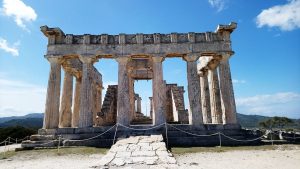
At the Temple of Aphaia on Aegina, the light seemed to possess an almost physical force. It did not merely illuminate the ruins. It moved through them, entered the intervals between the columns, sharpened the edges of the stone, and joined the temple to the sea, the sky, and the distant mountains of Attica. The building appeared less like an isolated monument than like an instrument designed to make the entire landscape visible.
Aphaia is peculiar in this respect. The sanctuary stands high on a pine-covered ridge in northeastern Aegina, suspended between enclosure and openness. The island rises beneath it, but beyond the ridge the world suddenly expands. Across the Saronic Gulf lie the coasts of Attica; farther away, Athens and the approaches to Cape Sounion belong to the same maritime horizon.
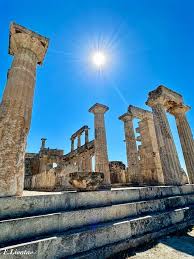
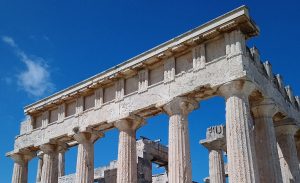
The temple therefore occupies not merely a beautiful location, but a commanding field of vision. Its Doric columns frame fragments of sky and sea. As one walks around the building, the landscape repeatedly appears, disappears, and reappears between the shafts. Stone alternates with emptiness; shadow alternates with brilliant light; the measured rhythm of architecture confronts the apparent infinity of the horizon.
This may be the special power of Aphaia. The temple does not dominate the landscape by overwhelming it. Instead, it gives the landscape order. The colonnade divides the immeasurable sky into intervals that the human eye can comprehend. The building makes the vastness around it intelligible without diminishing it.
The effect is intensified by the ruin’s condition. The ancient temple was once roofed, enclosed, painted, and considerably darker within its central chamber. What we encounter today is more porous. The lost walls and roof allow sunlight, wind, vegetation, and distant views to pass through the building. The surviving temple has become, perhaps even more completely than in antiquity, an architecture of light.
At Cape Sounion, the most beautiful sunset in Greece
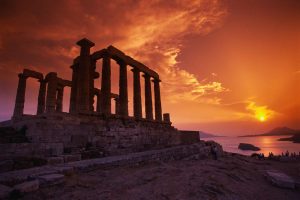
At Cape Sounion, the impression is different but equally powerful. The Temple of Poseidon stands at the final southern edge of Attica, where the land seems to end abruptly above the Aegean Sea. There, the architecture does not frame a sheltered island landscape. It confronts open water, powerful winds, and an immense horizon.
Sounion is famous, with good reason, for what may be the finest sunset in Greece. As the sun descends, the light becomes horizontal. It passes between the columns, warms the marble, lengthens the shadows, and turns the entire promontory into a theatrical threshold between land, sea, and sky. The temple seems almost to dissolve into the atmosphere.
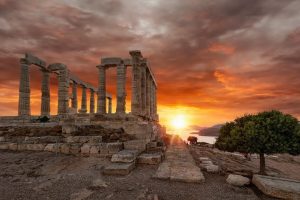
Yet the sunset is not simply picturesque. The location expresses the character of Poseidon himself. The sea below is beautiful, but it is also unstable, dangerous, and beyond human control. The temple stands above that elemental power as an image of permanence and order. Its vertical columns rise against the horizontal sea; its repeated architectural rhythm confronts the ceaseless movement of water.
At Aphaia, light binds island, temple, and distant coast into a harmonious unity. At Sounion, light stages a confrontation between human order and the immensity of the sea. In both places, the site is not secondary to the architecture. The site is part of the religious meaning.
This is what makes the selection of locations for ancient Greek temples seem almost superhuman. Our ancestors did not simply choose prominent hills because they were defensible, visible, or beautiful, although all those considerations mattered. They recognized places where the natural world already possessed a heightened character. The temple was then positioned so that architecture, landscape, movement, and light would intensify one another.
The building did not create the sacred place from nothing. It revealed what was already latent within it.
This principle can be seen throughout the Greek world. At Delphi, the sanctuary rises beneath the immense cliffs of Mount Parnassus, in a landscape that feels both protected and threatened by the mountains above it. At Olympia, the sacred precinct developed within a fertile plain associated with rivers, groves, athletic gathering, and pan-Hellenic identity. On the Athenian Acropolis, architecture occupies a rock that commands the surrounding city and the routes toward the sea.
Each sanctuary possesses a different topographic personality. None feels interchangeable. The Temple of Apollo at Delphi would lose its meaning if transferred to an ordinary plain. The Temple of Poseidon would be diminished if removed from the edge of the sea. Aphaia belongs to its ridge and to the maritime world visible from it.
The ancient Greeks appear to have understood that sacred architecture does not consist only of proportion, columns, sculpture, and technical refinement. It also consists of approach, altitude, orientation, distance, wind, horizon, and the movement of the sun.
One must therefore imagine the ancient experience not as a static view, but as a sequence. The worshipper approached the sanctuary along a path. The temple might first appear at a distance, disappear behind a slope or grove, and then emerge again from a more dramatic angle. As the visitor moved, the relationship between columns and landscape continually changed.
This moving encounter was fundamental because a Greek temple was not ordinarily a church in the later Christian sense. It was not primarily a large interior hall in which a congregation gathered. The central cult image was housed inside the temple, but much of the communal ritual took place outside, around the altar and throughout the sanctuary.
Sacrifice, prayer, procession, music, smoke, offerings, animals, and crowds all took place in the open air. The exterior of the temple and the surrounding landscape therefore carried immense religious importance. Sunlight was not simply a practical means of illumination. It belonged to the ritual environment.
The sacred experience spread outward
This helps explain why Greek temples can feel inseparable from their settings. The worshipper did not leave the natural world behind in order to encounter the god. The god was encountered through a particular manifestation of that world: Athena on the commanding rock of the Acropolis, Apollo beneath the cliffs of Delphi, Poseidon above the sea at Sounion, Aphaia within the luminous maritime landscape of Aegina.
The deity was not merely placed inside the landscape. The landscape disclosed the nature of the deity.
This extraordinary sensitivity to place has also given rise to a fascinating, if controversial, idea: that Greece’s greatest sanctuaries were deliberately connected by geometry. The Temple of Aphaia, the Acropolis of Athens, and the Temple of Poseidon at Sounion are often said to form a “sacred triangle.” Other researchers extend this network to Delphi and Olympia, noting that several of these major sanctuaries lie at remarkably similar distances from one another. Most strikingly, the distances from Aphaia to Delphi, Athens to Delphi, and Delphi to Olympia are all approximately 121 kilometers, a coincidence that has inspired decades of speculation.
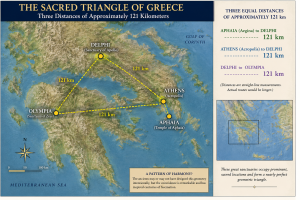
The theory is undeniably seductive. It seems to reflect the Greeks’ mastery of geometry and their profound concern with harmony, proportion, and cosmic order. Yet the archaeological evidence remains inconclusive. The celebrated triangle formed by Aphaia, Athens, and Sounion is not truly equilateral but approximately isosceles, and there is no surviving ancient text describing a coordinated geometric master plan linking the sanctuaries of Greece. The temples were built over many centuries by different city-states, making such coordination historically difficult to demonstrate.
Whether intentional or not, the geometric relationships point toward a deeper truth. Aegina, Athens, Sounion, Delphi, and Olympia were not isolated monuments but part of a shared sacred geography. They marked mountain passes, maritime routes, commanding promontories, fertile valleys, and places where the landscape itself seemed to invite worship. The Greeks possessed an extraordinary ability to recognize locations where architecture, topography, and light could reinforce one another.
The (Lack of) Light in Orthodox Churches
This becomes even more apparent when contrasted with the Orthodox churches that now dominate the Greek landscape. After the overwhelming brilliance of Aphaia and Sounion, entering an Orthodox church—such as the great Monastery of Saint Nektarios on Aegina—can feel like stepping into another spiritual universe. The heavy masonry, small windows, icons, incense, candles, and iconostasis create an interior of shadow and mystery.
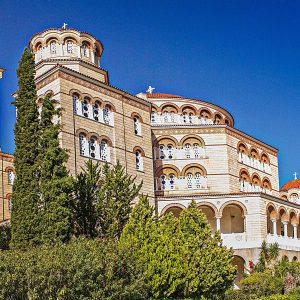
Yet this should not be understood simply as a contrast between light and darkness. The ancient Greek sanctuary celebrates divine presence through the openness of the natural world. The Orthodox church seeks the divine through interiority, mystery, and liturgical revelation. In the temple, light reveals the harmony of the cosmos; in the church, light is deliberately restrained so that a single candle, a golden icon, or a shaft of sunlight acquires profound spiritual significance.
The contrast reflects two different religious visions. The Greek temple organizes the landscape; the Orthodox church organizes attention. One invites the worshipper to encounter the divine through sea, mountain, sky, and horizon. The other invites an inward journey, where revelation emerges gradually through prayer, ritual, and sacred symbolism.
Standing among the columns of Aphaia, or watching the sun set through the colonnade of Poseidon at Sounion, one cannot escape the feeling that these locations were chosen with extraordinary intuition. Whether or not the famous geometric alignments were intentional, the true genius of the ancient Greeks lay elsewhere: they knew how to recognize places where architecture did not dominate nature but completed it.
Their temples do not merely occupy the landscape.
They make the landscape itself appear divine.
July 29, 2026, www.helleniscope.com
DISCLAIMER: The views and statements expressed in this article constitute constitutionally protected opinions of this author.
















Nick’s Lyrical writing brings the atmosphere of Greece to life. Very true indeed. Thanks for sharing your experience. And welcome back.
I remember well. Stupendous!
Nick, welcome back.
You express very eloquently what everyone experiences, consciously or unconsciously, when visiting sacred temples, whether ancient or contemporary.
The contrast you observe between Christian and pre-Christian temples with regard to the use of light is not coincidental. It’s an interplay between the mystery (what we do not know and cannot comprehend) and what has been revealed to us.
I remember a bishop visiting my church for the first time who commented repeatedly that we need more light. I know that Fotis Kontoglou also urged that icons be made with brighter colors.
Light is a huge part of our religious experience. In Western churches, sunlight penetrates stained-glass windows to give a bright image and a transcending effect. In Eastern churches, light is reflected off mosaic icons, giving a similar sparkling effect.
A beautiful icon from St. Catherine’s Monastery at Sinai uses a gold leaf with tiny grooves to depict a light ray that slides down from the sky onto Virgin Mary’s head. The artist literally creates motion with that light reflection, a bright spot that slides down.
For us, today, light takes a bigger meaning. We desperately need light (transparency) to stop the killing of our church from within.
Light! Boy, do we need it!
Nick, first of all, welcome back!
Regarding the “sacred triangle” which is more isosceles than equilateral, would you happen to know what actual ascending angles are? They eerily remind me of the Great Pyramid of Cheops?
Am I reading too much into this?
(Don’t get me started on the Great Pyramid! It’s got so many mathematical and geographic constants in it that boggles the mind!)
I wish I could help – but I am sure – if you are so interested in these math dimension – AI could help or even google… We know that ancients Greeks, starting with the Minoans, were in close contact with Egypt and learn a lot of their Math by the Egyptians. Later, they developed and advanced their math…. The close connection to Egu\ypt continued for centuries with the Library of Alexandria etc… So there must be a lot to learn if you start digging…