ΕΑΝ ΠΡΟΤΙΜΑΤΕ ΕΛΛΗΝΙΚΑ ΠΑΤΗΣΤΕ ΤΗ ΣΗΜΑΙΑ ΣΤΟ ΚΑΤΩ ΜΕΡΟΣ ΤΗΣ ΟΘΟΝΗΣ
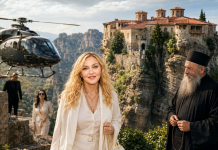
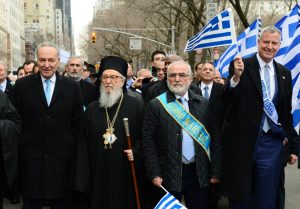
OUR MAIN PHOTO: Ivan Savvides parades as a Grand Marshall in 2017 on our Fifth Avenue Independence Day Parade. The Greek-American community offered a big thank you to the man who had reopened Panagia Soumela of Pontos.
How Ivan Savvides, Russian leverage, and reportedly Putin himself helped restore the August 15 Liturgy — and why Turkey now refuses to permit it on the Panagia’s feast day. For over half a century, Washington has offered useless promises about reopening Halki Seminary…
By Nick Stamatakis
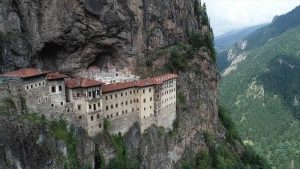
For a third year, the Neo-Ottomans of Ankara will allow Panagia Sumela to celebrate only on August 23 — the “Nine Days of the Panagia,” the leave-taking (Apodosis) of the Dormition — instead of August 15, the actual feast of the Dormition of the Theotokos.
This is no minor calendar adjustment.
For the Greeks of Pontos, August 15 and Panagia Sumela are inseparable. And what happened there on August 15, 2010, when Orthodox worship returned after an interruption of 88 years, was arguably the greatest symbolic advancement of the Ecumenical Patriarchate’s religious freedom in the history of the Turkish Republic.
Now Ankara is slowly diminishing it.
Panagia Sumela, founded according to tradition in the fourth century and flourishing under the Empire of Trebizond, survived even the Ottoman conquest of 1461. Its monastic life ended only with the destruction and expulsion of Pontos’ historic Greek Christian population in the early twentieth century. After 1923, Pontic Greeks could return only as tourists.
Then came Ivan Savvides.
Savvides was not merely a wealthy Pontic Greek businessman. He was a member of the Russian State Duma, affiliated with Vladimir Putin’s United Russia party, and one of the most influential representatives of Russia’s large Pontic Greek community.
Beginning in 2007, Savvides helped organize Orthodox pilgrimages to Sumela and pressed for the restoration of worship there. In November 2009, he personally raised the issue in Moscow with Mehmet Ali Şahin, then speaker of the Turkish Parliament. Russian Orthodox accounts subsequently credited Savvides with an exceptionally important role in the negotiations.
On June 8, 2010, Turkey finally authorized a Divine Liturgy at Sumela. Savvides met Ecumenical Patriarch Bartholomew shortly before the event to discuss preparations.
Then, on August 15, 2010, Patriarch Bartholomew celebrated the Divine Liturgy at Panagia Sumela for the first time since 1922.
Thousands came from Greece, Russia and throughout the Orthodox world.
For Pontic Hellenism, it was a resurrection.
Savvides, Putin and the Russian connection
There is another part of the story that should not be omitted simply because diplomacy of this kind rarely leaves a paper trail.
Informal accounts suggest that Savvides asked Vladimir Putin to intervene with Erdoğan — and that Putin did.
The account is entirely consistent with the politics of the period. Savvides belonged to Putin’s ruling party and had access in Moscow. Putin himself had already developed a strong personal connection with Orthodox Christianity and Mount Athos, which he has visited several times, mostly outside the framework of formal state ceremony.
No Kremlin transcript has surfaced documenting a Putin-Erdoğan conversation specifically about Sumela. But the broader sequence is clear: Savvides mobilized the Russian-Pontic connection, Moscow’s political weight reinforced the effort, Ankara moved, and the Liturgy returned.
That is the important point.
Russia achieved what Washington still has not
The contrast with Halki Seminary is striking.
Halki has been closed since 1971. For more than fifty years, American presidents, secretaries of state, ambassadors and religious-freedom officials have urged Turkey to reopen it.
Yet Halki remains closed.
At Sumela, Russian and Pontic pressure centered around Ivan Savvides — and, according to persistent informal accounts, reaching Putin himself — produced an actual result.
This does not make Putin a universal defender of religious freedom. Nor does it diminish Patriarch Bartholomew’s ecclesiastical role.
It simply shows that political leverage accomplished what decades of State Department statements have not.
How Ankara began taking the concession back
The weakness of the 2010 victory was that Sumela was never returned to the Ecumenical Patriarchate. It remained a Turkish state-controlled monument, with worship dependent on government permission.
That allowed Ankara later to change the rules.
The controversy intensified after Turkey moved its commemoration of Mehmed II’s 1461 conquest of Trebizond to August 15 — the same day Orthodox Christians have celebrated the Dormition for centuries.
The Church did not choose August 15 to provoke Turkey.
Modern Turkey placed its conquest celebration on the ancient Christian feast.
By 2023, Turkish nationalist and Islamist politicians were campaigning against the August 15 Liturgy. Ankara eventually allowed it that year, but from 2024 onward imposed a new formula:
Not August 15, but August 23.
The same happened in 2025 and now again in 2026.
August 23 is a legitimate Orthodox feast — the Apodosis of the Dormition, the “Nine Days of the Panagia.”
But the political meaning is obvious: the Christians may commemorate Panagia Sumela only after Turkey has commemorated Mehmed the Conqueror.
That is why the 2010 event remains so important. It was perhaps the single most symbolically powerful expansion of the Ecumenical Patriarchate’s religious freedom in modern Turkey, achieved to a remarkable degree through Ivan Savvides and Russian-Pontic political leverage.
Now Ankara is reducing that victory without formally abolishing it.
The monastery remains open. The Liturgy remains permitted.
But for the third consecutive year, not on August 15.
The Christians may return to their ancient sanctuary.
The Neo-Ottoman state will simply decide when.
August 18, 2026, www.helleniscope.com, n.stamatakis@aol.com
DISCLAIMER: The views and statements expressed in this article constitute constitutionally protected opinions of this author.