

ΕΑΝ ΠΡΟΤΙΜΑΤΕ ΕΛΛΗΝΙΚΑ ΠΑΤΗΣΤΕ ΤΗ ΣΗΜΑΙΑ ΣΤΟ ΚΑΤΩ ΜΕΡΟΣ ΤΗΣ ΟΘΟΝΗΣ
By Nick Stamatakis
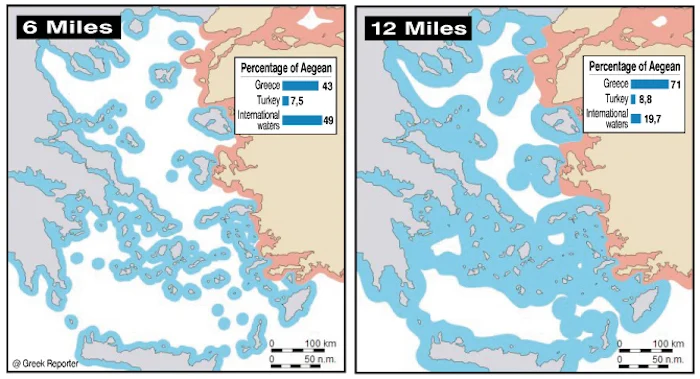
Greece’s announcement by FM Gerapetritis that it intends to expand its territorial waters to 12 nautical miles marks a decisive—if long delayed—moment in the Aegean. Presented officially as a lawful and measured exercise of sovereignty, the move also exposes decades of strategic hesitation, selective application of international law, and the enduring impact of fear-driven policy. As Athens finally signals normalization of its maritime rights, the announcement arrives in a world where legal frameworks are increasingly subordinated to power politics—and where the Aegean is once again becoming a testing ground for strategy rather than law.
In previous years, especially since 1995, under what can only be described as a phobic and risk-averse political leadership, Greece exercised its sovereign right to extend territorial waters only in the Ionian Sea, on its western flank. This produced a globally unique and legally incoherent situation: a state applying international law selectively, expanding its sovereignty where there was no adversary reaction to fear, while freezing its rights where those rights mattered most. No serious maritime power behaves this way.
The Aegean remained locked at six nautical miles not because of law, but because of intimidation—and because Greek political elites mistook restraint for strategy.
Today, Foreign Minister Giorgos Gerapetritis invokes international legality and environmental planning to justify what should have been done decades ago. The reference to the United Nations Convention on the Law of the Sea (UNCLOS) is legally sound—but politically hollow in a world where law increasingly follows power, not the other way around. And that world has changed dramatically.
After the latest geopolitical shocks emanating from Washington—particularly under Trump-era and post-Trump transactionalism—the notion that international law constitutes a binding framework has become largely ceremonial. From Ukraine to Gaza to the Red Sea, rules are invoked selectively, enforced inconsistently, and abandoned when inconvenient.
This is the strategic context in which Greece now finds itself.
Mediation, “Equity,” and the Erosion of Law
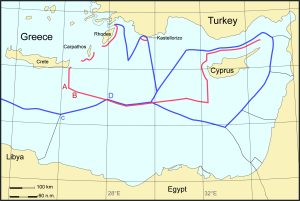
There is a growing likelihood that the West will attempt one final maneuver to keep Turkey anchored within its strategic orbit—not through pressure or deterrence, but through mediation. This effort would likely take the form of encouraging Greece and Turkey to enter negotiations over the delineation of their Exclusive Economic Zones.
Such mediation, however, is unlikely to be grounded in UNCLOS.
Instead, Greece may be confronted with the legally corrosive and globally anomalous notion of so-called “equitable distribution”—a political construct designed to dilute treaty law in favor of power balancing. This concept has no basis in UNCLOS, no grounding in customary international maritime practice, and no precedent among serious maritime states. It directly undermines the fundamental principle that maritime rights derive from sovereignty and law, not from bargaining leverage or geopolitical convenience. Greece must reject this concept unequivocally.
If the United States or its partners believe such a notion is legitimate, a simple question arises: why was “equitable distribution” never proposed when the United States delineated its own EEZs with the Bahamas, Cuba, or Mexico? Why is this “flexibility” never suggested in the South China Sea, where a continental power borders multiple island states such as the Philippines and Taiwan? Is Greece somehow a different—and lesser—“island nation” than the Philippines?
The selective resurrection of “equity” reveals its true nature: not a legal principle, but a diplomatic tool reserved for weaker actors. In practice, “equitable distribution” is an invitation for Greece to trade legality for the illusion of stability. History is unambiguous on this point: such exchanges never favor the state asked to surrender law in the name of balance. They merely postpone confrontation while institutionalizing disadvantage.
Turkey’s Strategic Calculus: Balancing—Until It Doesn’t
Turkey, meanwhile, is playing a longer and far more coherent game.
It will continue to balance between East and West:
Seeking the F-35s, it has already partially paid for
Attempting a workable settlement in Syria with Kurdish actors
Maintaining dialogue with Washington, and Brussels, and Russia
But these are tactical moves, not strategic anchors.
Turkey’s structural interests lie to the East:
Russian gas pipelines remain indispensable to its energy security
Chinese investments are deeply embedded in Turkish infrastructure and logistics
The emerging India–Israel–Greece strategic cooperation reshapes Eurasian connectivity in ways Ankara cannot ignore
Turkey is not drifting eastward—it is gravitating toward the east.
With nearly 90 million people, a robust industrial base, and one of the most productive indigenous defense industries in the wider region, Turkey is not a state that can be disciplined, isolated, or subordinated. It will not accept permanent strategic containment, nor will it submit to U.S.–Israeli regional domination—especially as its own leverage grows.
The 3+1 Factor—and Ankara’s Red Line
This is why the 3+1 framework—Greece, Cyprus, Israel, plus the United States—is viewed in Ankara with deep hostility. Not as a diplomatic alignment, but as a containment architecture.
Turkey does not oppose cooperation per se; it opposes exclusion.
And exclusion accelerates realignment.
Conclusion: Greece Must Choose Reality Over Comfort
Greece now stands at a familiar crossroads.
It can:
Invoke international law while behaving as though it will be arbitrated away
Or finally internalize the reality that law without power—and resolve—is merely narrative
Extending territorial waters in the Aegean is not an escalation. It is normalization delayed by decades of fear. At this historic juncture, Greece should not be afraid of Turkey’s “casus belli”. Greece’s Air Force, with scores of updated F-16 Vipers and two dozen Rafale fighters, is in control of the airspace over the Aegean. And the arrival of the new Belhara frigate, “Kimon”, enhances this control further. The likelihood of Turkey reacting militarily to Greece’s expansion of its territorial waters to 12 miles is reduced significantly.
The real danger lies not in Turkish reaction, but in Western “solutions” that ask Greece to compromise legality for illusory calm—while Turkey prepares, patiently and methodically, for a future that lies east of Europe.
January 17, 2026, n.stamatakis@aol.com www.helleniscope.com
DISCLAIMER: The views and statements expressed in this article constitute constitutionally protected opinions of this author.
TO SUPPORT HELLENISCOPE OR BECOME A SUBSCRIBER, LINK HERE!!
Sources
Reuters – Greece plans extension of territorial waters despite Turkish warning
https://www.reuters.com/world/middle-east/greece-plans-extension-territorial-waters-despite-turkish-warning-2026-01-16/Kathimerini – Greece to expand territorial waters, create second Aegean marine park
https://www.ekathimerini.com/politics/foreign-policy/1292535/Turkish Minute – Greece plans new expansion of territorial waters despite Turkey’s war threat
https://www.turkishminute.com/2026/01/17/greece-plans-new-expansion-of-territorial-waters-despite-turkeys-war-threat/Devdiscourse – Greece’s territorial waters expansion in Aegean: A potential flashpoint
https://www.devdiscourse.com/article/headlines/3772259















No doubt Greece has the law on her side, for expanding to 12 miles. But right does not make might. I doubt she’ll go ahead with that plan. If I were Turkey’s president, I would certainly fight Greece over the expansion. The Aegean is too small and has too many islands for 12 miles waters. The expansion on the Ioanian sea was no problem, because Italy is too far away. That’s not the case with Turkey. And the international court is not going to do a thing, if it comes to a war between Greece and turkey. The cop on the beat, America, is now absent and does not care, unless Trump sees a profit.
It’s a bit more complicated than that… The Law of the Sea provides of safe passage corridors for shipping and so there is no such a thing as a “closed sea”. Black Sea is a very closed sea, yet Turkey applied all the rules of the Law of the Sea there. There are many other closed seas globally where the same law applies. The law simply delineates sovereign rights on the bottom of the sea and the body of water above it. Before that law (UNCLOS), all countries followed the same principles to delineate their sovereign rights on the sea bottom. The new law covers activities such as fishing and this is a thorny issue as the Turks currently violate all laws and fish anywhere in the Aegean even close to Greek Iskands and coastal areas – less than 6 miles from the shore.
I am aware of the safe passage Turkey doesn’t worry about that. The international law means nothing to her. She worries about being closed in, with Greece having the upper hand so close to her land. One Belhara frigate is not gonna do it for Greece. The Black sea doesn’t have the islands that the Aegean has, so close to a separate country. It would be great if Greece could do that. But I can’t see any Greek government taking that risk. We had two catastrophes in our history. We don’t need another one.
The law principles are the same in the Black Sea, the Baltic, the Adriatic or the Aegean. If Greece had patriots instead of the traitors who now rule there wouldn’t be a question whether we will apply the Law of the Seas. The prime minister would inform the U.N. then NATO and the EU give a date and apply the law.
Nick, what you see Russia doing if Turkey goes ahead and successfully attacks Greece in the Aegean Sea?
The Russians will likely stay neutral. Their problem is with the puppet Mitsotakis government. They know the Greek people are friendly. Above all, they owe gratitude to the Greek shipowners who have helped them at a very critical time. They understand that these shipowners very much control power in Greece and one way or they other they will help bring Greece back to a more balanced political position. The shipowners, regardless of their individual egotistical attempts to control power – express in general the interests of Greece and Hellenism: open trade globally, peaceful relations with all nations.