


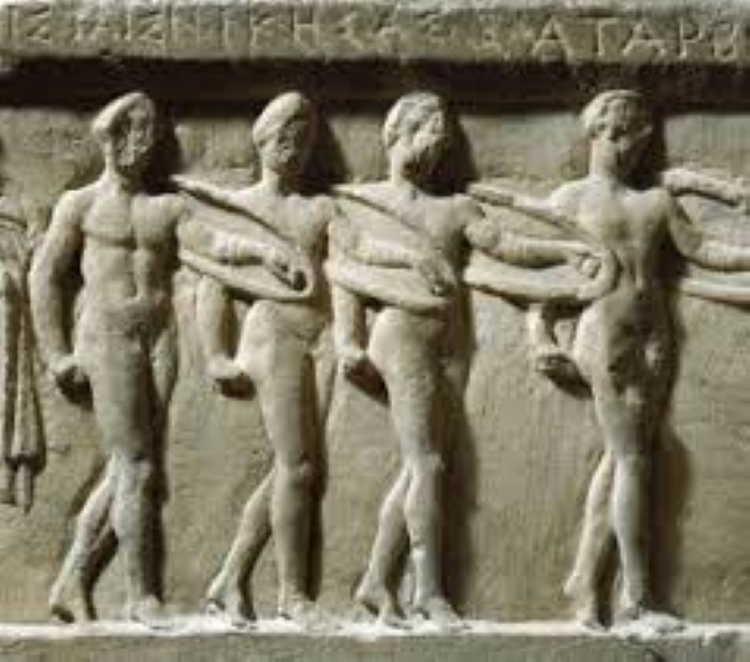
PHOTO: Ancient sculpture depicting Pyrrichios…
By Nick Stamatakis
A few weeks ago, in response to a reader’s comments, I hinted at the likelihood of the Greek origins of the Palestinians, at least partially. This is a huge issue, and it does not fit in the confines of a short post. First, we must understand that the trade between the Minoan and Mycenean civilizations (the first European civilizations who used writing) and Egypt (and Lebanon, Syria, and Palestine in the wider Levant) dates back to at least 2,500 years BC!! This means the Minoans and Myceneans were in Egypt a full thousand years before the Israelites arrived and were enslaved there… Multiple archaeological finds from Crete and the wider Middle East verify close contact with the Minoans. The hieroglyphics used in Egypt and early Crete reveal the same.
How about DNA studies? First, let’s get this out of the way: It has been proven that ancient Minoan DNA is closely related to modern Cretan DNA – especially to the residents of Lasithi in Eastern Crete. Also, Minoan DNA is similar to Mycenean and modern Greek DNA – and it is not connected to sub-Saharan African DNA. There is no direct connection to sub-Saharan Africa as some politically correct books (Bernal’s “Black Athena”) suggested 35 years ago. Studies about Palestinian DNA are so far inconclusive. Still, there are some strong suggestions that Palestinian DNA is related to the ancient DNA of peoples from the central and western Mediterranean. We do not expect an easy answer to this because for the last 3,000 years, Palestine has been subjected to multiple invasions, occupations, and population movements. One fact is certain: The population movement between Greek lands and Palestine is constant through the centuries. The last remarkable episode was during WWII when tens of thousands of Greeks moved there to escape the Germans mainly staying in Gaza.
We have more conclusive results by examining some non-linguistic cultural traits, such as dancing. We Greeks are known for our pride in our “Ancient Dances,” particularly the War Dances of the Pontian “Serra” and the Cretan “Pentozali,” both thought to originate in the ancient Greek war dance Pyrrichios. We call them the “3,000-year-old dances,” although we could also use 4,000 or 5,000 instead. Here is a ceramic miniature from the Archeological Museum of Heraklion, Crete (among the top five archaeological museums on Earth – I had the great opportunity in my early twenties to meet and spend a couple of days with its founder – now-deceased – archaeologist Manolis Sakellarakis. What an unforgettable experience!)…
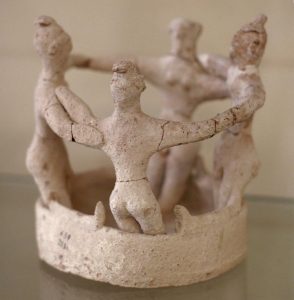
Here is another one – dated roughly around 2,000 BC….
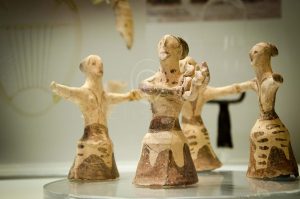
Below, in the first two videos, you can see Palestinians dancing their Dabkeh dance; they also believe it is a very ancient dance. Dabkeh (link here) is danced throughout the Levant (Palestine, Lebanon, Syria, and Jordan). The similarities of Dabke with the Pontian Serra and Cretan Pentozali are beyond amazing. The music, the dresses, the steps, the war attitude, the knives… Yes, the Greek dances are a bit more elaborate, but… I will stop here. Make your own evaluation… And yes, I watched dances from other Arabic countries and even some Kurdish, Persian, and Israeli dances… They have nothing in common with Dabke and the Greek dances…
December 8, 2023, n.stamatakis@aol.com www.helleniscope.com
DISCLAIMER: The views and statements expressed in this article constitute constitutionally protected opinions of this author.
TO SUPPORT HELLENISCOPE OR BECOME A SUBSCRIBER, LINK HERE!!
=====================
Below the Pontian Serra and the Cretan Pentozali…
















Αυτός είναι ξεκάθαρα Κρητικός χορός και αυτό είναι συνεπές με την ιστορία. Σύμφωνα με όσα ξέρουμε οι πρόγονοι των Παλαιστινίων, οι Φιλισταίοι, ήρθαν στην Παλαιστίνη το 1200 πχ. από την Κρήτη!
Yes, it looks that way. Unfortunately in the Middle East history is not just history. Historical facts that going back thousands of years are re-interpreted and mis-interpreted to serve current political goals. This phenomenon is global but in the Middle East it has a different, much stronger, effect. People are talking about their neighbors and their love or hatred towards them as if events that happened 2,000 years ago took place just yesterday.
Having said that I must underline that the image all Middle Eastern people have for us Greeks is positive beyond belief. Alexander the Great must be the only conqueror in history that is still today beloved from Greece all the way to India and Central Asia where he built Alexandria Eschata (“the last”) in modern Tajikistan. His name among all those people is “Iskander” and is universally referred to with adoration, admiration and love.
let’s also not diminish the importance of ottoman turks forcing subject populations to move to other regions they controlled. So captured Greeks would have been sent to the orient for turkish nefarious purposes. Just as converted muslims from the Balkans were sent to the regions. The notorious mübadele.
Forgive but don’t ever Forget the atrocities they committed–please say something positive towards our fellow Jewish brethren in Israel!
We all have seen that at least half of Israelis oppose this war and the genocide of the Palestinians. To take revenge is one thing, an eye for an eye is one thing but to kill massively and indiscriminately civilians with 500-lb bombs is atrocious.
Hamas will be defeated when a Palestinian state is established and guaranteed by international powers. Peace will come when Israel disavows any supremacy claims by its extremists.
Thanks so much for sharing Palestinian dancers with your readers. I watched a documentary made by John Pilger, filming in Palestine around 2000. The precious Palestinian culture center was destroyed by Israel. All the art was violated and feces was thrown all over the rooms. It was sad to see.