


ΕΑΝ ΠΡΟΤΙΜΑΤΕ ΕΛΛΗΝΙΚΑ ΠΑΤΗΣΤΕ ΤΗ ΣΗΜΑΙΑ ΣΤΟ ΚΑΤΩ ΜΕΡΟΣ ΤΗΣ ΟΘΟΝΗΣ
OUR MAIN IMAGE: An artistic rendition of the closeness of the “duo” Guilfoyle-Marafatsos
The Wall Street Journal (link here) follows Christos Marafatsos from Kimberly Guilfoyle’s diplomatic orbit to AKTOR’s energy business in Bulgaria. But federal lobbying records had already led Helleniscope to the same name (link here) — and to a wider network of Greek corporate clients paying his Washington firm.
What is the relationship of AKTOR CEO Mr. Exarchou to Greek PM Kyriakos Mitsotakis?
By Helleniscope’s Editorial Team
Today, September 25, The Wall Street Journal published a striking investigation into the man frequently seen beside U.S. Ambassador to Greece Kimberly Guilfoyle: Greek-American businessman and political operative Christos Marafatsos.
Just the WSJ title and subtitle are indicative: “The Mystery Man Shadowing Kimberly Guilfoyle as She Pushes Deals Across Europe” and Subtitle: Christos Marafatsos works as an energy lobbyist while also closely advising the U.S. ambassador to Greece
According to the Journal, Marafatsos has appeared so often at Guilfoyle’s side that some European officials reportedly assumed he was an embassy official — even her chief of staff.
He is not. He is a registered Washington lobbyist whose clients include major Greek corporate interests — most importantly for the Journal’s investigation, AKTOR Energy.
And that is where Helleniscope readers should feel a sense of déjà vu.
Weeks before the WSJ placed Marafatsos at the center of this story, Helleniscope had already followed the federal lobbying disclosures to his door.
WE HAD ALREADY FOUND THE PAPER TRAIL
In August, while examining the activities of Greece’s Public Power Corporation in the United States, Helleniscope reported that PPC North America had hired Catalyst Strategies LLC, with Christos Marafatsos listed as its registered lobbyist.
The question then was simple: why was a company still substantially owned by the Greek state paying a Washington firm to cultivate executive-branch relationships?
The records showed PPC North America paying Catalyst $60,000 through the second quarter of 2026.
But PPC was only one client.
Those clients included:
AKTOR Energy — $160,000
ONEX Technologies — $120,000
PPC North America — $60,000
ASMA Associates — $60,000
O&G International Ventures — $40,000
Across those filings, the named lobbyist was Marafatsos.
The paper trail was already there.
What the Wall Street Journal has now supplied is the scene behind the paperwork.
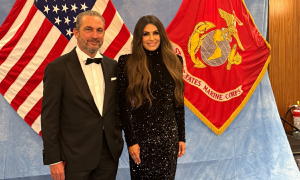
PHOTO: AKTOR CEO Alexandros Exarchou with Amb. Kimberly Guilfoyle
FROM WASHINGTON TO BULGARIA
The Journal’s investigation takes the story to Bulgaria, where Guilfoyle was promoting the Trump administration’s push to expand American LNG sales in Eastern Europe.
That policy itself is straightforward. Washington wants European countries to buy more U.S. gas and rely less on Russia. Greece is becoming an important gateway for moving LNG north through Bulgaria, Romania, Moldova, Ukraine, and neighboring markets.
But according to the WSJ, Guilfoyle’s advocacy became more specific.
The Journal reports that she encouraged Bulgarian officials to work with AKTOR Group.
Marafatsos sat beside Guilfoyle during a meeting with the Bulgarian president.
That matters because Marafatsos was not simply a political supporter traveling with a friendly ambassador.
He was AKTOR’s registered lobbyist.
Since when are American ambassadors assisted in official business meetings abroad by registered lobbyists?
READ THE FILING (link here)
AKTOR Energy retained Marafatsos’s Catalyst Strategies LLC beginning in late 2025.
The federal registration says Catalyst would engage with the State Department and executive branch, explain AKTOR’s projects and their relationship to U.S. priorities, build relationships, and continue communications to advance the company’s interests.
Marafatsos is the lobbyist listed on the filing.
The money followed:
$40,000 in Q4 2025
$60,000 in Q1 2026
$60,000 in Q2 2026
Total disclosed lobbying income from AKTOR: $160,000.
Put that filing next to the WSJ reporting and the issue becomes clear.
The man paid to advance AKTOR’s interests with the U.S. executive branch was, according to the Journal, also present at high-level diplomatic meetings where AKTOR’s commercial interests were discussed.
That does not establish illegality or a quid pro quo.
But that overlap is precisely what the Journal is investigating.
THEN THERE IS THE PRIVATE JET
The most eye-catching detail in the Journal’s report is that AKTOR CEO Alexandros Exarchou flew Guilfoyle to Bulgaria aboard a private jet.
Exarchou is not a peripheral player. He is chairman and CEO of AKTOR Group and a central figure in the company’s rapidly expanding LNG business.
So the sequence described by the Journal is worth laying out plainly:
AKTOR is building a major regional energy business.
It pays Marafatsos’s lobbying firm to cultivate relationships in the executive branch and advance the company’s interests.
Marafatsos becomes a frequent presence around the U.S. ambassador.
AKTOR’s CEO flies that ambassador to Bulgaria aboard a private aircraft.
The ambassador then promotes the American LNG agenda there and, according to the Journal, encourages Bulgarian officials to work with AKTOR.
Marafatsos attends a meeting with the Bulgarian president.
The Journal is documenting a situation in which the boundary between official U.S. diplomacy and private corporate representation became unusually blurred.
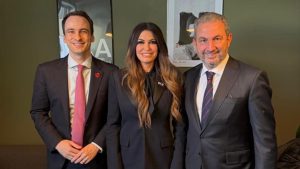
PHOTO: Science Advisor to the President, Mr. Kratsios, Amb. Guilfoyle, AKTOR CEO Mr. Exarchou
WHY AKTOR MATTERS
AKTOR is no longer merely the large Greek construction company many readers remember.
The group is aggressively expanding into LNG.
Its Atlantic SEE LNG Trade venture, owned 60% by AKTOR and 40% by DEPA Commercial, is designed to import American LNG into Greece and move it north through the so-called Vertical Corridor.
In June, the venture doubled its long-term agreement with U.S. exporter Venture Global to at least 1 million metric tons annually for 20 years beginning in 2030.
That creates an important counterpoint.
AKTOR’s commercial strategy is genuinely aligned with declared U.S. policy.
Washington wants more American LNG sold into Europe.
AKTOR wants to distribute American LNG across Southeastern and Eastern Europe.
Those interests can legitimately overlap.
The harder question the Journal raises is why broad U.S. energy policy appears, in some meetings, to have become advocacy for one particular Greek commercial operator, while that operator’s paid lobbyist enjoyed exceptional access to the ambassador.
THE EXARCHOU–MITSOTAKIS CONNECTION
The AKTOR story also has an important Athens dimension. Alexandros Exarchou has emerged during the Mitsotakis years as one of the most prominent corporate operators in sectors where government policy matters enormously — infrastructure, banking and energy. Together with shipowners Dimitris Bakos and Ioannis Kaymenakis, he took control of Intrakat and then acquired AKTOR, building a group with a public-works backlog measured in the billions. AKTOR itself described the trio’s strategy as an effort to become a leading player in infrastructure and public-private projects in Greece and Southeastern Europe.
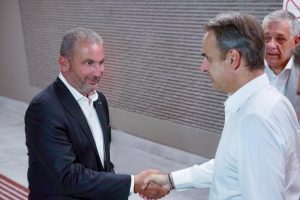
PHOTO: AKTOR CEO Mr. Exarchou with PM Mitsotakis
The relationship with the government is especially visible in banking. Exarchou, through Thrivest, became a central private investor in the restructuring of Attica Bank and Pancreta Bank into the country’s so-called “fifth banking pillar” — a project Mitsotakis publicly supported. Exarchou himself called the prime minister’s backing “extremely important.” The subsequent agreement committed up to €475.1 million from the state-controlled HFSF and up to €200 million from Thrivest, with Thrivest positioned to hold a controlling stake after the restructuring. The HFSF says the arrangement followed an international market-sounding process that failed to attract another investor, an important part of the government’s defense of the deal.
The record shows a close convergence of interests: Exarchou’s business empire has expanded rapidly across government-sensitive sectors while Mitsotakis’s administration has promoted many of the same infrastructure, banking and energy priorities. Their public proximity continues: in August 2026, Mitsotakis and Exarchou appeared together at the inauguration of the Kalamaria extension of the Thessaloniki Metro, where Exarchou participated as chairman and CEO of AKTOR.
MARAFATSOS’S BROADER NETWORK
AKTOR is only one piece of the story.
Marafatsos has spent years building relationships in Republican and Greek-American political circles and has held leadership roles in Greek-American organizations supporting Donald Trump.
His lobbying business then placed him at the intersection of major Greek corporate interests and the U.S. executive branch.
Besides AKTOR, Catalyst’s filings identify clients including PPC North America, ONEX Technologies, ASMA Associates and O&G International Ventures.
Does Marafatsos have other benefits in Greece beyond his lobbying fees in DC? We can only wonder…
The filings repeatedly describe efforts to establish relationships with departments including State, Energy and Interior and to advance the clients’ interests before the executive branch.
That makes the story bigger than one meeting in Sofia.
Marafatsos had built a portfolio of Greek-linked businesses operating in sectors — energy, shipbuilding, infrastructure and strategic investment — that overlap heavily with U.S. foreign-policy priorities.
==================
A useful timeline
The chronology makes the overlap easier to see:
- Late 2025: Aktor Energy retains Catalyst Strategies; Marafatsos registers to lobby U.S. executive agencies on Aktor’s behalf. LegiList
- Q4 2025: Catalyst reports $40,000 from Aktor. Congress.wiki
- Early 2026: Aktor/DEPA’s Atlantic-SEE begins commercial U.S.-LNG activity through the Vertical Corridor.
- Spring 2026: According to WSJ, Aktor CEO Exarchou flies Guilfoyle to Bulgaria on a private jet; Guilfoyle encourages Bulgarian officials to work with Aktor; Marafatsos participates in high-level meetings while being Aktor’s registered lobbyist. The Wall Street Journal
- April 28: Guilfoyle participates in the Albania signing involving Aktor LNG USA and Venture Global. CNN
- Q1/Q2 2026: Catalyst receives another $120,000 in disclosed Aktor lobbying income. Congress.wiki
- June 11: Aktor/DEPA’s Atlantic-SEE doubles its 20-year Venture Global LNG commitment to at least 1 million tons a year. Venture Global LNG
- June 24: Guilfoyle says she personally brought Aktor CEO Exarchou together with a U.S. DFC delegation to discuss support for critical-infrastructure investment. Euro2day
- July 20: Aktor’s Q2 lobbying disclosure is filed, bringing reported Catalyst income to $160,000.
=========================
WHAT HELLENISCOPE KNEW — AND WHAT WSJ ADDED
The distinction matters.
Helleniscope did not previously report the Bulgarian presidential meeting. Nor did we have the Journal’s reporting that Guilfoyle specifically urged Bulgaria toward AKTOR, or the private-jet detail involving AKTOR CEO Alexandros Exarchou. Those are significant new findings by The Wall Street Journal.
What Helleniscope had already uncovered was the architecture beneath the story: Christos Marafatsos, Catalyst Strategies, the federal lobbying registrations, the outreach to the State Department and executive branch, and the Greek companies paying for that advocacy—including, specifically, PPC North America’s decision to hire Marafatsos’s firm.
Now, The Wall Street Journal has followed that trail from Washington into the rooms where diplomacy and billion-dollar energy deals converge.
THE QUESTIONS NOW
No evidence presently available establishes that Guilfoyle took money from AKTOR, that Marafatsos secretly held a government post, or that authorities have concluded any law was broken.
But the transparency questions are unavoidable.
What exactly is Marafatsos’s role in relation to Ambassador Guilfoyle?
When he attends diplomatic meetings, do foreign governments know he represents private commercial clients?
Does Marafatsos hold any U.S. government security clearance or official advisory role? And when he participates in diplomatic meetings, what safeguards govern his access to sensitive or nonpublic information?
When those clients have a direct financial interest in the subject being discussed, is that relationship disclosed?
What were the terms of the private flight to Bulgaria?
Who paid?
Was there reimbursement or ethics approval?
And when U.S. officials promote the Vertical Corridor and American LNG, how do they ensure that U.S. policy is not perceived as favoring one particular commercial intermediary?
The Wall Street Journal has now taken those questions onto the international stage.
Helleniscope had already found part of the ledger.
Now the story is about what access that ledger may have helped secure.
September 25, 2026, www.helleniscope.com, n.stamatakis@aol.com
DISCLAIMER: The views and statements expressed in this article constitute constitutionally protected opinions of this author.













Wow! Helleniscope hot on the trail. Looking forward to more on this intriguing story
Interesting that the WSJ missed an important detail…While European Natural Gas prices have nearly tripled year to date, United States Natural Gas have remained stagnant…it is quite reasonable to believe that the once upon a time “pricey” US LNG is now “attractive” for Europe, presenting an interesting opportunity for “economic arbitrage” for these Greek companies….but it would be interesting to see how much LNG tanker capacity is diverted from the Persian Gulf to the “Gulf of America” to load it up…and even more interesting to see if that “diversion” would affect European prices in a “downward” manner, or if the price remains constant, with Greek companies “pocketing” the rest. Please remember that the Greek Power Company relies more on Natural Gas and less on Lignite for power generation these days…hint hint?
And of course, lobbyists are always useful to influence an administration that has already contemplated banning the exportation of Diesel, so that the lucrative “US LNG” doesn’t suffer the same fate…
Another interesting trend though, is that Greek surnames ending in “os” appear to be preferred for gaining access to high-ranking officials in Washington D.C. (Karloutsos, Marafatsos, Kratsios, etc..) :)