



EDITOR’S NOTE (Nick Stamatakis). Having spent much of my professional life around sponge fishermen and divers through my business, I’ve developed a special affection for Sophia Loren, especially in her 1957 debut in Boy on a Dolphin. Not that I was not instantly attracted to her beauty when I first saw the movie…
Set against the stunning backdrop of the Greek island of Hydra, Boy on a Dolphin marks Loren’s dazzling English-language debut. She plays Phaedra, a fiercely independent sponge diver whose life takes a dramatic turn when she discovers a sunken statue of a boy riding a dolphin—an artifact believed to hold immense historical and monetary value. Caught between her loyalty to her heritage and the lure of wealth, Phaedra becomes entangled in a moral struggle involving a principled American archaeologist (Alan Ladd) and a cunning art collector (Clifton Webb).
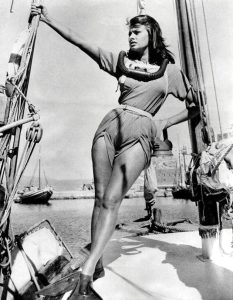
The film is as much a visual feast—with its luminous Mediterranean scenery and underwater sequences—as it is a testament to Loren’s magnetic screen presence. Am I the only one who thinks Sophia Loren is più Greca che Italiana—more Greek than Italian in this movie, and in general?
The movie made a glorious comeback in Greek cinemas just last month. Among its many pleasures is a scene where Loren sings the beloved 1950s Greek song, “Τι είναι αυτό που το λένε αγάπη”, still astonishing audiences with her artistic flair and remarkably authentic Greek accent.
To whet your appetite, you can watch that iconic moment here, followed by the full film below. This is Helleniscope’s perfect treat for a hot summer weekend… especially after a week of such grim news. We all deserve a little beauty and a moment of escape.
BELOW YOU CAN WATCH THE FULL MOVIE – VERY ENJOYABLE EVEN IF YOU HAVE SEEN IT BEFORE…
July 11, 2025, n.stamatakis@aol.com www.helleniscope.com
TO SUPPORT HELLENISCOPE OR BECOME A SUBSCRIBER, LINK HERE!!
=============
===============
The Film That Put Greece on the Hollywood Map Makes a Glorious Comeback in Cinemas
A landmark 1957 production that brought Greece to global audiences returns to the big screen—restored, radiant, and rooted in history. Here’s everything you need to know — and where to watch it.
Related Article

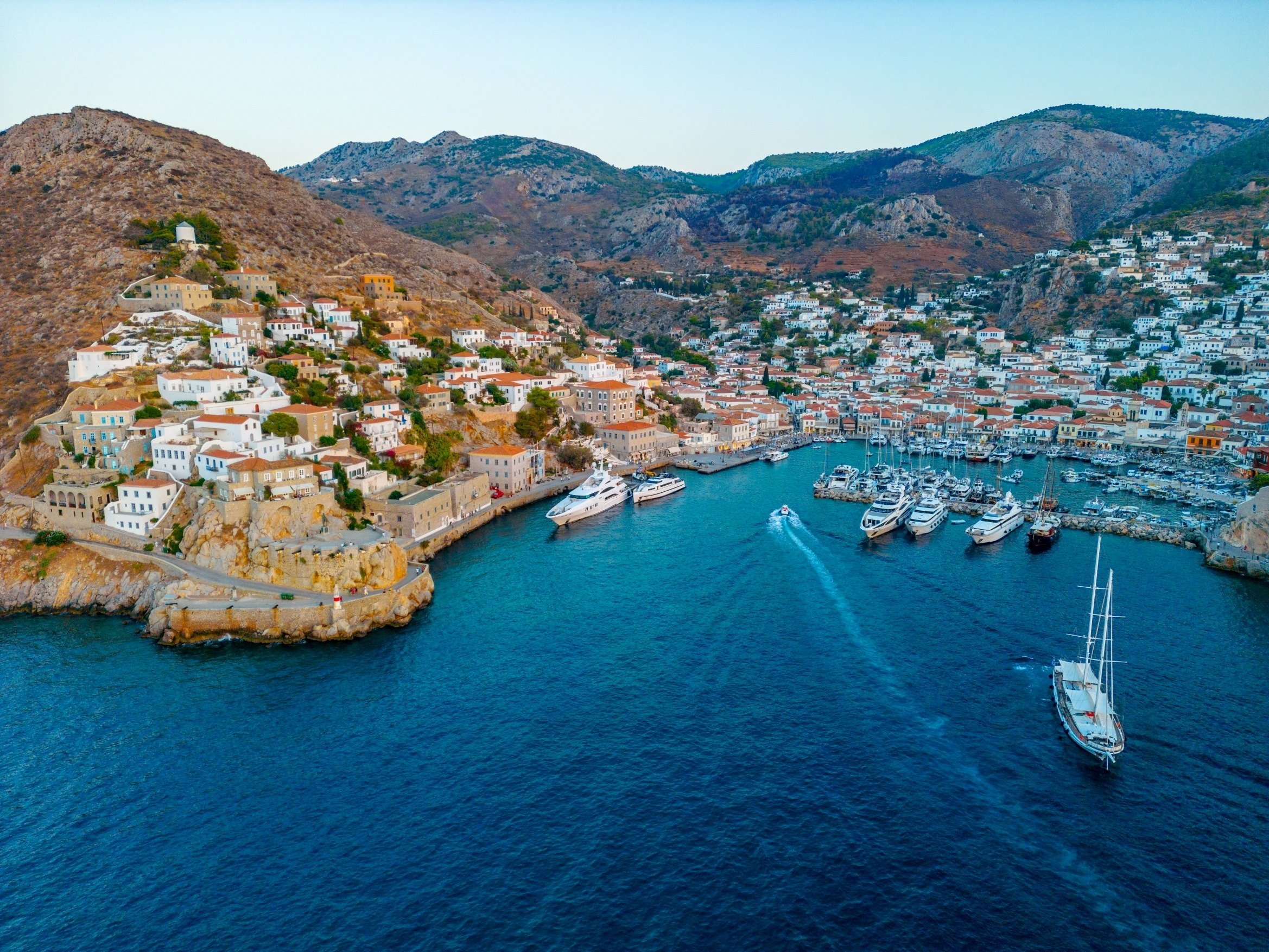
What Brought Sophia Loren to Hydra? A Story of Hollywood, Diplomacy, and Destiny
Long before the Greek islands became cinematic shorthand for paradise — and decades before international studios lined up to shoot blockbusters on their shores — one bold production brought the marble ruins, sapphire seas, and sun-bleached villages of postwar Greece to the world’s movie screens.
At its center: a bronze statue glinting beneath the waves, a sponge-diving heroine in search of a better life, and a love story tangled in politics, beauty, and betrayal.
And this summer, nearly seven decades later, that landmark film returns to Greek cinemas, newly restored and more radiant than ever.
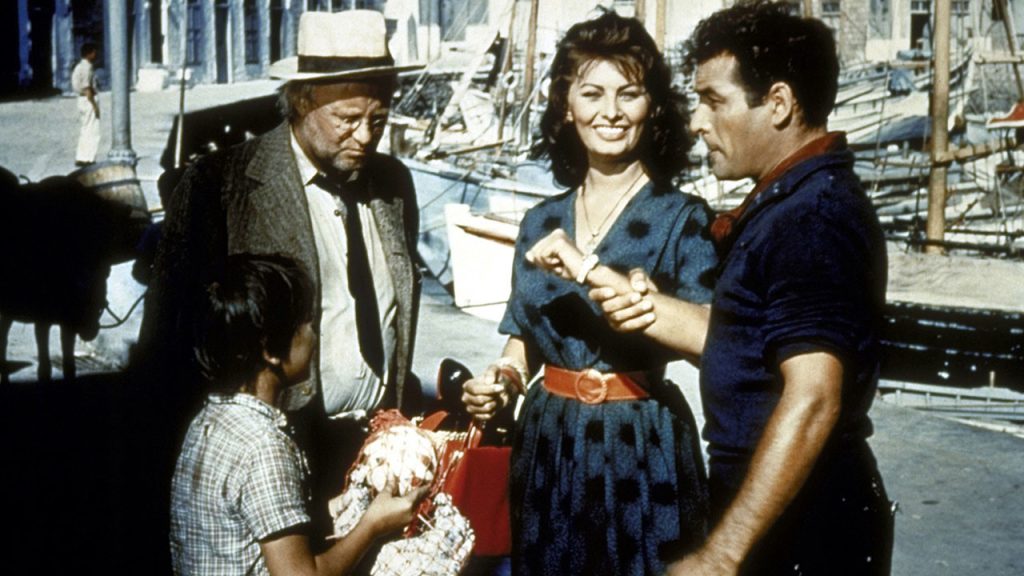
A Daring Dive into Greek Waters
Directed by Jean Negulesco and based on the 1955 novel by David Divine, this was the very first Hollywood film shot in Greece, a cinematic leap that would change how the world saw the country — not just as a cradle of civilization, but as a living, breathing setting for drama, romance, and golden-age glamour.
Filmed largely on the Saronic island of Hydra, with glimmering glimpses of Athens, Rhodes, Delos, and even the mist-shrouded monasteries of Meteora, the movie unfolds against the dazzling backdrop of the Aegean.
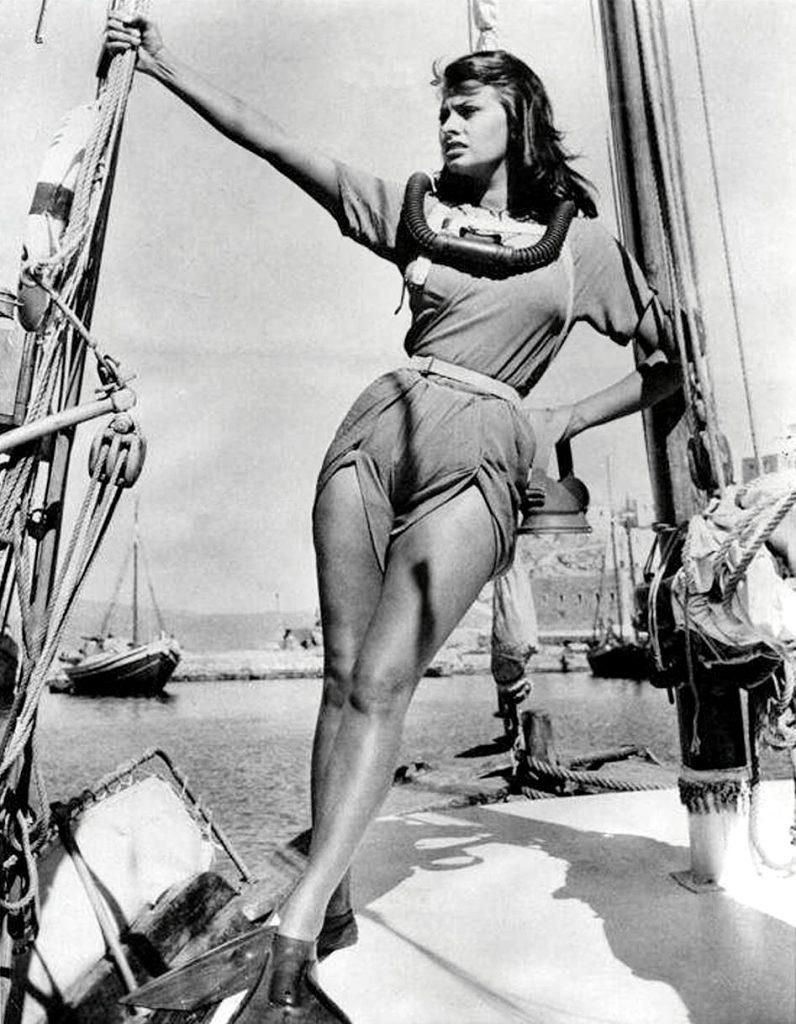
At the heart of its story is Phaedra, a strong-willed sponge-diver who chances upon an ancient statue of a boy riding a dolphin. Her find becomes a prize fiercely contested between two men: an American archaeologist devoted to cultural heritage, and a suave millionaire collector with private motives.
Starring a 22-year-old Sophia Loren in her English-language debut, alongside Alan Ladd and Clifton Webb, the film gave global audiences not only their first real glimpse of Greece in Technicolor but also one of the era’s most unforgettable on-screen presences.
In case you didn’t already guess the film’s name it’s: Boy on a Dolphin.
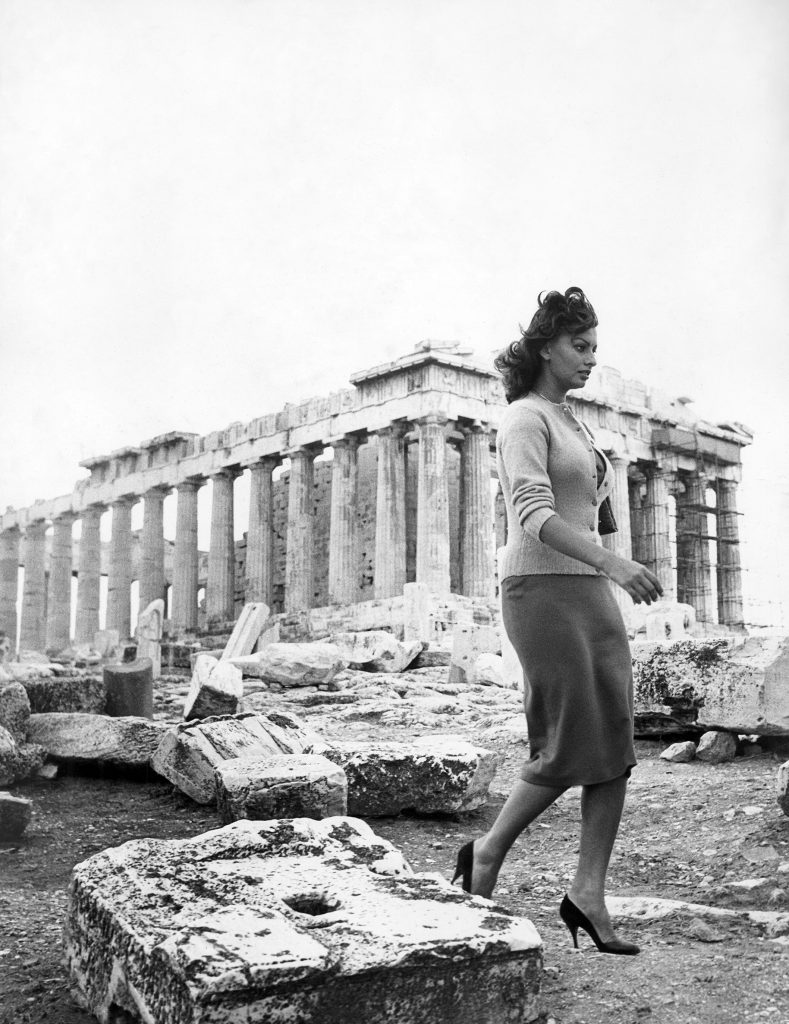
Italian screen star Sophia Loren on the acropolis, with the Parthenon in the background, during a sight-seeing tour of Athens, Greece, Sept. 17, 1956. She is in Athens for scenes of the film Boy on the Dolphin, in which she co-stars with Alan Ladd and Clifton Webb. Scenes are to be shot in the Aegean Sea. (AP Photo)
Between Myth and Modernity
More than a romantic caper, Boy on a Dolphin is steeped in themes that still resonate — national identity, the ethics of cultural ownership, and the timeless allure of the Greek landscape. Greek actor and director Alexis Minotis (husband of Oscar-winner Katina Paxinou) plays the role of a government agent tasked with safeguarding the statue for the Greek people, grounding the film in real questions about antiquities, tourism, and Greece’s place in a changing world.
A Score That Swims Beneath the Surface
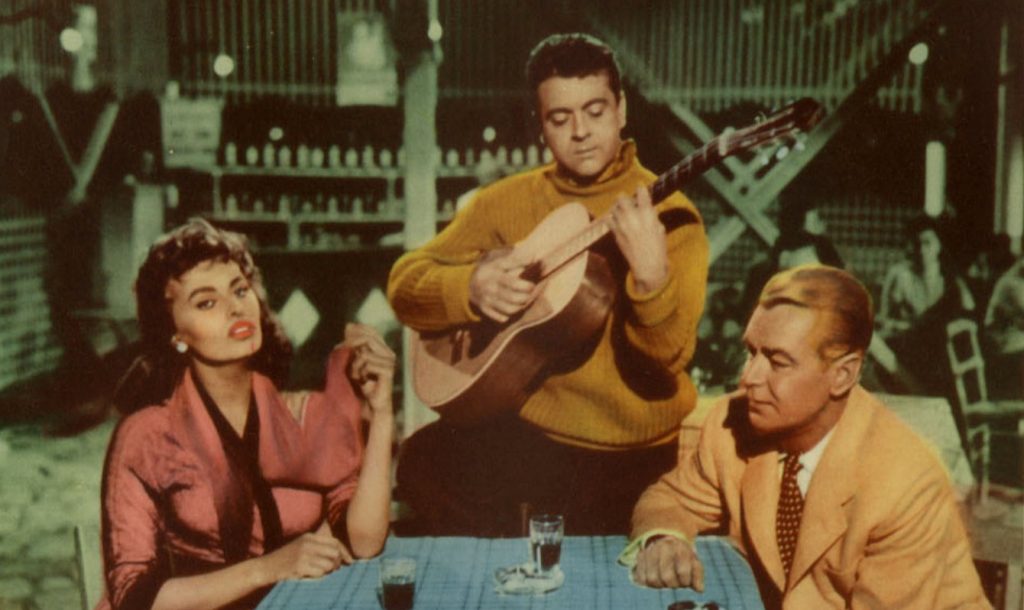
Composer Hugo Friedhofer, a cellist turned film composer, created a lush, shimmering score that earned him an Academy Award nomination for Best Music in 1958. In one unforgettable moment, Loren sings the 1955 Greek hit “Τι ’ναι αυτό που το λένε αγάπη” (What is This They Call Love) alongside Tonis Maroudas, adding authenticity and local color to an already atmospheric film.
That melody was the very foundation for the film’s English-language theme. Reimagined with lyrics by Paul Francis Webster and sung by Julie London, it became “Boy on a Dolphin”: the same haunting tune, now transformed into a sultry ballad that accompanies the film’s signature underwater diving scene, echoing with waves, longing, and quiet heartbreak.
The world premiere took place on April 10, 1957, in New York City, not just as a cultural event but as a diplomatic gesture: a benefit for Queen Frederika’s Fund for Greek Orphans, reinforcing Greece’s soft power in the postwar world.
Screening in Greece, Once Again
Now, for the first time in years, Boy on a Dolphin returns to the country that gave it its soul.
The newly restored version will screen exclusively at Cine Paris in Athens on June 19, with additional screenings to follow in selected cinemas across the country.
For tickets to the Cine Paris screening please go here. More updates will follow soon on the additional screenings.
















I cannot help wondering how Sophia Loren managed to walk around the Acropolis grounds in high heels!
Unlike most actresses Sophia Loren truly was unique, an Italian walking work of art!
And humble in her gratitude + loyalty toward that old ugly husband who made her famous.
As teenager, I went to drama school, the Stella Adler Conservatory + we watched many old films… the one thing legendary old Stella Adler would repeat on us was “Darlings, dare to be yourself – dare to be outrageous!”
Years later, after she died I was gifted a book on her life + discovered how spiritual she was + her reverence for the Russian Royal family.
She’s still alive, aged 90
A timeless, classic beauty…..one of a kind and unforgettable. No other woman today comes even close to her. And yes, she was more Greek than Italian; più Greca che Italiana…
“una faccia, una razza” especially Greeks from the Ionian….
She looks very classic Italian
She’s a Napolitano
I would not think she’s Greek
By looking at her
Only that Napoli (true Geeek name is “Neapolis”) was a Greek colony established at about 900 BC by settlers from Kymi (Euboea) – not far away from Athens…
She is more Greek than I can desrcibe…
Even today in soccer fields and everywhere else, Napolitans proclaim proudly their Greek origins… The same as citizens of Marseille and Nice in the south of France…
Alan Ladd and his fellow leading men in this marvelous film got a little boost from Hollywood’s best-kept secret: Boxes. Meanwhile, Sophia Loren did her part by filming in trenches — all to disguise the fact that La Loren could look down on them without heels. Now that’s movie magic with a wink! Of course Ladd was perfect as the enigmatic gunslinger in “Shane”. Jack Palance too…
Shane, one of the best Westerns ever made!
I visited Hydra last month when I was in Greece. Great island! I want to spend few nights on the island in the future. It is quiet, low key, and alot to experience.