
By Eleni Phufas-Jusma
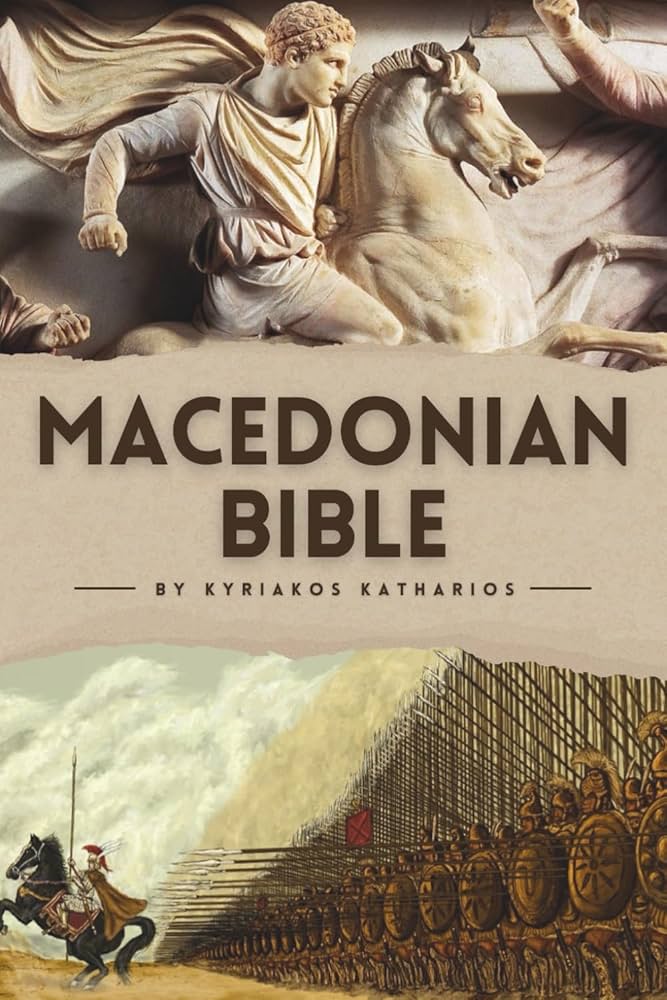
Macedonian Bible by Kyriakos Katharios is a groundbreaking work on the Macedonian question, a subject that has shaped world history for millennia. Translated into English by Eleni Phufas-Jousma, the book synthesizes historical insight with the personal experience of an author who has devoted his life to defending the integrity of Greece and its people. Katharios, an activist and writer based in Greece, writes with both passion and conviction, offering readers a powerful entry point into this pivotal issue. Helleniscope discusses his life and most important issue for him – the topic of Macedonia. This book is available on Amazon.com
Q: Kyriakos, can you tell us a bit about your childhood? Your parents?
About my childhood … I was born in 1964 in Kechrokampos, near Kavala and grew up there. It was just a village then of about 800 inhabitants and today there are fewer than 200. We always had horses, 5 to 6, and huge shepherd dogs…it was and idyllic but hard life. I grew up in the family business, and life was demanding. As kids, we were taught to handle shotguns from the age of about eight or ten, because our herd was often attacked by wolves and we had to know how to deal with them. We also became strong riders early on—learning to gallop bareback, without saddles or bridles—just like the Native Americans we used to see in Western movies. At the same time, I discovered a love for reading. As I got older, that passion grew, and I started buying and collecting books of my own.
Q: How many books do you have today?
Well, nowadays I have a rich library with over five thousand books.
Q: What are the cultural values you received from your family?
From my parents and grandparents, I inherited the core values of honesty, bravery, and love for one’s country. Both of my grandfathers, as I mention in my latest book Macedonian Bible, lived those values through their actions. My grandfather Nikolaos Katharios fought in the Macedonian Struggle, the First World War in Macedonia, the Battle of Skra, the Asia Minor campaign, and later in the Second World War, where he also joined the EAM-ELAS resistance. My other grandfather, Kyriakos Georgiadis, fought on the Albanian front and later took part in the nationalist resistance of Fostidis during the Bulgarian occupation. Their lives and sacrifices passed down to me not just as stories, but living examples of courage and dedication.
Q: You’re describing harsh and difficult times
Yes of course. During the occupation, both of my grandfathers’ homes were set to flames—one by the Germans in Kleisoura of Kastoria, the other by the Bulgarians in Kastanoto of Xanthi. In Kleisoura, my grandmother Aspasia lost 22 members of her family in a single day. In Kastanoto, my grandfather Kyriakos—whose name I carry—and his family escaped death by sheer luck, while 15 of their neighbors were executed before their eyes. I grew up with these stories, not as distant history but as living wounds and lessons, shaping my sense of who we are and the values I hold to this day.
Q: Tell us about your education – What did you originally want to study at the university?
Archaeology… Walking in our mountains with our flocks, I would see the ancient castles (there are three in my area), ancient tombs and human bones in the middle of nowhere, ancient wells, but also cobblestones, as well as stone walls that held back fertile soil that was cultivated by the previous inhabitants. I wanted to investigate them as I tried to imagine the ancient inhabitants building them, burying their dead, talking to each other, fighting and all that…
On Mount Pangaion and in the Rhodope Mountains, archaeologists have uncovered caves, altars, and inscriptions linked to the cult of Dionysus. These modest ruins suggest sites of ecstatic worship and prophecy rather than grand temples. They reflect the wild, mystical character of Dionysian religion rooted in the mountains of Macedonia and Thrace. I was especially impressed with the castle with the huge stones on the walls, which I am convinced is the lost Oracle of Dionysus… I missed being able to pursue archaeology by a few points on the entrance exams, so I studied Economics of the Law School of Thessaloniki… I was a good student, graduating with excellent grades. I published my studies in the reputable economic journal Oikonomikos Taxidromos at the time, but I was not professionally involved in the field of study. Studying Economics helped me not only in my business life but also in making sense of Greece’s finances — the financial crisis, the bailout agreements) which were imposed on Greece by the so-called “Troika”, and everything that led to the country’s economic and demographic collapse.
Q: You are well known in Greece for your participation in the Yugoslav wars during the US’s Clinton administration on the side of Serbia. What motivated you to get involved?
In Thrace, I observed a growing problem with the Muslim population, which was being influenced and guided by Turkey through its consulate. I feared that, at some point, Turkey—taking advantage of both the demographic majority of Muslims and the Pomaks, who were being gradually Turkified with Greek acquiescence—would demand autonomy, just as the Bosnian Muslims had done. Such a move, I believed, could create the conditions for war. By fighting on behalf of the Serbs, I understood that I was, in essence, defending my own homeland against Turkish ambitions.
Q: Your most recent book Macedonia Bible is now available in English. How did you first hear or learn about the subject of Macedonia issue?
My first contact with the Macedonian Question came from the stories of Grandfather Nikolaos Katharios… His meeting with Pavlos Melas in 1904, the huge impression that Melas made on him, all these we heard like fairy tales from a very young age and as I grew up I began to investigate the Macedonian problem.
Q: For those not acquainted with Pavlos Melas can you describe him in a few words?
Pavlos Melas was an officer of the Greek army and one of the leading figures who believed in the struggle against Bulgarian influence in Macedonia. Living in Athens, he traveled three times to Ottoman-occupied Macedonia in 1904—first in March, then in July, and finally in August—where he shaped his conviction that armed resistance was necessary. In August, he entered Macedonia with an armed band and began fighting both Bulgarians and Turks under the nom de guerre Mikis Zezas. His guerrilla corps was composed of Cretans and Macedonians.
On October 13–14, 1904, during a clash with Ottoman forces in the village of Statista (today part of the Municipality of Kastoria), Melas was killed. His death marked the true beginning of the Macedonian Struggle, stirring Greece with fierce determination. Inspired by his sacrifice, Greek officers and volunteers from across the country poured into Macedonia, forming armed units that confronted and ultimately halted Bulgarian efforts to Slavicize and Bulgarize the region. With his martyrdom, Pavlos Melas entered immortality in Greek history.
Q: Yes, Melas is a historical figure of immense importance. So then was there anything else that motivated you to research and become involved in the Macedonia issue?
Yes. As a student, a fellow student of mine, had invited me and hosted me in his village in Xiropotamos, Drama, where for the first time I was introduced to an acquaintance of my fellow student with a Macedonian conscience but not a Greek one… When I mentioned to him that part of my origin was from Kleisoura, Kastoria, he asked me “so that is, you’re a native?” I replied “native Macedonian” and he started speaking to me in Bulgarian…. I tell him “What is this Bulgarian you’re talking?” and he replied, “it’s not Bulgarian, it’s Macedonian.” “Macedonian is Greek, I responded. Not Bulgarian.” He then reacted in a menacing way so I grabbed him and my classmate got in the middle to separate us.
Q: For those who may not know the background of the conflict – Why was this man so upset? Can you explain this a bit more?
During the Macedonian Struggle (1904–1908 and during WWII, while allied with the German axis, Bulgaria promoted claims over Macedonia. Kleisoura became a battleground in the Greek–Bulgarian struggle over Macedonia.
I met others later — very fanatical people — and that’s how I wanted to learn a lot more about the Macedonian issue, starting from ancient Macedonia, so that I could personally deal with their propaganda …
Q: Were you able to find the information you needed to make your argument?
It is not at all easy to learn about the Macedonian issue… History is vast with many aspects that you have to study. As a student I began reading books on the Macedonian issue asking myself questions and then trying to find answers (e.g. who made their map? What happened to the Slavic speakers of Greek consciousness that Bulgarians call Grecomans? When did their propaganda about the name begin?
It took years to find answers. I also went to the Museum of the Macedonian Struggle with the memories of my grandfather Nikolaos recorded on tape which I gave to the museum officials and they listened to the tape. So now the name of my grandfather Nikolaos Katharios is recorded in the archives as a Macedonian fighter. I was sent a document with the seal of the Museum that mentioned the name of my grandfather as a Macedonian… From time to time, I wrote articles in newspapers such as the Voice of Nestos on the Macedonian issue, as well as articles about the Pomaks of Thrace and their Turkification by the Turkish consulate with the consent and responsibility of the Greek state – another of many thorns in the side of the Greek people.
Q: You mention thorns—Given the severe financial hardships that many Greeks face in contemporary Greece, what do you fear the most??
I am convinced that if Greece does not return to its own national currency, the country faces collapse — along with its people, whose numbers are already shrinking by about 50,000 every year due to low birth rates, high death rates, and the emigration of young people abroad. In just ten years, things will look even worse, because starting in 2033 Greece’s loan payments will triple, after the debt extension that Tsipras agreed to in 2018 when he signed the Prespa Agreement.
Q: You sound pessimistic.
I am. The Greeks will awaken to a bitter reckoning, for they have entrusted their future to politicians who prize private profit over the common good, and who imperil not only the nation’s prosperity but the very continuity of Hellenism itself…
Q: Finally the question on everybody’s mind. Some might say that the Macedonian issue is laid to rest. That the governments of Skopje and Athens and the wider EU have decided that North Macedonia is now reality. How do you respond?
The Macedonian issue not only has not been overcome, but it will continue to create friction… Greek governments must respond to the propaganda carried out by NGOs, and counter it through a special task force against every form of propaganda whether online or at public events. We will never accept the designation ‘Macedonian language’ or the designation ‘Macedonians’ (the formulation ‘Macedonians – citizens of North Macedonia’ is not applied by the Skopjans because it was a foolish wording by former Minister of Foreign Affairs Kotzias and Prime Minister Tsipras). We must respond with our own statements on websites and at events worldwide, explaining what the real Macedonian language is, so that when the time comes we are ready for them to lose the designation ‘Macedonians’ internationally. We must also be prepared — economically and militarily — to absorb the shocks and, if necessary, to annex territory in the event of the possible dissolution of this stillborn statelet.
Q: Thank you, Kyriako Katharios, for an interesting and sobering discussion about Macedonia, its history, and your place in the history of this region of Greece.