

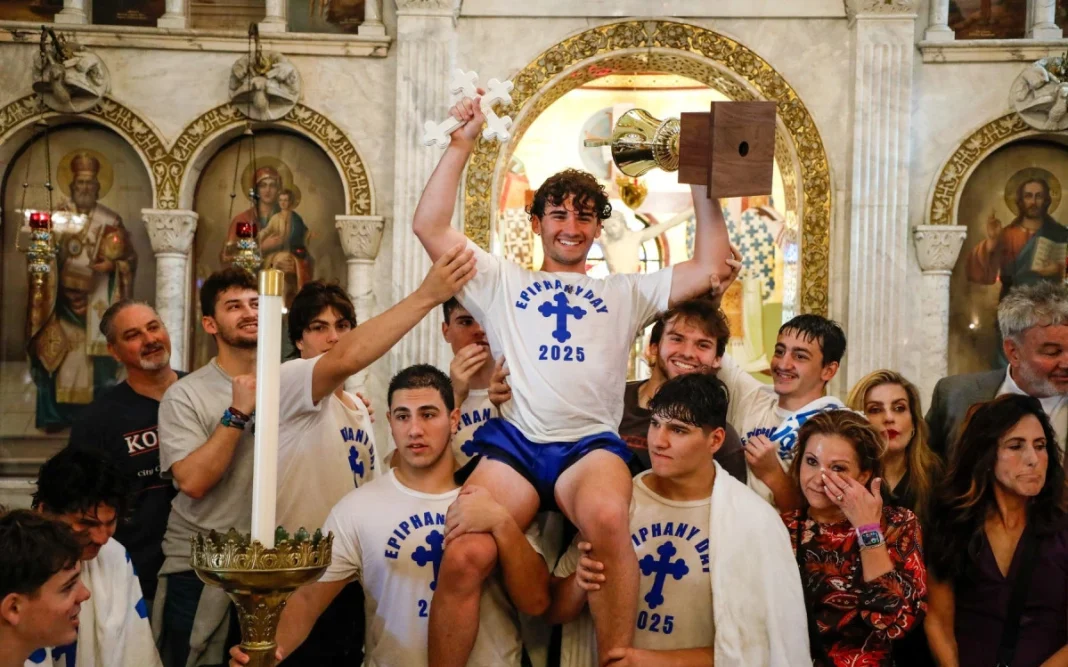
EDITOR’S NOTE (By Lambros Karpodinis). Yesterday’s New York Times article offers a striking look at how outsiders view Orthodoxy and why a growing wave of converts—primarily young men—are joining the Church. Many describe themselves as “refugees” from Evangelical, Catholic, or mainline Protestant backgrounds. What seems to attract them most is their belief that Orthodoxy has resisted “wokeness” and preserved a traditional, male-centered structure. They even call themselves “orthobros,” celebrating the absence of female clergy and LGBTQ visibility.
The article focuses entirely on a Russian/Slavic parish in California, overflowing with converts, yet it makes no mention of the far larger Greek Orthodox presence in America. The converts are drawn not only to cultural traditionalism but also to the rigors of fasting, the physicality of standing through the liturgy, and the sense of brotherhood—often tied to the online “manosphere.”
While similar reports have predicted an Orthodox “boom,” we should remain cautious. American religious life encourages people to “shop” for a faith, a concept foreign to Greeks, Russians, and Slavs, whose national identities are historically tied to Orthodoxy. Despite visible growth, Orthodox Christians remain under 1% of the U.S. population; meaningful change would take generations and far more parishes.
More concerning are the motivations some converts express: many come from far-right, pro-Russian online circles and seek a Church that confirms their politics, rather than allowing the Church to shape them. This raises the danger that such converts may eventually pressure Orthodox communities to change for them, rather than embracing genuine Orthodox tradition.
====================
NY TIMES: Orthodox Chuch Pews Are Overflowing In America
Something is changing in an otherwise quiet corner of Christianity in the United States, one that prides itself on how little it has changed over time. Priests are swapping stories about record attendance numbers. Older members are adjusting — or not — to the influx of new attendees. Parishes are strategizing about how to accommodate more prospective converts than existing clergy can reasonably handle on their own.
Across the country, the ancient tradition of Orthodox Christianity is attracting energetic new adherents, especially among conservative young men. They are drawn to what they describe as a more demanding, even difficult, practice of Christianity. Echoing some of the rhetoric of the so-called manosphere, new waves of young converts say Orthodoxy offers them hard truths and affirms their masculinity.
“In the whole history of the Orthodox Church in America, this has never been seen,” the Very Rev. Andrew Damick, an Antiochian Orthodox priest and author in Eastern Pennsylvania, said of the large groups of young people showing up at many parishes. “This is new ground for everyone.”
In the United States, Orthodox Christianity is by far the smallest and least-known of the three major branches of Christianity, representing about 1 percent of the population, compared with about 40 percent who are Protestant and 20 percent who are Catholic. Orthodox pews here have historically been occupied by immigrants from Ukraine, Greece and other countries with large Orthodox populations. Their American-born children often drift to other churches.
But a homegrown Orthodox Christianity is strikingly emergent. Many of the young Americans new to the pews have been introduced to Orthodoxy by hard-edge influencers on YouTube and other social media platforms. Critics call the enthusiastic young converts “Orthobros.”
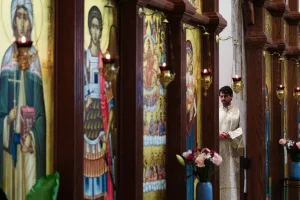
One night this summer, the young adults of All Saints Orthodox Church in Raleigh, N.C., gathered at a bookshop and bar on the city’s north side. At the event’s peak, there were a mere handful of women present, and more than 40 men. The men noticed, and believed they knew why.
Young Orthodox Christians in Raleigh, N.C., gathered at a bookshop and bar in an upscale strip mall on the city’s north side in August. Credit…Cornell Watson for The New York Times
“Protestant and Catholic churches have a very feminine atmosphere,” said Josh Elkins, center.Credit…Cornell Watson for The New York Times
Orthodoxy “appeals to the masculine soul,” said Josh Elkins, a student at North Carolina State University who was chatting with other young men.
“The Orthodox Church is the only church that really coaches men hard, and says, ‘This is what you need to do,’” said Mr. Elkins, 20, who casually quoted a second-century martyr and rattled off terms like “monarchical episcopate” in conversation. He beamed as he talked about the weekly worship service known as the Divine Liturgy, an hourslong affair at which attendees typically stand the entire time, rather than sitting in the pews or kneeling.
The Divine Liturgy is just one aspect of Orthodox faith and practice that is unfamiliar to many Americans, including other Christians. Orthodox services include chanting, incense and genuflecting deeply before painted icons. Much of the liturgy takes place out of the sight of the congregation. The church also maintains a strict and complicated schedule of fasting.
“It’s so much harder than I thought it was going to be,” said Matthew Herman Hudson, 29, who converted in his early 20s and works in the bookstore in Raleigh. “But it speaks to me in a way that nothing else ever did.”
Mr. Hudson said that when he first converted, he had to explain to friends what Orthodoxy was. Now, customers at the bookstore often identify his necklace as an Orthodox cross, with its distinct three bars.
Generation Z is upending the expectations of many scholars and faith leaders, who watched the country steadily secularizing for decades, with each generation less religious than the last. Some recent surveys suggest that young adult men are defying that trend.
The Orthodox Church traces its ecclesiastical lineage to Jesus Christ and the early apostles. As Christianity expanded in its first millennium, a theological and political divide opened between the Eastern church and the Western, or Roman Catholic, church. A schism in the 11th century over issues including papal authority divided the two bodies definitively, with Eastern Orthodoxy flourishing in the Middle East, Eastern Europe and Russia.“A lot of guys are returning to traditional masculinity,” said Josh Moorman, 25, who will be baptized at All Saints next year.
Some older Orthodox believers have noted that many young adult converts are drawn to harder-edge expressions of faith and practice.
Orthodox Christians in the United States are younger and more male than many other Christian groups here. More than 60 percent of them are men, compared with 46 percent of evangelicals, according to the Pew Research Center. Orthodox Christians are also much younger, with 24 percent of adult adherents younger than 30, compared with 14 percent of evangelicals. The gaps are the same as those between Orthodox Christians and Catholics.
Some converts report approvingly that Orthodoxy has a more masculine feel than other traditions. Priests, who must be male and can marry, often have large beards and big families. Orthodoxy asks practitioners to make sacrifices like fasting, rather than offering them emotional contemporary music and therapeutic sermons, which critics describe as the typical evangelical megachurch experience.
“There’s no war for us to die in — well, there are wars for us to die in, just not ones that are honorable,” Laric Copes Jr., 28, who attends All Saints, said. For former Protestants like himself, Orthodoxy serves as “a kind of frontier of exploration,” he said.
“Young men need purpose, whatever that is,” said Jerod Stine, 26. “Young men are struggling to find jobs, they’re struggling to get into schools, and they’re really being told by society, ‘We don’t really need you.’”
Mr. Stine and Mr. Copes used to attend the same evangelical megachurch, but lost track of each other when the church collapsed in scandal. They reconnected for the first time in years at the Orthodox gathering at the bookstore.
The new energy in many Orthodox parishes tracks with broader trends among young men embracing harder-edge and more intense versions of several Christian traditions. In the Catholic church, a significant minority of young people prefer the pre-Vatican II Traditional Latin Mass, and attend parishes where women wear veils to mass.
These remain relatively small religious subcultures, but they are part of a shift that enthusiastic observers are calling a revival. Pew Research found this year that after years of decline, the Christian population in the United States has been stable for several years, a change fueled in part by young adults.
Some argue that the common denominator in churches attracting young people is not their style of worship but their treatment of the supernatural. Father Damick, the priest in Pennsylvania, pointed out that charismatic Christianity, whose theology includes an openness to faith healing and “spiritual warfare,” has also resisted trends of religious decline.
“You’re much more likely to see growth in churches that are not just conservative morally, but that take the unseen world seriously,” said Father Damick, who is also chief content officer of Ancient Faith Ministries, a pan-Orthodox publisher and media group.
Many converts say they appreciate the notion that Orthodox theology and practices have remained the same since the birth of Christianity.
As a joke recounted fondly in Orthodox circles puts it: “How many Orthodox does it take to change a lightbulb?” The answer: “Change? What’s that?”
“The Orthodox Church stands as the hope of those who wish to be normal, to be healthy, true and beautiful,” said the Rev. David Winn, the priest at All Saints.
Orthodox Christians in the United States are younger and more male than many other Christian groups.
Father Winn, 38, converted in the early 2010s. He has a seemingly endless energy for meeting with people curious about the church. His wife, Destinie, runs a popular Orthodox parenting account on Instagram when she is not home-schooling their four — soon to be five — children, or hosting groups from the church on their big back porch overlooking a patch of woods in nearby Cary.
Father Winn arrived at All Saints in 2020, the year that many observers say was pivotal for the growth of Orthodox Christianity in the United States. Orthodox churches were significantly more likely than others to ignore the coronavirus pandemic and continue to hold in-person services.
By 2023, in-person attendance at worship services had bounced back completely at the average Orthodox parish, while at other religious congregations it lagged behind, according to research published last year.
Some Orthodox parishes now have their own schools, long a rarity in a tradition with such small numbers. The pan-Orthodox Saint Constantine School has more than 500 students at its flagship school in Houston, which opened in 2015. The network opened a new campus in Pittsburgh last year, and another in Dallas this fall.
In North Carolina, All Saints is exploring the possibility of opening a school, as well as adding a second priest and a new location. This fall, the parish had a record 165 catechumens, people in the typically yearlong process of formally joining the Orthodox Church.
The online influencers that many young men credit with introducing them to Orthodoxy speak directly about politics and culture in a way that parish priests more often avoid. They tend to share an unbending social conservatism, with a particular interest in the “traditional family” and what they describe as the threats of feminism, homosexuality and transgender identities. They are also generally opposed to the state of Israel.
Orthodox Christianity is a broad term that includes the Greek, Russian, Antiochian and Serbian Orthodox churches and other branches.Credit…Cornell Watson for The New York Times
The Rev. Josiah Trenham, one of the most well-known American priests, appeared on Tucker Carlson’s show shortly after the assassination of the right-wing activist Charlie Kirk to discuss Christian mourning traditions. In a more recent video reflection on the prominent white nationalist Nick Fuentes’s appearance on Mr. Carlson’s show, Father Trenham claimed he didn’t know much about Mr. Fuentes and went on to praise the men’s conversation about the scourge of pornography.
Father Trenham’s congregation in Riverside, Calif., has more than 1,000 active parishioners, and 241 in the process of converting. “Five years ago I had 75, which I thought was a lot,” he said in an interview this fall. “The trajectory is increasing.”
Certain corners of the Orthodox internet are not just conservative or traditionalist, but openly racist and antisemitic, with several far-right figures converting in recent years. In the South, there is a strain of neoconfederate Orthodoxy that marries white supremacy and Orthodox practice. Matthew Heimbach, who organized the notorious Unite the Right rally in Charlottesville, Va., in 2017, had been excommunicated from the Antiochian Orthodox church but joined another branch.
The Orthodox Christian writer Rod Dreher warned recently that “antisemitism is spreading like a virus among religious conservatives of the Zoomer generation,” including among the Orthodox.
In interviews, parish priests said they see it as part of their jobs to acculturate “Orthobros” with extreme views to parish life, which they insisted was far removed from the violent rhetoric online.
But critics say that top church leaders rarely condemn even the most noxious rhetoric from high-profile Orthodox Christians.
“From an institutional perspective, I get it, you’re excited about growth,” said Sarah Riccardi-Swartz, an assistant professor of religion and anthropology at Northeastern University who has written about Americans who convert to Russian Orthodoxy. “But when that growth comes with violent political tendencies, that is not good and it has to be checked.”
At All Saints, many young converts said they had become less invested in online Orthodoxy the more they attended actual church. Austin Nolan, an accounting student, said his priest at his previous parish in Asheville, N.C., had warned him, “Don’t be an Orthobro.”
Some converts report approvingly that Orthodoxy simply has a more masculine feel than other traditions. Credit…Cornell Watson for The New York Times
Austin Nolan, 21, and his fiancée, Nadia Fuentes, 19, are now both catechumens at All Saints.Credit…Cornell Watson for The New York Times
Mr. Nolan, 21, and his fiancée, Nadia Fuentes, 19, are now both catechumens at All Saints. After a packed Sunday service in August, they filed outside for an informal coffee hour.
Mr. Nolan was raised as a Baptist and Ms. Fuentes as a Methodist, the two Protestant traditions that have dominated the religious landscape in the American South for generations.
But the couple agreed that too many mainstream Protestant churches offered only shallow theology and “far-left” ideology. Ms. Fuentes’s former church had a female pastor, which she said she didn’t approve of, and she said she once saw a transgender woman, whom he described as a man, in the women’s bathroom there during a Christmas service.
“There’s just more validity in a church that can trace its lineage all the way back to the apostles,” Mr. Nolan said.
The couple said they were looking forward to raising an Orthodox family, one oriented around duty, truth and “objective beauty standards,” Mr. Nolan said. In their future home, they are planning a prayer area facing east.









I wish there was a Russian Church closer to us… Rev. Josiah Trenham – a wonderfully engaging and inspirational priest and leader of the faith. Dreher simplistically decries conservative Christians who seem to exhibit Anti Semitic positions… but he overstates this. To get a fuller picture and analysis he needs to read “Two Hundred Years Together” by Solzhenytsin. The top reason for the appeal of Orthodoxy lies in its traditional roots and its perceived resistance to the “corrupting influences” of Western liberalism…which are often supported by Liberal secular Jews.
The “Editor’s Note” is rife with envy. I know several “Orthobros” and you couldn’t find a more sincere and zealous bunch of young men. And no, they aren’t joining the Orthodox Church because they “love” Putin. I could go on but for now let it be said, that unless the leaders of the GOA pull their heads out and realize that they are Americans of Greek heritage, then the GOA will continue its long, painful (and unnecessary) descent into irrelevance.
The converts are hardly far right and Putin has never come up in conversation. My greatest fear is that “Russians hideing under the bead”‘ nonsense, will get some of us killed. Has not the Kirk assignation not shown how unstable some elements are in America? The outrageous Archons statement about ROCOR, Antioch, Serbia and the Greek Orthodox delegation to DC is highly dangerous.
George Michalopoulos.
There is no envy in the editorial. It just notes that the GOA is not attracting as many converts, as its larger footprint in America would indicate. As for the moniker “Orthobros,” it is noted that it was their own invention. There was never any doubt expressed as to their sincerity in converting to Orthodoxy.
George, you nailed it. Envy or no envy , the stark truth is that the GOA is unwelcoming to outsiders going back 40 plus years ago when 15,000 Campus Crusade for Christ Bill Bright followers wanted to convert after 15 years of study on the early church were shown the door by Iakovos and later the then sitting patriarch for no substantive reason that they were Xeni (strangers) and not ethnically controllable Greek pizza parlor owners from Sparta who usually dominate parish councils. The “balance of power” might be shifted. The Greek hierarchs and a lot of clergy (and George and I are both of Greek heritage) are xenophobic and Hellenism has always trump Orthodoxy for the post position.
Don’t believe me ? Then why does the Greek Orthodox Patriarchate of Jerusalem not have any Arab Orthodox bishops since 99.99 percent of their congregations are Arab or Palestinian? Because the Greek Patriarchate owns tons of land in Israel and God Forbid that non-Greeks somehow shift the balance. There’s a factual reason why GOA wasn’t mentioned. Just ask the Ortho Bros how they were dissed by the Greeks.
Nick, the featured church is in Raleigh, NC.
To you Eleni…don’t concern yourself about Rod Dreher. AIPAC paid him $7,000 for his post about anti-Semitism.
Patriarch Bartholomew who presents himself as the leader of 350,000,000 Orthodox Christians needs to show leadership as these converts and inquirers come to the Orthodox Church. My understanding is that many of these people through their studies have concluded that the Orthodox Church is the same Church of the Apostles. The Roman Catholic Church has made major changes at various junctures in its history, yet still claim to be the Church of the Apostles.
On St. Andrew’s day Pope Leo will go to Constantinople to pray with Patriarch Bartholomew. Then they will go to Nicea and possibly declare a common date for Easter which will certainly sharpen the division in the Orthodox Church.
These ecumenical activities must confuse the inquirers to Orthodoxy. The Patriarch needs to affirm the teachings of the Church. He needs to be dealing with the surge of converts, not with Pope Leo. These converts and seekers don’t want religious leaders who devote their time to green issues, gender issues but those who are true followers of Jesus Christ who have the fulness of the faith and who will share it with them
It pains me to respond to the editorial comment preceding the article that the “far larger” Greek Orthodox presence in the USA is hardly likely to attract anyone who is serious about God. In my experience of over 30 years, Greek parishes are largely centered on the Greek culture, with emphasis being placed on Greek school, Greek festivals, Greek recipe books, Greek language – and that’s all important because we are cultural beings, but the average convert doesn’t convert to Orthodoxy for the baklava. When I see God and the Gospels being put on a back burner because it’s somehow more important to let the kids do school activities on Sundays, or the parish dropping the ball on church music because most of the choir has departed for warm weather between Christmas and Easter, all I can think is, at least the Russians take God seriously. They have their ethnic schools and ethnic festivals, too, but God and His Mother and the saints are much more emphasized in Russian parishes than they are in the Greek parishes I’ve been in. I apologize because I’ve almost certainly given offense, but you need to know why converts aren’t flocking to Greek churches, unless the Greek Church is the only option in town.
Mrs. Mutton…I think your points are valid!
Yes, the GOA must decide whether it is a Greek club or the Body of Christ. Our Lord stated, “you can’t serve 2 masters because you will love one and hate the other.” That being said, there are many Russian parishes that are more like ethnic enclaves than the local GOA parish.
I liked a lot of the article but there were parts that seemed like a hit job. I heard reports that Sarah Riccardi-Swartz was an entirely unethical reporter when it came to her past reporting on Orthodoxy. The mere fact they used her in this article might indicate they had alternative motives.
On another note…I hope Orthodox commentators would stop bashing the Orthobro’s. These young men are new and have a lot of zeal. We need to have patients. The zeal they possess is MOSTLY very helpful. Sometimes it has been a problem but from what I have seen, the positives far out weigh the negatives.
I didn’t see any bashing of the Orthobros. The moniker has been invented by them and it is part of who they feel they are.
Why should Bart, Elpi and Co. care about converts and increasing the faithful in Greek churches? Their wet dream, “We Are The World’ of a global, One World Religion, and their many pathways to come to Christ, is the only thing on their mind when it comes to growth. They don’t want growth, they want change and innovations, a kumbaya moment pejoratively speaking, which describes a naive or overly optimistic ill attempt at unity with other faiths.
Finally, leave Orthobros alone….