


ΕΑΝ ΠΡΟΤΙΜΑΤΕ ΕΛΛΗΝΙΚΑ ΠΑΤΗΣΤΕ ΤΗ ΣΗΜΑΙΑ ΣΤΟ ΚΑΤΩ ΜΕΡΟΣ ΤΗΣ ΟΘΟΝΗΣ
When Turkey Demands “Equity” and the U.S. Echoes It: How Legal Clarity Is Lost in the Eastern Mediterranean
By Nick Stamatakis
By treating Turkish revisionism as a negotiable political claim rather than an assertion that must be tested against the law of the sea, recent U.S. diplomacy in the Eastern Mediterranean has taken a troubling detour from principles Washington traditionally espouses. This approach risks undermining Greece’s sovereign rights, weakening the legal order that underpins maritime stability, and sending a dangerous signal to revisionist powers worldwide.
1. Fidan’s “Fair Share” is Not Legal Equity
In statements before the Turkish national assembly this month, Foreign Minister Hakan Fidan explicitly called for Turkey to receive its “fair share” in the Eastern Mediterranean and for all disputes in the Aegean to be examined “as a whole.”
While Fidan paid lip service to “international law,” it is striking that his demand for fair or equitable distribution is rooted in a narrative that departs from the legal entitlements established by the UN Convention on the Law of the Sea (UNCLOS). Turkey has never ratified UNCLOS and rejects core provisions that grant full maritime zones — including EEZs and continental shelf — to islands like Crete or Rhodes, contrary to settled international practice.
What Fidan calls “fair” is better understood as revisionist geography: the assertion that geography, rather than law, should be the basis for delimitation. This is not a legal interpretation, but a political demand meant to reshape sovereignty itself.
2. Barrack’s Bridge: A Political Frame, Not a Legal One
U.S. Ambassador to Turkey Tom Barrack has publicly articulated Washington’s desire to act as a “bridge” between Greece and Turkey, emphasizing dialogue, regional connectivity, and prosperity as foundations for a new regional order. Barrack described the U.S. role as helping build communication channels and a framework where “everything starts with communication — and communication is fuelled by prosperity, not fear.” In-Cyprus
While such language sounds constructive, it stands in stark contrast to a rigorous legal framework. Barrack’s emphasis on flexibility and economic benefit lacks explicit anchoring in the law of the sea, which should be the governing basis for maritime delimitation. European-style “regional order” ambitions cannot substitute for juridical clarity when property rights and sovereign maritime entitlements are at stake.
3. The Problem with “Equity” as a Diplomatic Concept
The American instinct to conceptualize energy-sharing as “equitable” or “fair” in the Eastern Mediterranean is not rooted in legal obligation but in geopolitical management. This is problematic for several reasons:
Equity without law becomes ambiguous. “Fair share” is left open to political negotiation rather than adjudication.
It rewards unilateral revisionist positions. If islands’ legal EEZs can be reduced through political bargaining, then Ankara’s centuries-old claims gain legitimacy without legal adjudication.
It erodes the normative force of UNCLOS. A rules-based order cannot survive selective application.
From a Greek viewpoint, the United States appears willing to let political stability trump legal consistency, a choice that only encourages those willing to discard legal norms for leverage.
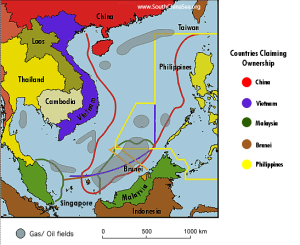
MAP: In the South China Sea, the US fully supports International Law principles for the island nations of the Philippines, Taiwan and Indonesia against China’s claims… Why the double standards in the Eastern Mediterranean?
4. A Stark Double Standard
This approach is inconsistent with how the United States generally applies maritime law elsewhere.
In the South China Sea, Washington champions UNCLOS principles and supports island entitlements against continental power claims. In disputes involving China and ASEAN claimants, the U.S. upholds a legal framework rooted in median lines and the rights of islands against mainland excess. Yet in the Eastern Mediterranean, when confronted with Turkish assertions that undermine legal norms, the same U.S. policy refrains from strong legal backing for Greece’s maritime rights.
Similarly, the United States consistently delineates its own maritime boundaries with neighbors such as Cuba and the Bahamas using legal median lines — without suggesting “equitable” reductions. The contrast underscores that “equitable distribution” is selectively invoked, often when it benefits a strategic ally whose revisionism Washington tolerates.
5. Strategic Expediency vs. Legal Principle
Why this divergence? The answer is geopolitical:
Turkey is a strategic NATO ally whose cooperation the U.S. deems essential in multiple theaters — from the Black Sea to the Middle East and NATO southern flank.
Greece, by contrast, is reliable and law-abiding but less pivotal in Washington’s calculus of regional balance.
“Equity” thus becomes a tool of strategic ambiguity: viewed as flexible diplomacy rather than a principled legal position.
But such ambiguity is not benign. When a power like Turkey can leverage its position to rewrite geographic rights under the banner of “equity,” the legal ballast that stabilizes maritime relations is cast adrift.
6. The Alarming Implications
The consequences are far-reaching:
It incentivizes revisionism: Other powers take note when legal principles are negotiable.
It weakens alliances: Law-abiding partners are asked to compromise legal rights while revisionists are indulged.
It undermines U.S. credibility: Selective advocacy for maritime law undercuts American moral authority.
7. Conclusion: Law Must Come Before Equity
If “equitable distribution” is invoked, it must be defined within a legal context — not as a euphemism for circumventing law in pursuit of geopolitical convenience. The United States should reaffirm that maritime rights derive from law first, not from negotiated balance of power.
In the Eastern Mediterranean, the path to stability lies not in ambiguous calls for fairness but in an unwavering commitment to a rules-based order that respects sovereign rights. Anything less is a betrayal of the very principles Washington claims to uphold.
December 14, 2025, n.stamatakis@aol.com www.helleniscope.com
DISCLAIMER: The views and statements expressed in this article constitute constitutionally protected opinions of this author.
















Why doesn’t Fidan begin by proving that he can apply “equity” in a manner that the Kurds, Armenians, Pontians, and Cypriots universally accept as “fair”…then as a next step, we can proceed to discuss “equitable reparations” for whatever the Turks have perpetrated against the remainder of the Greeks (and others) since the days of the Byzantine empire…when we are done with all of that accounting, it’s not clear what is really left for the Turks, other than a “historically equitable” one-way ticket back to the Steppes of central Asia, Fidan’s original neighborhood, where “fermented mare’s milk” flows plentifully, and is considered a prized delicacy…