

ΕΑΝ ΠΡΟΤΙΜΑΤΕ ΕΛΛΗΝΙΚΑ ΠΑΤΗΣΤΕ ΤΗ ΣΗΜΑΙΑ ΣΤΟ ΚΑΤΩ ΜΕΡΟΣ ΤΗΣ ΟΘΟΝΗΣ
Nearly 200 years after the assassination of Ioannis Kapodistrias, the British Foreign Office has still not released its archives from the critical period of 1828–1831. The secrecy surrounding these documents continues to fuel speculation about Britain’s role in the political turmoil that preceded his killing. The controversy has resurfaced following reports of British objections to a new film portraying Kapodistrias as the victim of foreign interference.
By Helleniscope’s Editorial Team
Greek media are reporting alleged diplomatic tension between Athens and London over the historical film “Kapodistrias,” a production focusing on the life and assassination of Ioannis Kapodistrias, the first governor of the modern Greek state, at a time when the movie is breaking records and has already been watched by over 150,000 people in its first four days in cinemas all over Greece.
According to the reports, the British Embassy expressed strong dissatisfaction with the film’s portrayal of Kapodistrias as the victim of an international conspiracy. The narrative reportedly highlights British hostility toward Kapodistrias for his efforts to establish a truly independent Greek state and for his refusal to submit to foreign financial and political pressure.
Sources cited by Greek outlets claim that British diplomats contacted Kyriakos Mitsotakis directly to protest the film, allegedly objecting to references linking British interests to the unrest that led to Kapodistrias’ assassination in 1831.
The trailer of the movie below shows that the scenario directly blames the British for their coordination with the assassins (below at 1:40).
At the center of the controversy is a long-standing historical issue: nearly 200 years after the assassination, the British Foreign Office has still not released its archives from the period 1828 to 1831. Greek commentators argue that these documents could shed decisive light on the role of British diplomacy and agents in the events that culminated in Kapodistrias’ killing in Nafplio.
Historians cited in the reports maintain that British officials of the era viewed Kapodistrias as an obstacle to their strategic interests in the eastern Mediterranean. His murder, they argue, ended an attempt to build a sovereign Greek state free from great-power control.
The film’s director, Giannis Smaragdis, says he faced intimidation during production and claims the project encountered resistance within Greece itself. He also notes that renewed public attention to Kapodistrias has revived calls for the full disclosure of British diplomatic records.
Two centuries later, the question remains unresolved: why do the British archives surrounding one of modern Greece’s most pivotal assassinations remain sealed?
Greek media are now calling for official clarification from both governments, as pressure grows for transparency and historical accountability.
We are watching the story continue to unfold.
January 2, 2026, n.stamatakis@aol.com www.helleniscope.com
DISCLAIMER: The views and statements expressed in this article constitute constitutionally protected opinions of this author.















I refuse to believe that the British would be “bothered” by an event that took place 200 years ago. I bet that its nothing more than publicity for the movie.
After Greece’s independence, Great Britain, France and Russia had very much influence to such an extent, that political parties were named as “the British party” with Mavrokordatos at its head, the French party with Koletis as its leader and the Russian party, with Kolokotronis as its leader.
Decisions by the Greek government, especially that concerned foreign policy, had to be cleared by the three power representatives. And knowing that they had destroyed Ibrahim’s fleet at Navarino, which had provided a breathing space to the Greek revolt, but, not its final freedom, which would come 5 years later, in 1832, and having secured Greece’s complete independence from the Ottoman empire, while Serbia was paying indemnity to the Ottomans, and also, by England having given, but mostly robbed Greece by two huge loans, which England expected full repayment, its understandable that the three powers, but England being the most aggressive, were using Greece as a debtor and a servant.
Kapodistrias was pro-Russian and certainly no democrat. He believed that Greece was not ready for full democracy, which the constitution gave to the people. The Greek constitution was more liberal and way ahead of all other European powers. Even America’s, because Greece abolished slavery in 1824, before any other country, except Haiti.
However, I dont see any benefit to England, at the point that they would assasinate a head of State. The British were not known to resort to such a tactic. They had Kapodistrias where they wanted him. Their navy could blockade Piraeus, starving Athens, as they will do numerous times.
The Maniotes were a power onto themselves. They rose first by marching and taking Kalamata in April of 1821 and then, declared the war over. They had no concept of a Greek State, where they had to pay taxation, or share power. Their rocky soil had necessitated their becoming pirates, accustomed to raiding, migration and robbing Greeks and Turks alike. They were comfortable in their stone built dwellings, shooting pot shots at neighbors, for grievances that went back generations.
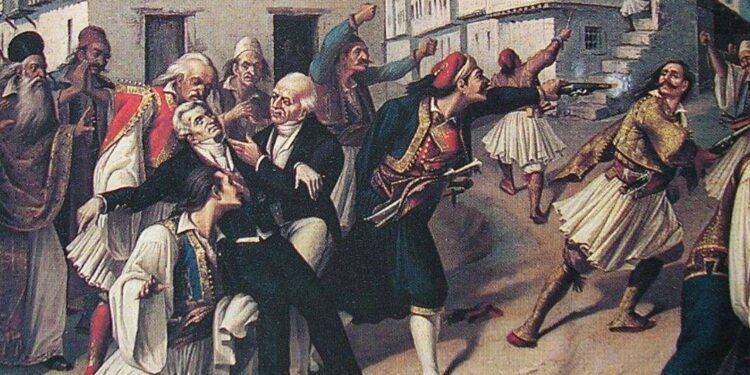
When Kapodistrias attempted to impose a government, they rebelled, captured the tax collectors, telling Kapodistrias that they didn’t pay tax to the Turks. They’re not going to pay now. Kapodistrias, by subterfuge, invited the leading family of Mavromichalis to send a representative to Nafplion. When the representative arrived, who was no less that the bey of Mani, Petrobey, he was thrown in prison. No Maniote was going to accept such a stain on their name. Petrobey’s son and brother waited for Kapodistrias outside of the church in Nafplion, and shot him dead. Petrobey was opposed to the assassination, but couldn’t stop it. One of the assassins was killed on the spot, the other was executed after a trial.
Any good detective, would look for motive. Knowing the Maniates’ culture of vendetta, and knowing that for the British, Greece was an insignificant side-show, while she controlled half the planet at the time, they had no motive to kill Kapodistria. . Let’s hear more opinions, based on evidence. And I dont consider as evidence of guilt, if the British haven’t released their records from 200 years ago. Who asked them to release those papers and where is their denial? The British have released the WWII records and they’re concerned for their reputation being ruined if the Greek records are released?
Bob,
The British release their archives after 50 years without anybody asking them. So, by keeping the Kapodistrias files sealed for 200 years is by itself raising suspicions…
The suspicion is that the British coordinated the conspiracy with the help of their local “hand”, the Grande Lodge of Greece…
I can verify here that I have asked an experienced researcher of these archives and there was no release of the section on Kapodistrias’ assassination.