


ΕΑΝ ΠΡΟΤΙΜΑΤΕ ΕΛΛΗΝΙΚΑ ΠΑΤΗΣΤΕ ΤΗ ΣΗΜΑΙΑ ΣΤΟ ΚΑΤΩ ΜΕΡΟΣ ΤΗΣ ΟΘΟΝΗΣ
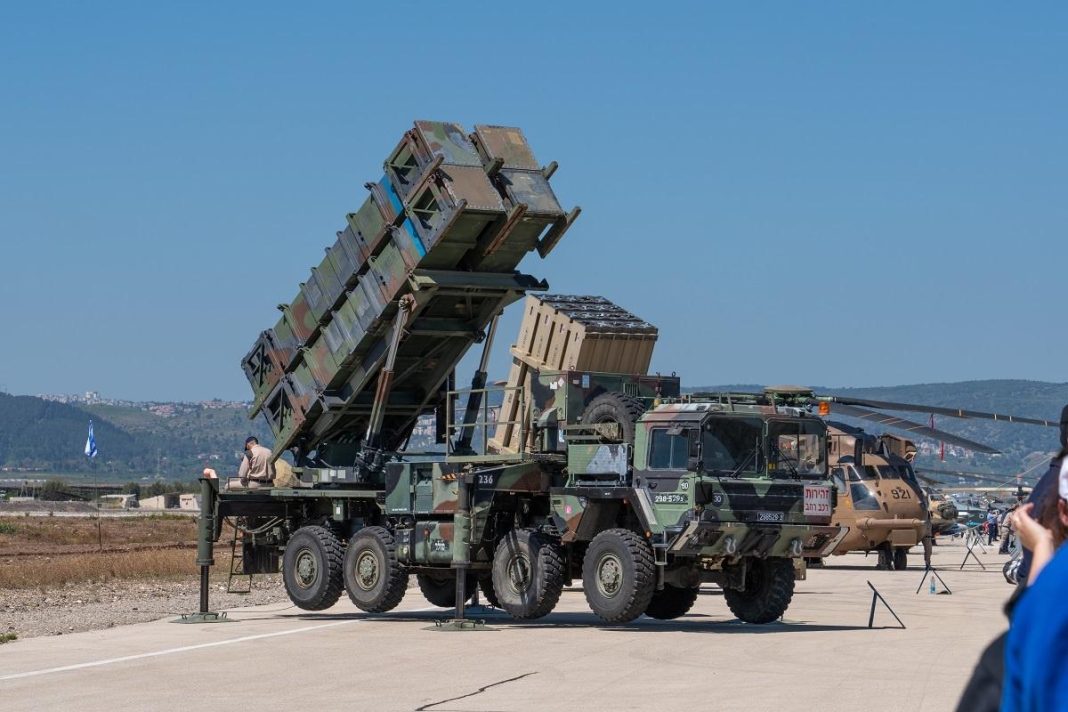
OUR MAIN PHOTO: Greek Patriot Battery
As Brussels presses Athens to provide Patriot missiles and other air-defense assets to Ukraine, Greece faces a dangerous choice between alliance demands and its own security. With Turkey still challenging Greek sovereignty in the Aegean and Eastern Mediterranean, weakening Greece’s defenses for a war with no clear path to victory could prove a costly strategic mistake.
By Helleniscope’s Editorial Team
Allied solidarity can become strategic self-harm, and Greece is getting dangerously close to that line as pressure mounts once again for Athens to surrender valuable air-defense assets to Ukraine.
The latest demands focus on Patriot interceptor missiles. Ukraine reportedly wants as many as 200 missiles from Greek stocks, while Greece and Spain are being singled out in European discussions because they retain Patriot inventories at a time when Kyiv is desperately short of interceptors. Greece, however, has only six Patriot batteries, one of which has been deployed abroad (in Saudi Arabia), and successive Greek governments have regarded the system as indispensable to defending Greek airspace.
The contradiction should be obvious. At the very moment Greece is investing billions in a new air- and missile-defense architecture, and as Defense Minister Nikos Dendias warns his European colleagues about revisionism in the Eastern Mediterranean, the Aegean and Thrace, those same allies are asking Athens to reduce stocks of some of the most valuable missiles in its arsenal.
The same pressure has repeatedly surrounded Greece’s Russian-built S-300 systems in Crete, which Ukraine can readily employ. Prime Minister Kyriakos Mitsotakis has been unequivocal on this issue, stating publicly that Greece would provide neither Patriots nor S-300s because both are critical to Greek deterrence. That judgment remains as valid today as it was when he made it: Turkey has not disappeared, the Aegean has not become less contested, and Crete has certainly not become less strategically important.
PHOTO: Greek S-300PMU-1 system
A similar danger surrounds Greece’s older Russian and East German air-defense equipment, including Tor-M1 and Osa systems. These weapons are aging and will eventually have to be replaced, but obsolete does not mean useless, particularly when the alternative is an empty position waiting several years for a replacement system to arrive. Greek defense planning has long relied on such shorter-range systems to protect sensitive areas, including the Eastern Aegean, and even Greek reporting that favors modernization acknowledges the islands’ vulnerability and the need for stronger—not weaker—air defense.
Athens has already acknowledged providing Ukraine with shorter-range anti-aircraft systems, in addition to ammunition, armored vehicles and other military assistance. Greece has not publicly confirmed that it has transferred its entire Tor-M1 or Osa inventory case, no operational air-defense system should leave a Greek formation until an equal or superior replacement is physically deployed, integrated, supplied with missiles and ready for combat.
This brings us to the question European leaders prefer not to ask. After four and a half years of war, what strategic result will another hundred or two hundred Greek missiles actually produce?
Although Russia failed in its initial attempt to subjugate the country, the equally uncomfortable reality is that Ukraine has not expelled Russia from the territories it occupies, while the cost in lives, money and materiel continues to mount. According to the best estimates, based on exchanges of war prisoners and also of the dead, the ratio of casualties is 10 Ukrainians to 1 Russian. In our judgment, there is no plausible military path by which transferring a portion of Greece’s limited air-defense arsenal will restore Ukraine’s 1991 borders. Russia, with its advanced hypersonic missiles (it is at least 15 years ahead in missile technology), has already achieved its “demilitarization” goal – not simply of Ukraine but of the “Combined West”; Ukraine is under a naval blockade and is already a landlocked country. The war is lost, and there is nothing to be done to win it…
For Greece, the calculation must therefore be different from that of countries protected by geography and surrounded by friendly states. Across the Aegean stands Turkey, a country with vastly greater demographic and military weight, unresolved claims against Greece, disputes over maritime jurisdiction and a continuing casus belli concerning the extension of Greek territorial waters.
Deterrence exists precisely so that such disagreements do not become military crises. Turkey does not need to invade a Greek island to exploit weakness; it can apply pressure through airspace, maritime incidents, drilling disputes, migration, challenges around small islands, or another carefully manufactured confrontation designed to test Greek resolve. A visible deterioration in Greek air-defense capability would not guarantee Turkish aggression, but it would unquestionably make coercion less costly and therefore more tempting.
This is why the debate should not be reduced to whether an individual Patriot missile, S-300 launcher, or older short-range system can be spared. Greece’s government has a more fundamental obligation: it must ensure that the country’s deterrent remains credible throughout the transition to its next generation of air defenses.
Greece has already provided considerable assistance to Ukraine to its own military and political detriment. The answer to further pressure should therefore be courteous but final: Greece will not weaken its own defenses in an attempt to alter the course of a war that, in our judgment, no additional shipment of Greek missiles can win.
Because if another serious crisis erupts in the Aegean, Greece may receive abundant declarations of European solidarity—but it will have to defend its territory with the weapons it was prudent enough to keep.
Sources
- Euronews, Aug. 31, 2026 — EU expected to lobby allies to give Patriot interceptors to Ukraine
https://www.euronews.com/my-europe/2026/08/31/eu-expected-to-lobby-allies-to-give-patriot-interceptors-to-ukraine - Kathimerini, July 17, 2026 — Greece pressed over Patriot assets; reports pressure on Athens and a Ukrainian request for as many as 200 Patriot missiles
https://www.ekathimerini.com/politics/foreign-policy/1309817/greece-pressed-over-patriot-assets/ - Office of the Greek Prime Minister, Apr. 25, 2024 — Kyriakos Mitsotakis rejects the transfer of Greek Patriot and S-300 systems to Ukraine
https://www.primeminister.gr/2024/04/25/34121 - Office of the Greek Prime Minister, July 12, 2024 — Mitsotakis discusses Greek military assistance to Ukraine and previous transfers of shorter-range anti-aircraft equipment
https://www.primeminister.gr/en/2024/07/12/34685 - Greek Ministry of National Defense, Sept. 1, 2026 — Nikos Dendias warns European counterparts about revisionism in the Eastern Mediterranean, the Aegean and Thrace
https://www.mod.mil.gr/en/minister-of-national-defence-n-dendias-participates-in-informal-meeting/
September 2, 2026, www.helleniscope.com, n.stamatakis@aol.com
DISCLAIMER: The views and statements expressed in this article constitute constitutionally protected opinions of this author.
















It will be a tragic blunder on the part of Greece.
Which is why Athens will probably do it.
Lord have mercy.
Four days have passed. Has Greece agreed to this?
It looks like Greece said “No”. Also Spain said no.