
EDITOR’S NOTE (Nick Stamatakis). Helleniscope’s readers know that Saint Catherine’s Monastery is more than a property dispute. One of the world’s oldest continuously functioning Christian monasteries, it occupies a unique place in Christian and Muslim history and has long served as a symbol of religious coexistence in the Sinai. The current negotiations therefore carry consequences extending well beyond questions of land ownership: they touch on religious freedom, cultural heritage, Egyptian sovereignty, and the preservation of a centuries-old Orthodox presence.
As the following report by tovima.gr explains, the coming weeks may prove decisive. A negotiated settlement would offer both Egypt and the monastic community an opportunity to protect the monastery’s historic character while placing its legal status on firmer modern foundations. Failure to reach an agreement before the expected October 24 court decision, however, could reopen questions that have remained unresolved for decades and intensify an already sensitive diplomatic and ecclesiastical dispute.
====================
Sinai Monastery: The 20 Days That Will Decide Its Fate — The Crucial October 24 Deadline
Intense behind-the-scenes maneuvering ahead of the Egyptian Court of Cassation’s ruling on the ownership status of St. Catherine’s Monastery — Meetings aimed at reaching a compromise, “obstacles” from the United States and Mount Athos, and Greece’s diplomatic efforts
The road to St. Catherine’s Monastery at Sinai is not an easy one. Visitors must travel along a modern highway through a vast desert, passing frequent checkpoints. The region is inhospitable and subject to a special regime because, for Egypt, it is tied to national security. At the checkpoint roughly 800 meters from the monastery, security inspections are extremely strict, and vehicles are generally left there.
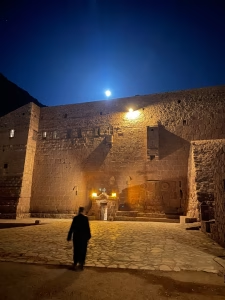
The imposing wall, built during the reign of Justinian and standing in the gap between two enormous mountain masses, gives the approaching pilgrim the impression of a fortress. That impression contrasts sharply with the small doorway through which visitors are almost forced to stoop in order to enter. This is not merely an act of reverence: nearby there once stood a large entrance through which even camels could pass in and out of the monastery. The monks closed it earlier to minimize their vulnerability to potential invaders.
The monastery’s nearly 15 centuries of uninterrupted operation are reflected in its fascinating, if somewhat labyrinthine, construction, where buildings from different periods coexist. Its history has been turbulent and eventful, but the situation became particularly complicated after 2015, when the first lawsuit over its property status was filed, and especially after May 2022, when the South Sinai Court of First Instance issued a ruling hostile to the monastery’s future.
At that point, the Sinai Monastery was forced to repel a different kind of invasion: the judicial deprivation of its property — in other words, of the resources necessary for its survival. The monastery’s main defense was that the court should dismiss the action because a private individual, who did not own the land in question, had brought it. The Egyptian authorities then intervened themselves, claiming ownership of the properties.
The Court of First Instance applied, with formalistic strictness, Egypt’s general legislation dating back to 1963, as well as the more specific Egyptian legislation concerning Sinai introduced in 1983, after the peninsula returned to Egyptian sovereignty. Under that legislation, all monuments belong to the state, as in European countries, while non-Egyptian citizens and foreign legal entities—meaning entities controlled by foreign nationals—are prohibited from owning agricultural land.
In Sinai specifically, all “desert lands” and “naturally protected areas” belong exclusively to the state, which may grant their use or exploitation, under state supervision, for a specified period. For this reason, the Court of First Instance not only recognized the Egyptian state’s ownership, but also ordered the demolition of all structures built by the monks that had not been designated as monuments, their eviction even from the monastery itself, and the payment of substantial compensation to the Egyptian state for the unlawful possession and use of its property.
The Sinai brotherhood appealed to the Ismailia Court of Appeal, which applied Egyptian law more favorably to the monastery. It recognized the validity of the monastery’s contracts concerning agricultural land, while in the case of places of worship it found that, although they are classified as monuments, they have remained in the monks’ continuous use and that the monks therefore have the right to continue using them.
Of particular interest is the fact that the court’s extremely lengthy judgment refers to the decrees of Justinian but not to the Achtiname — the Covenant — of Muhammad, since neither the Holy Monastery invoked it nor did the court consider itself legally bound by it. By contrast, numerous references appear to the modern Egyptian Constitution.
The two rulings brought to the surface something the monks had already understood well in 1984, when they attempted to register all the land in their possession. Egyptian legislation did not permit them full ownership of either the monuments or the monastery’s other real estate. Yet because the Egyptian authorities had not enforced the legislation, a “gray zone” persisted and eventually became the basis for the argument that long-term possession had ripened into ownership through prescription. The Egyptian court rejected that argument, refusing to recognize acquisitive prescription over state-owned land.
Uproar Over the Ruling
The Ismailia ruling provoked a storm of reactions, not only in the Christian world — St. Catherine’s Monastery is a UNESCO World Heritage Site — but more broadly because of the Covenant of Muhammad, bearing the imprint of his hand as a seal, which guaranteed the full protection of the monks and their property.
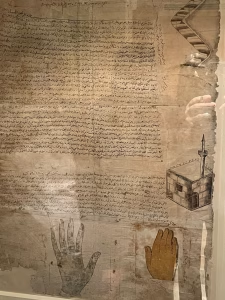
PHOTO: The historic document – a decision signed by Prophet Mohammed himself – recognizing the privileges of Sty. Catherine’s Monastery at Sinai.
That document has been respected throughout history and is regarded as a symbol of peaceful coexistence between the Muslim and Christian worlds. That symbolism is reinforced by the harmonious juxtaposition, within the monastery complex, of a dome topped by a cross and a minaret bearing a crescent.
As expected, the case eventually reached the Court of Cassation. The court has already reached its decision but has postponed publication of the judgment four times to give the monastery and the Egyptian state — represented by the Ministries of Justice and Foreign Affairs — time to negotiate.
This is because, under Egyptian law, if the parties reach a settlement before the judgment is formally published, the settlement is accepted and the court’s ruling is not made public.
Information reaching the brotherhood from Egyptian sources insists that there will be no fifth postponement and that, unless a compromise is reached, the ruling will be published on October 24. That leaves just 20 days in which to conclude a possible agreement and avert the worst for the monastery.
The situation is at a critical point because of the obvious complications, but also because of the serious illness of Archbishop Symeon, who is recovering in Athens. Everything that has happened so far shows how delicate the balance in the negotiations has become.
Following the severe internal crisis within the Sinai brotherhood that culminated in the resignation of the 90-year-old former archbishop Damianos on September 12, 2025, after 52 years in office, Symeon was elected the new Archbishop of Sinai, Pharan and Raitho. He was formally enthroned at the monastery on October 31.
Verbal Agreement
Immediately after taking office, Symeon appointed a team of experts to produce a precise inventory of the monastery’s real estate and its uses: which properties served religious purposes and which agricultural ones, which were close to the monastery and therefore of major importance, and which were not priorities. Historical evidence was compiled and the necessary documentation was drawn from international scholarship.
The Egyptian state viewed this technocratic approach as a positive and sincere basis for negotiations, and talks began. They ultimately resulted in verbal agreement on a major accord recognizing and protecting the monastery’s Greek Orthodox identity, regulating its operating status, recognizing the monks’ religious freedom and, most importantly of all, safeguarding the monastery’s Fundamental Regulations.
The major agreement would be the first and only agreement between Egypt and the Holy Monastery and would represent a strategic success for the monastery and for its position within the Egyptian legal order.
On the issue of real estate, the brotherhood made a shrewd maneuver. It accepted that the properties were subject to Egyptian law but requested that they become the subject of parallel negotiations, which intensified beginning in June of this year.
According to available information, one proposal under discussion was that properties used exclusively for religious purposes would remain in the monastery’s possession and use in perpetuity and without rent, while agricultural properties would remain in its possession in return for a symbolic rent.
The agreement had reached 99% completion but could not be finalized, despite three lengthy meetings between the two delegations. Shortly before the Feast of the Dormition — celebrated at St. Catherine’s on August 28 — the exchange of proposals stopped because the monastery receives a large volume of visitors at that time and had to attend to them.
During that period, various actors opposed to an agreement, realizing that it was close to completion, began to mobilize. At the time, August 26 was seen as the critical date for the Egyptian Court of Cassation’s ruling to be published, before the court granted its fourth postponement.
Pressure groups opposed to any agreement exist in both Egypt and Greece, fueling mistrust between the two sides.
On the Feast of the Dormition, Michael Rigas, the Greek-American U.S. Deputy Secretary of State, visited the monastery as a pilgrim. Rigas follows the Old Calendar, has ties with the ultra-conservative Esphigmenou Monastery on Mount Athos and has repeatedly spoken about violations of the rights of the Sinai brotherhood.
His visit triggered alarm at the Egyptian Foreign Ministry, which dispatched a delegation to accompany him. Rigas made no public statements.
A few days later, Symeon became seriously ill and was forced to travel to Athens for treatment. While the Archbishop of Sinai was ill, a letter from 20 monasteries of the Athonite community addressed to Symeon was made public on September 11, expressing their opposition to any potential change in the monastery’s property status.
“What sixteen centuries of history have respected must remain respected today,” they stressed, warning that any change to the existing arrangements would set a dangerous precedent for other sacred monasteries and monuments.
According to those familiar with the behind-the-scenes developments, the author of the letter is said to be Fr. Ieronymos of Simonopetra, who expresses Damianos’s position. The former archbishop quickly welcomed the intervention by the 20 monasteries, with support from Theophilos of Pantokrator and Arsenios of Karakallou.
The letter caused unpleasant surprise within the St. Catherine’s brotherhood because it was issued without the Archbishop of Sinai’s knowledge and, in effect, treated their monastery as though it were a monastery of Mount Athos, even though its spiritual point of reference is the Patriarchate of Jerusalem.
The initiative was also regarded as offensive by Patriarch Theophilos and by Ecumenical Patriarch Bartholomew. Most importantly, it was seen as misleading public opinion about the monastery’s actual legal position following the court decisions.
Bartholomew, under whose jurisdiction Mount Athos falls, immediately summoned the signatories of the letter for talks at the Phanar. They responded that the Holy Community first had to convene and later informed him that they would come on a day when he was scheduled to travel to England. In other words, they never went.
In this atmosphere, Kyriakos Velopoulos — who aligns himself with arguments advanced by the Russian Church — Maria Gratsia, who represented the Sinai monks opposed to the creation of a public-law legal entity to administer the monastery’s property in Greece, and the political party Niki all found an opportunity to align themselves with the letter.
In recent weeks, several reports in Egyptian media have offered various scenarios for the ruling of the Court of Cassation. Some suggest it will be closer to the Court of Appeal’s judgment; others that it will more closely resemble the Court of First Instance’s decision —unless, even at the eleventh hour, a compromise is reached.
The Greek government is quietly but firmly supporting the Sinai brotherhood’s efforts. According to reliable information, during the meeting between Greek Prime Minister Kyriakos Mitsotakis and Egyptian President Abdel Fattah el-Sisi in El Alamein, on the sidelines of the Greece-Egypt-Cyprus trilateral meeting on September 8, Mitsotakis discreetly sought to gain more time for the monastery.
The Monks’ Anxiety
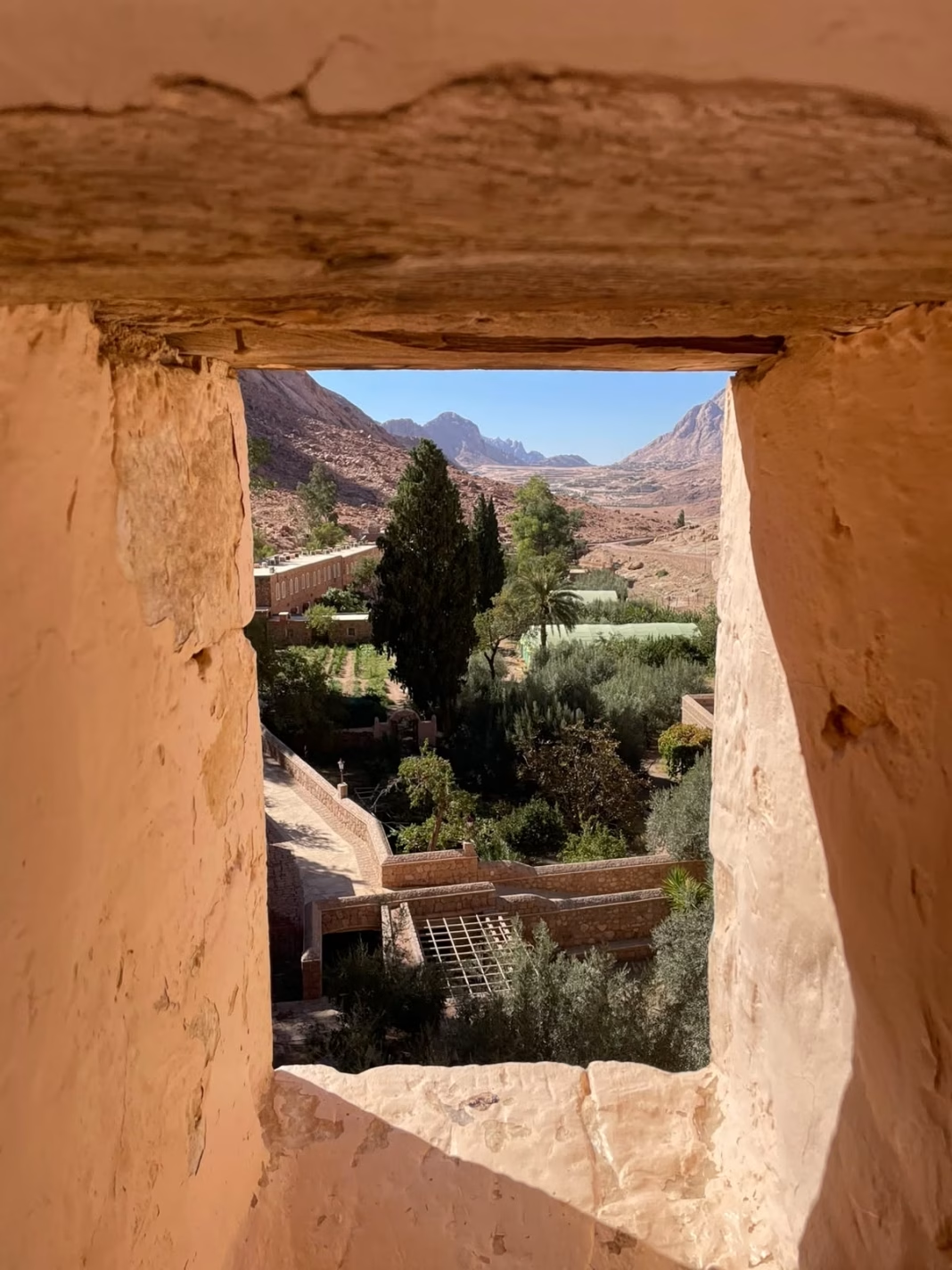
From the windows and battlements of St. Catherine’s walls, one no longer sees threatening raiders, but instead enormous tourism developments seeking to capitalize on their proximity to the monastery as a tourist attraction.
The monks continue to live according to their own rhythm, but they are troubled by a reality that threatens to disrupt it. The encouraging news is that Symeon is recovering and talks are expected to resume.
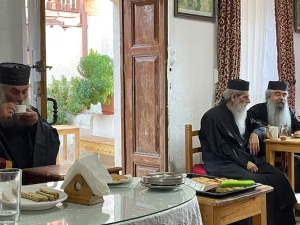
“The monastery has survived many empires. The Prophet Muhammad and Napoleon passed through here, as did Christian emperors and Muslim caliphs. After every trial, it becomes stronger. We fear nothing for the monastery,” says the monk who offers us coffee in the guesthouse.
Seventeen monks remain at the monastery. Four of them are in Athens accompanying Symeon, while another five belong to Damianos’s circle. The community is divided and is still trying to heal the wounds left by the events of August 2025.
Life there seems to move between earthly and metaphysical needs.
“At Sinai, the rocks are bare. Nowhere to hide from yourself. Or from the God who once walked on these mountains. Here, you have no choice but to be truthful,” another monk observes.
Around the monastery and the tourism it attracts revolves what was once a flourishing Greek community, which at one time numbered as many as 80,000 Greeks but today has dwindled to around 2,000, including Greek Egyptians.
A central figure in that community is Antonis Kazamias, president of the Hellenic Center of Cairo, who has long assisted the monastery while maintaining excellent relations with the Egyptian government and society.
Among the Greek community’s assets is also the Abet Foundation, the Greek school in Cairo, which possesses extensive property and whose president is, by statute, the serving Archbishop of Sinai.
Before his resignation, Damianos passed an amendment to the foundation’s statutes stipulating that the new archbishop would not have the right to take any decision for the following three years.
The foundation is currently administered by people close to Damianos. In recent years, a section of the Greek community had fallen into conflict with him and holds him and those around him responsible for the monastery’s present difficulties.
Meeting With Moussa
Kazamias also serves as an informal guide in Sinai for various visiting officials, including PASOK Member of the European Parliament Nikolas Farantouris, who recently visited the monastery to be briefed on the situation and explore how the European Parliament might contribute to a fair and sustainable solution.
During his meeting with Yasmine Moussa, legal adviser in the office of the Egyptian Foreign Minister and the official responsible for the “Sinai file,” the MEP insisted on preserving “the monastery’s property status unchanged.”
Although Moussa listened to his arguments, she presented the Egyptian side’s reasoning for why ownership could not be transferred to the monastery, even though Egypt receives €4 billion in financial support from the European Union.
The episode illustrates both the difficulty of the negotiations and the sensitivities of a state determined to assert sovereignty over its territory while repudiating its colonial past.