

ΕΑΝ ΠΡΟΤΙΜΑΤΕ ΕΛΛΗΝΙΚΑ ΠΑΤΗΣΤΕ ΤΗ ΣΗΜΑΙΑ ΣΤΟ ΚΑΤΩ ΜΕΡΟΣ ΤΗΣ ΟΘΟΝΗΣ
By Nick Stamatakis
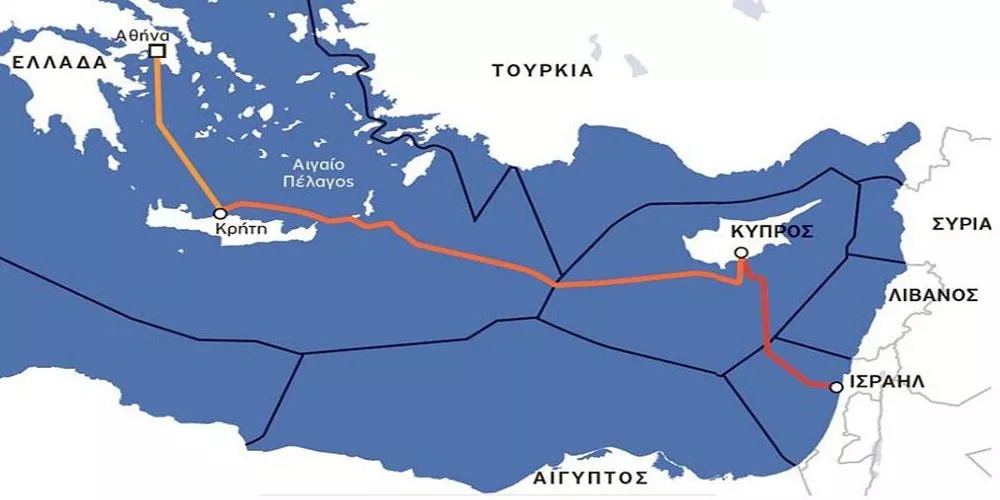
The Great Sea Interconnector (GSI) — a €1.9 billion subsea cable meant to connect Greece, Cyprus, and Israel — was supposed to symbolize unity, end Cyprus’s energy isolation, and elevate Greece as Europe’s energy hub. Instead, it has become a monument to division, indecision, and national weakness.
In recent weeks, Cyprus has taken a firm stance. Finance Minister Makis Keravnos has declared the project “not viable,” citing two independent studies that question its economic and technical feasibility. He has refused to authorize the recovery of €25 million in costs for ADMIE, Greece’s transmission operator, essentially freezing the regulatory approval needed for the project to advance. For Nicosia, the math is simple: why should Cypriot taxpayers foot the bill for a stalled project riddled with uncertainty, while Athens and Brussels collect the political dividends?
President Nikos Christodoulides recently confirmed that the European Public Prosecutor’s Office (EPPO) has opened a criminal investigation into complaints tied to the project. For Nicosia, this is no minor detail: it raises questions of accountability, transparency, and potential corruption. With cost-recovery mechanisms still unresolved, Cyprus fears being left holding the financial bag while others reap the political rewards.
Athens, on the other hand, pushes forward, eager to present the GSI as a strategic pillar of Greece’s regional influence. Yet this eagerness masks a deeper failure — one that goes beyond financial disputes and strikes at the heart of national sovereignty.
Turkey has openly threatened the project, sending warships to obstruct surveys and claiming large swaths of maritime space that belong to Greece and Cyprus under international law. And how has Greece responded? With silence, passivity, and a naïve hope that Brussels or Washington will one day intervene on its behalf.
This is unacceptable. Greece possesses one of the most powerful navies and air forces in the Eastern Mediterranean. Instead of relying on empty diplomatic gestures, Athens should have long ago used its military power to defend sovereign rights at sea. Even more critically, Greece should have signed an Exclusive Economic Zone (EEZ) delimitation agreement with Cyprus decades ago. That agreement would have closed any legal loopholes and permanently secured Hellenic maritime rights. Instead, successive governments in Athens — including the present one under Mitsotakis — have obediently followed American “Deep State” directives.
Washington’s goal has been clear: to promote an “equitable distribution” of maritime rights between Greece, Turkey, and Cyprus — a euphemism for robbing Greece and Cyprus of their rightful zones to appease Ankara. But why is this “equity” standard applied only here? Why does the American establishment not impose equitable distribution in the Caribbean between the U.S., the Bahamas, and Cuba? Why do they not push for equitable distribution in the South China Sea, where tiny island nations such as Taiwan and the Philippines are recognized as having their full rights under the Law of the Sea, even against the massive landmass of China? Why then must Greece and Cyprus be the exception, forced to surrender what international law clearly grants them?
The truth is simple: Greece’s political class has chosen submission over sovereignty. Cyprus, for all its financial caution, at least dares to raise questions and defend its people’s interests. Athens, meanwhile, leaves Hellenic rights perpetually open to dispute, hiding behind European bureaucracy while allowing Turkey to dictate terms on the water.
The Great Sea Interconnector was supposed to unite the Eastern Mediterranean. Instead, it has exposed the divide between Cyprus’s realism and Greece’s cowardice. Until Greece asserts itself — diplomatically, militarily, and legally — it will remain a pawn in someone else’s game, while its own allies carve away its sovereign rights piece by piece.