
September 27, 1831: Greeks Assassinate Ioannis Kapodistrias
The diary reads January 12, 1828. In the Cathedral of the Virgin Mary in Aegina, two men stand side by side: Ioannis Kapodistrias and the first governor of Greece and the son of the “king of Mani” Georgios Mavromichalis . Three years later, in another Church on September 27, 1831, in Agios Spyridon in Nafplio, the second would execute the first! The love and respect for Sotira, as everyone called him, had turned into hatred and ended in a vendetta.
Greece may have been small in size, but its political passions were great.
Kapodistrias left his posts in Russia where he became Minister of Foreign Affairs to serve his country. Theodoros Kolokotronis in his memoirs claims the idea of inviting him to Greece, although initially he was not in favor of this idea. When he changed his mind, he convinced the English Admiral Hamilton and Stamford Canning.
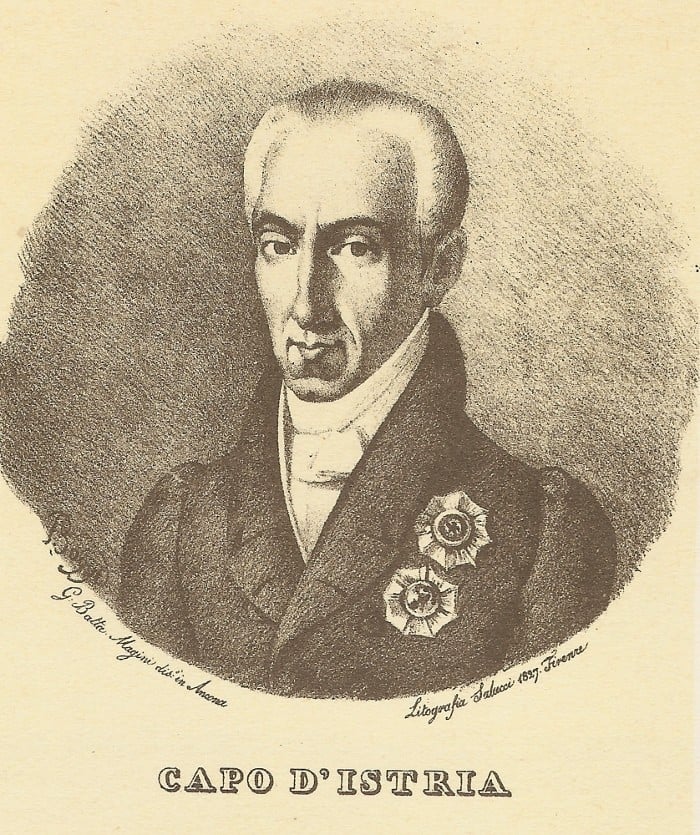
The English did not see his election in a good light. They believed that during the seven years of his term he would be influenced by Russia and the Tsar. Kapodistrias, knowing the problems of the country he was taking on to govern, tried to obtain guarantees from the Great Powers. He started from London, but the reception was cold. After all, George Canning was being buried on the same day. He followed Paris and ten months after his election he finally arrived in Nafplio on January 18, 1928 and four days later he went to Aegina, the then capital of the state.
A state that is not… a state
He found a state in disintegration, or rather a state that had never acquired institutions and a strong administration . Turkish troops were still present within its borders, the fighting had not stopped, piracy threatened the country’s supply, civil strife broke out at the first opportunity.
There was no army. He tried to transform the irregular detachments into a unified military force , while he transformed the privately owned ships of the shipowners into a War Fleet.
He understood that he could not democratically govern a country that had 400 years of slavery behind it and an authoritarian administrative system directed by the Sultan. In this, his influences from Tsarist Russia, where there was a complete lack of Democracy, were very clear. He believed that in the first phase there should be a Despotism, for the institutions to function and then for the people to decide on their future. After all, neither the people nor the government decided on the future, but the Great Powers that were the guarantors of its creation.
During his reign, the battles with the Turks ended with the victorious Battle of Petra (September 1829), while the new Greek state almost included Samos and Crete . While the ambassadors of the Great Powers agreed to this, their governments backed down.
He tried to limit the privileges that had been given to various governors by the Turks, had been maintained during the Revolution, but could not be accepted in an independent country. This created conflicts, tensions in which the Great Powers also played a role . The English and French did not see him as the Governor of Greece, but as the Tsar’s Minister of Foreign Affairs. Even though he had refused the financial compensation of Russia as well as a salary from the state.
The vendetta that led to his murder
In 1830, a rebellion broke out in Mani, led by Tzanis Mavromichalis , brother of Petrobey . The latter was imprisoned in Nafplio, having asked to go to Mani to calm the situation. His attempt to escape on a British warship made the situation even more difficult.
The decision was made: Revenge, that is, vendetta.
Constantis and Giorgis Mavromichalis , brother and son of Petrobey respectively , undertook to get their blood back.
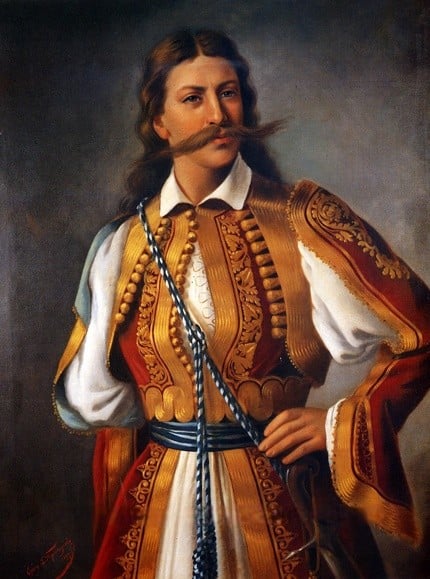
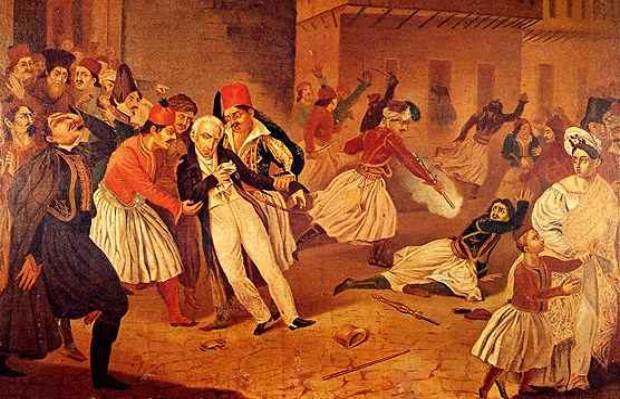
On September 27, they stabbed and shot the first Governor outside the church of Saint Spyridon in Nafplio.
Giorgis Mavromichalis approached him and plunged a black-handled knife into his stomach. Kapodistrias , wounded, retreated, but behind him, Konstantis Mavromichalis took out his pistol and fired. With them was policeman Ioannis Karagiannis , who fired but missed. The fourth, also a policeman, Andreas Georgiou , remained uninvolved .
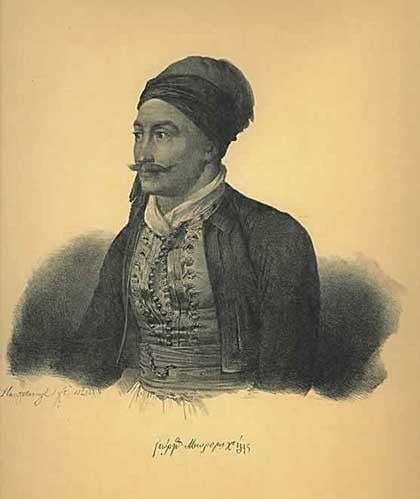
The Cretan bodyguard George Kozonis , who had lost his arm in the fight for the independence of his island, shot Constantis, who was killed by Major Christos Fotomaras . While the Governor was dying, George Mavromichalis fled to the French ambassador’s house. The enraged crowd surrounded it and threatened to set it on fire. He eventually surrendered to the authorities. He was tried, sentenced to death and executed a few days later. Constantis’ body was thrown into the sea.
The role of foreigners and Petrobey’s confession
There is evidence implicating France in the Governor’s murder, with England knowing but not reacting.
Years later, in 1840, Petrobeis Mavromichalis , upon hearing someone accuse Kapodistrias, is reported to have said: “You are not measuring well, philosopher… Curse the English and French who were the cause, and I lost my own people, and the Nation a man who will never be found, and his blood torments me to this day… “