
ΕΑΝ ΠΡΟΤΙΜΑΤΕ ΕΛΛΗΝΙΚΑ ΠΑΤΗΣΤΕ ΤΗ ΣΗΜΑΙΑ ΣΤΟ ΚΑΤΩ ΜΕΡΟΣ ΤΗΣ ΟΘΟΝΗΣ
By Helleniscope’s Editorial Team
I. The New Contract: £8 Billion for Twenty Typhoons
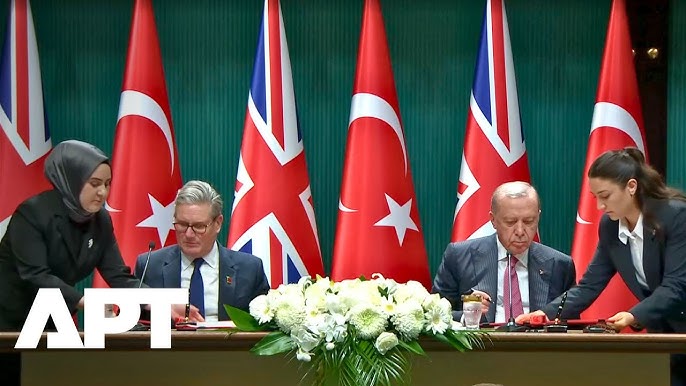
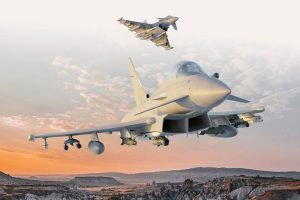
In late October 2025, Ankara and London sealed one of Europe’s largest fighter-aircraft export deals in years. Turkish President Recep Tayyip Erdoğan hosted British Prime Minister Keir Starmer in Ankara for the signing of a contract worth roughly £8 billion (US $10.7 billion). The agreement will deliver 20 Eurofighter Typhoon jets, manufactured by a consortium led by BAE Systems alongside partners in Germany, Italy, and Spain.
For Britain, it was a long-sought diplomatic and industrial win — reviving an export line that had fallen quiet since deliveries to Qatar and Saudi Arabia. For Turkey, it was a declaration of strategic intent: Ankara is rebuilding its combat aviation fleet after years of turbulence in its relations with Western suppliers.
Deliveries of the new aircraft are expected to begin near 2030, complementing the planned rollout of Turkey’s indigenous TF-Kaan fifth-generation fighter.
II. The Secondary Hunt: Used Jets From the Gulf
President Erdoğan confirmed that negotiations are also underway with Qatar and Oman to purchase used Eurofighters from their inventories. Estimates vary — but Turkish sources mention around a dozen aircraft from each partner. These would serve as a stopgap force, allowing the Turkish Air Force to restore its numbers before the brand-new jets arrive later in the decade.
The used-aircraft option is telling. It reflects both the urgency in Ankara’s defense planning and the limits of its industrial capacity to bridge the gap between retiring F-4 Phantoms and the unready TF-Kaan. Qatar’s small but modern Typhoon fleet, originally supplied by Britain, is considered a perfect fit. Oman’s earlier-block Typhoons would require upgrades, but could be transferred quickly.
III. The Strategic Context: Exile From the F-35 Club
Turkey’s hunger for advanced fighters is the direct consequence of its 2019 expulsion from the US-led F-35 Lightning II program, following its purchase of the Russian S-400 air-defense system. That rupture left Ankara with only aging F-16s and a shrinking fleet of F-4Es — and a lingering sense of strategic humiliation.
For years, Ankara tried to repair ties with Washington to unlock new F-16 sales and modernization kits, while also courting European suppliers. Germany long blocked Eurofighter exports to Turkey, citing human-rights and regional-policy concerns. London’s push under Starmer finally overcame that deadlock — signaling both a shift in German pragmatism and a new British appetite for muscular export diplomacy. Helleniscope’s Take: Given the many troubles the F-35 program is facing and also the uncertainty of how it fares against the S-400 (and the much more advanced S-500) Russian missiles and their powerful radars, it is still to be determined whether this is actually a setback for Turkey.
IV. Europe’s Industrial Diplomacy
For the UK, the deal is more than a sale: it is a statement that post-Brexit Britain still shapes the defense architecture of Europe’s periphery. The Typhoon sale links Britain’s BAE Systems directly into Turkey’s emerging fighter ecosystem, potentially offering collaboration on avionics, pilot training, and maintenance hubs.
Yet London must walk a narrow line. Human-rights organizations in Britain and Europe criticized the deal, arguing that Ankara’s record — from crackdowns at home to operations in northern Syria — makes such exports morally fraught. But Starmer’s government framed the agreement as a “strategic NATO investment” to support the alliance’s southeastern flank amid renewed Russian aggression in the Black Sea region.
V. Regional Reverberations: Aegean Anxiety
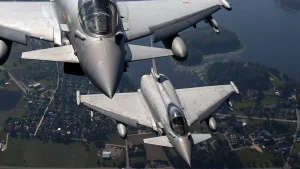
No one is watching more closely than Greece. For Athens, every uptick in Turkey’s airpower triggers a recalibration of its own modernization plans. Greece already fields Rafale F3R fighters and has orders for F-35s, giving it a technological lead — but Ankara’s Eurofighter acquisition could narrow that gap.
If Qatar and Oman indeed supply additional Typhoons, the Turkish Air Force could deploy as many as 40–50 advanced multirole fighters before its indigenous Kaan becomes operational. That would reintroduce parity over the Aegean and Eastern Mediterranean, forcing Greece to rethink sortie ratios, maintenance cycles, and long-term pilot training investments.
Helleniscope’s take: We cannot help but notice that for one more time in modern history the British government (and whoever is behind it) tries to save Turkey from a true catastrophe. Alas, this will be the last time, as the geopolitcal chess game has shifted Eastwards and the West cannot master the weapons systems and the power to face the BRICS tsunami…
VI. A Transitional Doctrine
Turkish defense officials describe the Typhoon deal as part of a “transitional airpower doctrine” — bridging the decade between the aging F-16s and the rise of the Kaan. In this sense, the Typhoon purchase is not merely about numbers but about capability continuity. The aircraft’s multi-role performance, advanced radar, and long-range Meteor missile integration make it a potent interim deterrent.
Financially, the cost is steep: £8 billion for 20 jets implies a unit package far above typical export prices, reflecting not only inflation and training but also Ankara’s willingness to pay for political access as much as for hardware.
Western media have framed the agreement as a “NATO signal to Putin” — a visible demonstration that Turkey, despite periodic friction with allies, remains anchored in the Western defense system. This narrative suits both Ankara and London: Turkey gains legitimacy, while Britain showcases itself as a diplomatic bridge between skeptical European partners and strategically vital, if difficult, allies.
Still, Turkey’s balancing act persists. Ankara maintains dialogue with Moscow, buys Russian energy, and hosts negotiations on Ukraine, even as it deepens military cooperation with NATO members. The Eurofighter deal thus embodies Turkey’s hybrid diplomacy — transactional, autonomous, yet ultimately Western-leaning when high technology is at stake.
VIII. Analysis: Between Power and Dependence
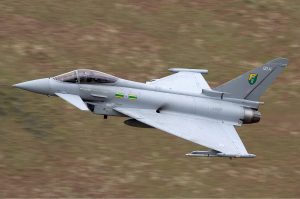
From an analytical standpoint, this twin pursuit of new British jets and used Gulf ones tells a story of constrained autonomy. Turkey aspires to sovereignty in defense production — yet the Eurofighter purchase underscores how dependence on Western technology remains unavoidable in the short term.
At the same time, Ankara’s capacity to mix sources (British, Qatari, Omani) demonstrates the flexibility of its defense diplomacy. It negotiates horizontally, not hierarchically — leveraging its regional relationships to substitute for US access.
For Greece and the wider region, the question is not whether Turkey can field a few dozen Typhoons, but how effectively it can integrate them into a doctrine that blends Western platforms, local production, and geopolitically ambivalent alignment. That, ultimately, will determine whether the Eurofighter deal reshapes the Aegean balance — or simply buys Ankara time until its homegrown jet truly flies.
IX. Conclusion: A Sky in Transition
Turkey’s Eurofighter deal is less a single purchase than a strategic bridge — across time, technology, and diplomacy. It connects the isolation of the F-35 crisis to a new era of pragmatic engagement with Europe. It also connects the fading roar of the F-4s to the yet-unproven whisper of the TF-Kaan.
For Britain, it revives the export lifeline of its aerospace industry; for NATO, it reassures the alliance’s flank; for Greece, it sounds another note in the long Aegean duet of deterrence and dependence.
In the skies over Anatolia, the Typhoon’s silhouette will soon join that chorus — a reminder that even in an age of domestic ambition, Ankara’s wings are still, for now, made in Europe.
October 28, 2025, n.stamatakis@aol.com www.helleniscope.com
DISCLAIMER: The views and statements expressed in this article constitute constitutionally protected opinions of this author.