
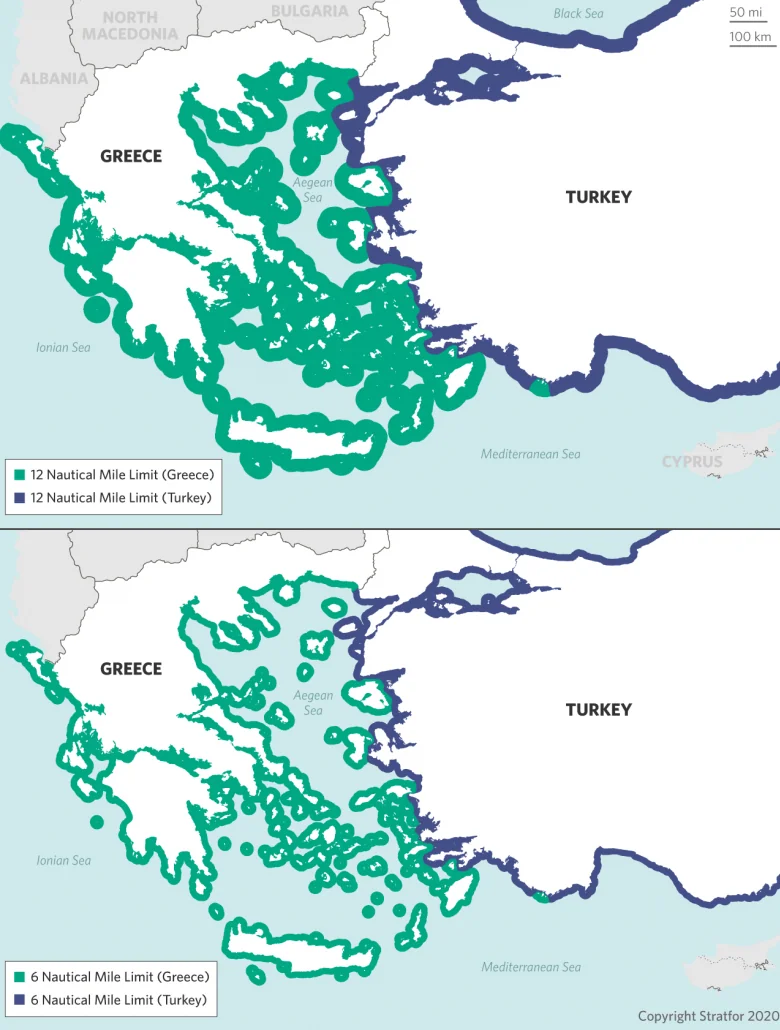
EDITOR’S NOTE (Nick Stamatakis). This article sheds new light on the confidential Greek-Turkish exploratory talks of 2003, during the government of Kostas Simitis. Drawing on recent commentary by former Deputy Foreign Minister Christos Rozakis in Kathimerini, it revisits negotiations that nearly resulted in a major maritime agreement — one that would have extended Greece’s territorial waters to 12 nautical miles only in select areas while leaving others at six. The revelations confirm earlier reports by Estia and raise concerns that the old negotiation records could now be used by Ankara to pressure Athens in ongoing discussions. Former Foreign Minister Evangelos Venizelos also proposes “temporary practical measures” for the Aegean and Eastern Mediterranean, echoing earlier calls for confidence-building steps. Together, these developments reignite debate over Greece’s maritime strategy, sovereignty, and the delicate balance of diplomacy in the region.
=================
Rozakis vindicates Estia: Maps showing 6-mile limits for our islands east of the 25th meridian! “And 6 miles of airspace!”
With an article in Kathimerini, the backstage of the 2003 exploratory talks under Simitis is revealed and our information is confirmed – Evangelos Venizelos proposes “temporary measures of a practical nature” for the Aegean and the Mediterranean – Turkey as representative of the Turkish Cypriots!
An article by former Deputy Minister Christos Rozakis, published yesterday in Kathimerini, vindicates Estia, which as early as October 21—under the title “The secret minutes of the exploratory talks: a weapon in the Turks’ hands”—had pointed out that maps limiting the territorial waters of our islands to 6 miles had already been agreed upon in 2003, under the Simitis government.
Our newspaper had even highlighted the dangers of those minutes being used by Hakan Fidan in the upcoming five-party conference.
“We came very close to an agreement in 2003,” admits the then Deputy Minister of Foreign Affairs Christos Rozakis, who further clarifies:
“Indeed, the progress of the exploratory contacts, led by two men who are no longer alive (the late ambassador to London A. Skopelitis and the late professor of International Law at the University of Athens Ar. Fatouros), had reached a point where Turkey had accepted 12 nautical miles for all the continental coasts of Greece, Euboea, and all islands west of the 25th meridian, such as the Sporades (and naturally, the Turkish continental coasts would also have 12 miles). For the remaining islands, however, the territorial sea would remain at 6 nautical miles.”
These were exactly the points Estia had already reported—warning that, in any conference (five-party or otherwise), the minutes of those exploratory contacts would be used by Turkish Foreign Minister Hakan Fidan as a powerful instrument of pressure against Greece.
Greece, the paper argued, would find itself in a very difficult position, forced to explain—before third countries—why, for 22 years (since 2003), it had not proceeded with the arrangements it had agreed upon.
And let there be no doubt: Fidan will present Turkey’s demands in a highly pressing manner, claiming that Greece is inconsistent with previously agreed solutions.
Thus, if anyone is caught by surprise, it will likely be the Greek minister, not the Turkish delegation, contrary to some reports.
Rozakis also gives an interesting explanation as to why the results of the exploratory talks were never formalized in 2003:
“Simitis’s problem,” he admits plainly, “was his parliamentary group. He didn’t think he could get the arrangements discussed in the exploratory talks through Parliament.”
At the time, the patriotic faction of PASOK still had a strong enough parliamentary presence to block the maneuvers of the Simitis circle.
Another “surprise,” as Kathimerini warns, is the possibility that Turkey might attend the five-party conference representing the interests of the Turkish Cypriots.
Such a development—and especially its acceptance by Athens and Nicosia—would amount to formal recognition of the dissolution of the Republic of Cyprus.
Under international law, the President of the Republic of Cyprus alone represents the interests of the Turkish Cypriots. Any deviation would mean acceptance of the annexation of the occupied territories by Turkey.
There is also an interesting article by Evangelos Venizelos, who speaks of temporary, practical measures, something Estia had already mentioned on September 21.
He specifically states:
“This creates the need to clarify what we propose to do regarding bilateral contacts between states in the region… Of a bilateral nature are also the practically crucial Greek-Turkish contacts concerning confidence-building measures, mainly of an aeronautical character, since issues such as airspace, search and rescue, and other related matters concern not only the Aegean but also the Eastern Mediterranean.”
And further:
“The revival of such a diplomatic initiative, given its history, inevitably intersects with discussions about temporary practical arrangements (explicitly provided for in UNCLOS) in areas with as yet undefined continental shelves and EEZs, regarding the passage of pipelines and cables.”