

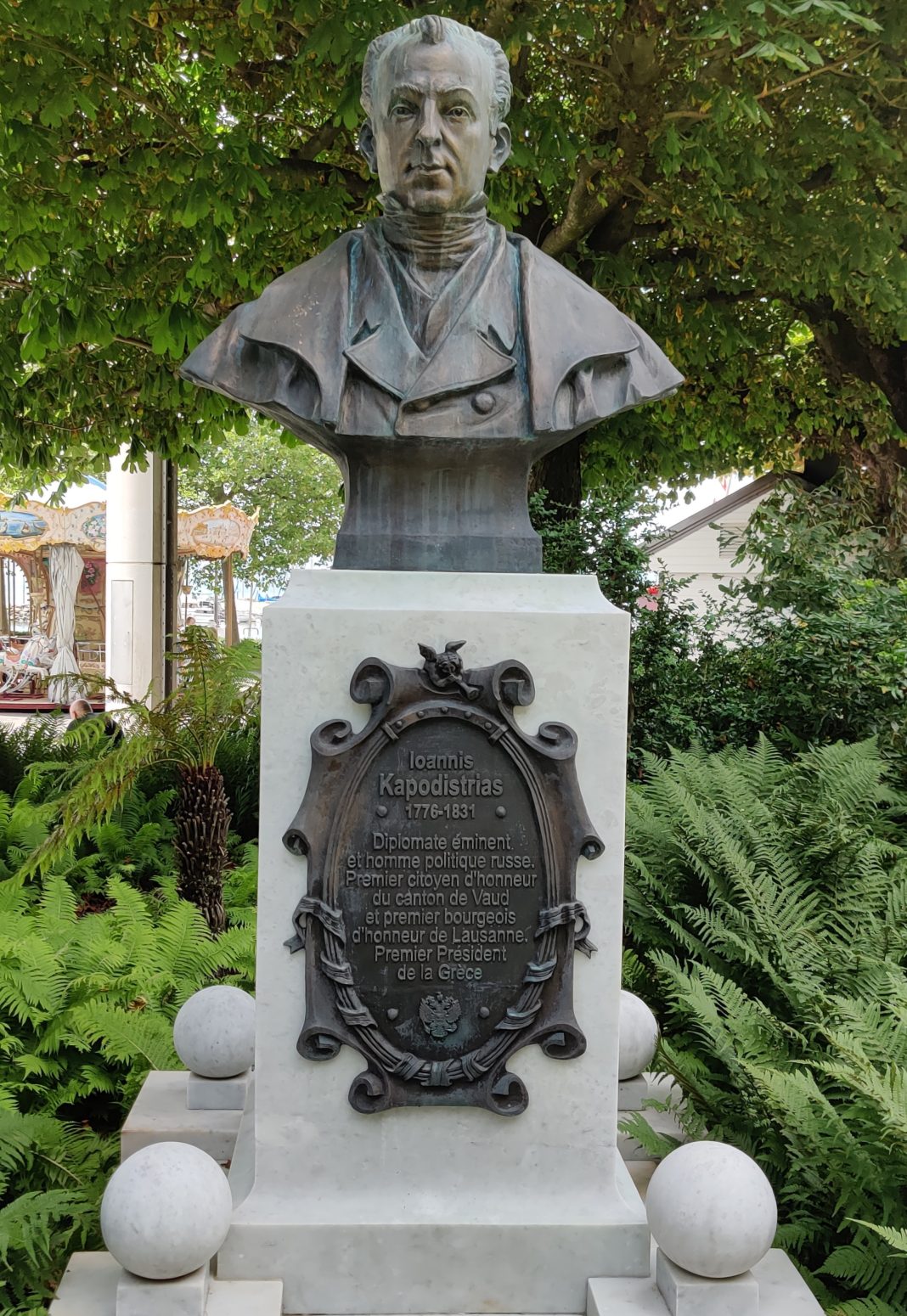
PHOTO: Bust of Kapodistrias in Lausanne…
EDITOR’S NOTE (Nick Stamatakis). This video was produced by the channel “History in Brief,” run by two young Greek Americans, Fanis and George Tsatalios. (Please consider subscribing to their channel—and encourage your children and family members to do the same!) They attended the premiere of Kapodistrias by Smaragdis and were deeply inspired by it.
Ioannis Kapodistrias played a significant but often overlooked role in the re-establishment of Switzerland after the Napoleonic Wars. Acting as a senior diplomat of the Russian Empire, he was closely involved in Swiss affairs between 1813 and 1815, when the Confederation faced political fragmentation and external pressure. Kapodistrias strongly supported the restoration of Swiss federal unity through a constitutional framework that balanced cantonal autonomy with a cohesive central structure. His influence helped shape the Federal Pact of 1815, which reaffirmed the confederation of cantons while preventing both excessive centralization and renewed foreign domination.
Equally important was Kapodistrias’ contribution to the international recognition of Swiss perpetual neutrality. At the Congress of Vienna, he argued forcefully that a neutral Switzerland was essential for European stability, serving as a buffer between the great powers. Through diplomatic negotiations—particularly with Austria, Britain, and France—he helped secure collective guarantees of Swiss neutrality and territorial integrity. This recognition was not merely symbolic; it embedded neutrality into the European balance of power and protected Switzerland from becoming a battlefield in future continental conflicts.
Kapodistrias’ work in Switzerland reflected his broader political philosophy: constitutional order, legal stability, and international legitimacy as foundations for small states’ survival. His efforts left a lasting imprint on Swiss political development, as both the 1815 constitutional settlement and the internationally guaranteed neutrality became cornerstones of Swiss statehood, shaping the country’s domestic governance and foreign policy well into the modern era.
===============