

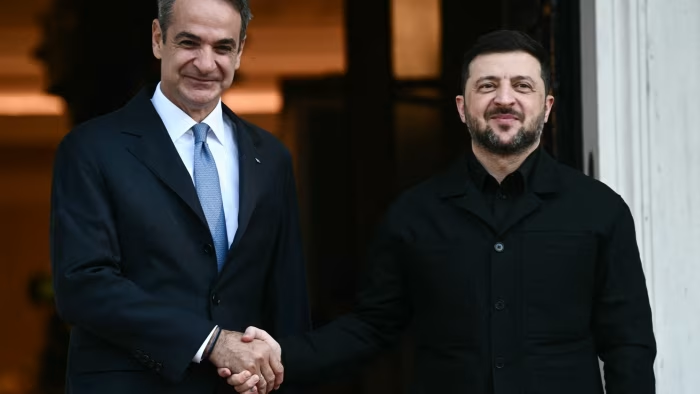
Prime Minister Kyriakos Mitsotakis has fully aligned himself with the bloc of states (Germany, Poland, etc.) that are fervently in favor of seizing Russian assets, without even informing Parliament of this decision and, of course, without taking into account the geopolitical, economic, and legal risks arising from such a move.
“The December European Council is absolutely critical, as we will need to take important decisions regarding the financial support of Ukraine, following commitments that the Council has already undertaken.
Our country supports Ukraine and will back any solution that can provide it with financial stability, so that the country can remain secure and continue to defend itself against the Russian invasion,” Prime Minister Kyriakos Mitsotakis stressed upon arriving at the EU Summit.
“However, we have emphasized many times that any solution must be legally and fiscally secure, and must ensure that the funds Ukraine receives and spends on armaments also take into account specific national priorities that member states may have,” he noted.
Mitsotakis may speak of a “legally secure” move, but he knows very well that when you steal something that does not belong to you, there can be no “security,” not even when wrapped in legal packaging.
Responding to a related question from a journalist, he pointed out:
“What matters is that we find a solution for financing Ukraine. Greece clearly prefers the reparations loan. We take into account the fact that Russian assets have already been frozen indefinitely, which I believe constitutes a very significant political statement toward all parties involved.”
“I fully share the view of the President of the European Council that we should not leave Brussels, and the room in which we are meeting, without finding a solution that is legally solid and that resolves Ukraine’s financing problems,” the prime minister concluded.
The legal risks behind the “reparations loan.”
The West proceeded to freeze Russian state assets shortly after the start of Russia’s full-scale invasion of Ukraine in 2022.
Of the approximately €300 billion in Russian foreign reserves that have been frozen internationally, €210 billion are located in Europe, mainly in Belgium, where they are held at the central securities depository Euroclear.
Legal experts and academics point out that the European Commission is moving into uncharted legal territory with the proposal for the so-called “reparations loan” to Ukraine.
Belgium opposes the plan, arguing that it would be exposed to the risk of being forced to compensate Russia if Moscow were to win potential legal challenges.
Specifically, Belgian Prime Minister Bart De Wever fears that his country could be “buried in legal disputes.”
He also expresses concerns about liquidity issues if Euroclear were required to rapidly settle any claims, arguing that EU member states would need to cover the legal costs collectively.
The Central Bank of Russia has already filed a lawsuit in Moscow, seeking $230 billion in compensation from Euroclear.
If the central bank were to prevail, it could seek enforcement of the ruling in other jurisdictions, particularly those that Russia considers “friendly.”
Russia could also turn to the Court of Justice of the European Union (CJEU), the Stockholm Arbitration Court, or a United Nations body.
And all this without even factoring in the geopolitical risks… For example, the risks to the euro, to Europe as a whole, and of course, Moscow’s reaction.













Well, let’s be honest, him and his family owe everything to the U.S. and Israel. He’ been and continues to be both bribed and blackmailed. Greece could have been both successful and independent instead of the U.S. and the Zionist…doormat (that’s not the word I want to use).
Good luck with that one—you hapless jokers!
George Kanenas.
There is no such thung as “independent” Greece. Greece is a small nation, with a relatively middling military, that does not produce its own hardware, with an economy that is still recovering and lagging behind the pre 2008 GDP.
No country can be independent, as a matter of fact. America, the military and economic powerhouse that she is, depends on China more than we can admit. America “FIRST” means America without allies. Not a good situation even for America. China depends on the world buying her products, otherwise, she’ll lose legitimacy in the eyes of her own people.
That still doesn’t make Greece a doormat. Her voice carries more weight than her size would have enabled her, if she was “independent” of the EU. Look at Great Britain, a nation much more advanced than Greece. They left the EU and have regreted it ever since.
Greece must be associated with others. Even Isreal, which is admittedly overbearing, is best to have it on Greece’s side than not. They have technology, investments and military expertise to offer.
Greece is absolutely a doormat. The Us effectively governs Greece and its foreign policy.
The coup against former prime Minister Karamanlis proves Greece is a doormat. Only prime minister’s going along with US interests govern Greece.