
By Lambros Karpodinis
Many contemporary people think that Greek civilization was a flash in the pan, during the Periclean age of Athens. While much of today’s Western thought was born after the defeat of the Persian empire’s incursion into Greece, Greek civilization was flourishing and producing in Southern Italy, Western Anatolia, the Southern Balkans, the Levant, and Egypt, with Alexandria as its epicenter. Many ideas in science, technology, religion, astronomy, and more were developed outside Greece, by Greeks or by Hellenized non-Greeks. For instance, Eratosthenes of Alexandria, understanding that the earth was round and not flat, was able to measure its circumference with astonishing accuracy.
Greek thought, including religion, developed over centuries through trial and error. The story of the development of Christianity, a faith that, though based on Judaism, is a product of Hellenism and reflects Hellenic thought. While the spread of Christianity was not Alexander the Great’s plan, his vision of the future, as being an amalgamation of Greek and oriental thought and world views, came to fruition in Christianity’s acceptance.
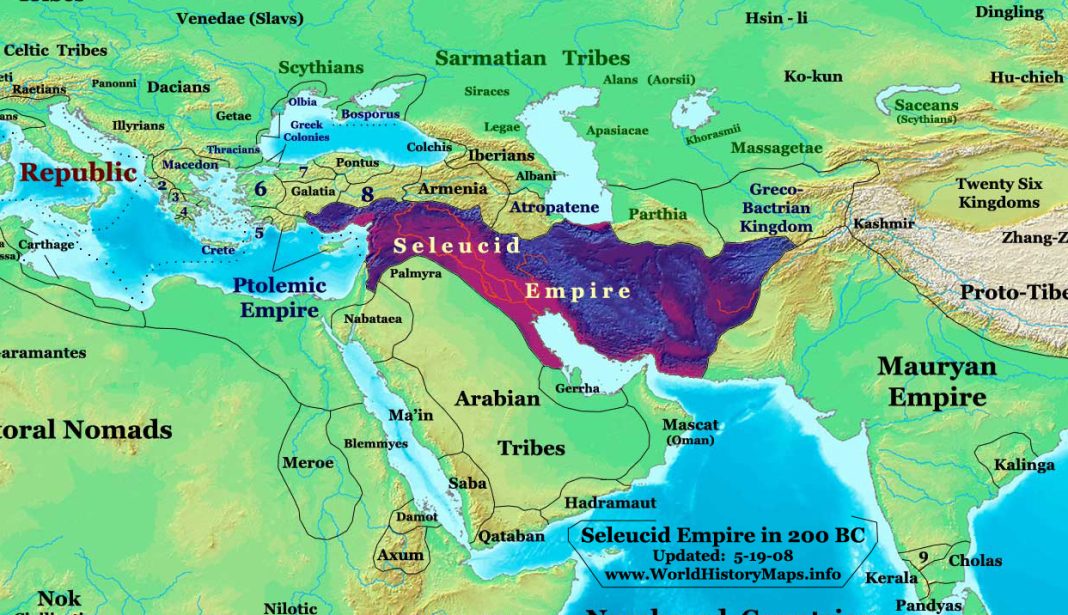
The Ptolemaic and Seleucid empires were both Hellenistic superpowers that reached their apex around 200 B.C. As competing empires, they fought each other in numerous wars. Wars between Greek states were common. The battles between the Seleucid and Ptolemaic empires were fought by mercenaries, many of whom were Jews and Greeks, hired by either empire to fight against each other.
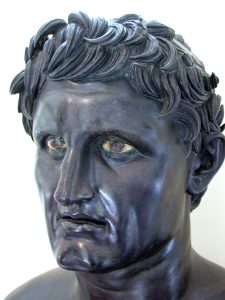
PHOTO: Bronze bust of Seleucus I Nicator.
Around the year 200 B.C. after three inconclusive wars, the Seleukid empire, under Antiochos III, (the great) won a decisive battle against the boy emperor of the Ptolemaic empire, Ptolemy V Epiphanes. The Seleukid empire took the lands that comprise today’s Israel.
The rule of Antiochos III was also as benevolent towards the Jews’ monotheistic faith as under the Ptolemies. The temple priests and scribes were exempt from taxation, and the Jews’ taxes to the state were reduced.
However, Antiochos III’s successes raised an alarm and the envy of the rising power of Rome. In 190 BC, the Roman legions slaughtered Antiochos’ army at Magnesia in southwestern Anatolia, and the following year the Roman Senate ordered Antiochos not only to pay Rome a huge indemnity for the war, but also to give up all his Anatolian possessions. This brutal Roman policy effectively cut Antiochos’ economic and military base in half while saddling him with enormous obligations. The annual tribute from Jerusalem was therefore increased, to the dismay of the high priest and worshipers of Adonai.
The Jewish diaspora began in earnest during Antiochus the Great’s rule, before the Roman conquest. This fact is significant in Christianity’s development. Eventually, the provinces of Lydia and Phrygia were Greek-speaking primarily, and we must suppose that the Judaean soldiers or veterans selected to garrison the cities here knew at least some Greek. However, they may have usually spoken Aramaic. In their new settings, the men and their families would increasingly have used Greek, and after a generation or two, the Judaeans of western Anatolia would have forgotten Aramaic. They were now a part of the Hellenistic Diaspora, and in their Sabbath worship, the Septuagint (The Torah written in Greek) would have been central.
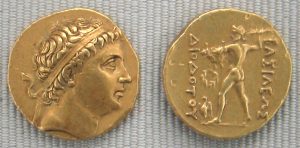
PHOTO: Gold coin of Diodotus, who asserted independence to form the Greco-Bactrian kingdom c. 245 BC. Greek legend reads: ΒΑΣΙΛΕΩΣ ΔΙΟΔΟΤΟΥ, Basileōs Diodotou, “of King Diodotus.”
By the first century A.D. (the years 0-99), synagogues were found in cities across the Greek-speaking world. Paul saw several synagogues in the harbor city of Salamis, Cyprus. The modest cities of Antioch in Pisidia and Ikonion in Phrygia had each a synagogue. Even the little neighboring cities of Derbe and Lystra had Judaean communities and presumably small synagogues. A Greek inscription dating from the first century CE shows the presence of a “synagogue of the Judaeans and the theosebeis (“God-fearers)” far to the north of Anatolia, in the city of Pantikapaion (today, the city of Kerch, on the eastern tip of the Crimean peninsula).
These synagogues of transplanted, Greek-speaking Jews, already open to adopting non-Jewish customs, found the words of the Gospel fertile ground. The synagogues themselves were nothing more than private homes for almost three centuries after Christianity’s birth.
As synagogues were small, private homes at first, eventually, in the bigger cities, they were built to accommodate larger numbers of people. To perceive the potentially large size of the synagogue, Luke tells us in Acts the following: “When Paul came to Antioch in Pisidia and went to the synagogue for Sabbath worship, he was invited by the president of the synagogue to give the congregation news from Jerusalem. Paul told them of the resurrection of Jesus. On the next Sabbath, so Luke says (Acts 13:44), “the whole city” gathered to hear more about this latest and greatest of the Judaeans’ miracles.” While we cannot doubt that the entire city was accommodated in the one synagogue, we can surmise that it was larger than a typical home.
In the very largest cities, such as Antioch in Syria and Alexandria in Egypt, synagogues eventually grew enormous and were splendid in their architecture and appointments. In rabbinic lore (of dubious credibility) about the Second Temple period, the great synagogue in Alexandria was so large that kerchief signals were required to keep the congregation coordinated during “Amens” and other responses.
In the earliest synagogues, little or no congregational organization was required. The heads of the families who had purchased the building supervised the conduct of worship services and the performance of rituals. As the congregation grew, it established a board of elders (presbyteroi) and an executive who held the title of archisynagogos, “leader of the synagogue.” In a small city in the Hellenistic Diaspora, the archisynagogos was also regarded as the head of the town’s Judaean minority in its more secular affairs. Moreover, the position of the archisynagogos became hereditary.
Leadership of a synagogue by a rabbi, schooled in the oral as well as the written Torah, was a much later development (it followed the Christianization of the Roman Empire in the fourth and fifth centuries).