


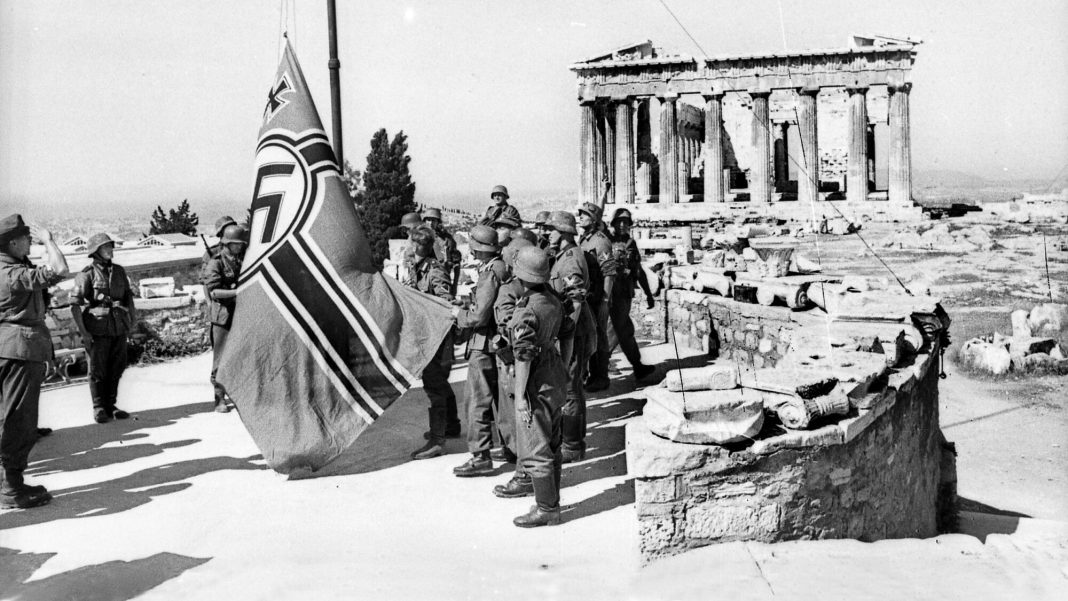
Thirty years have passed since the historic milestone of the creation of the National Council for the Claiming of Germany’s Debts for Nazi atrocities in Greece.
By Giorgos Chatzidimitriou
This is an anniversary that Kyriakos Mitsotakis—who has entrusted the fate of German reparations to the good will of Berlin—would like to see pass quickly. Nevertheless, these days mark thirty years since the informal founding, on January 22, 1996, of the National Council for the Claiming of Germany’s Debts to Greece. It was a historic milestone, as this decisive act in the pursuit of justice for our long-suffering people contributed decisively to keeping alive the flame of claims for the crimes committed in the country by the Occupation forces.
As the Council’s secretary, Dr. Aristomenis Syngelakis, emphasizes, the National Council “provided moral and political support to the victims’ judicial struggle, exposed the hypocrisy and intransigence of German governments, and exerted constant pressure on Greek governments and political parties to assume their responsibilities.”
It also contributed “to the broadening and strengthening of the movement,” with perhaps its greatest achievement being “the almost unanimous decision of the Plenary Session of the Hellenic Parliament on April 17, 2019, in favor of the firm and decisive pursuit of German debts.”

Furthermore, the National Council, “through its timely and decisive interventions (in the Hellenic Parliament, the government, and Greek society), thwarted Berlin’s long-standing attempt to falsify historical truth and infiltrate schools and Greek society, aiming to undermine the claim for German debts through initiatives such as the Greek-German Youth Foundation (GGYF), the German ‘Fund for the Future,’ the program ‘Memories of the Occupation in Greece’ (MOG), and others.”
These institutions are generously funded by the German Foreign Ministry. Under seemingly harmless titles and under the pretext of promoting “friendship,” “mutual understanding,” and “virtuous relations among peoples,” they persistently and systematically cultivate, in reality, the distortion of truth and historical amnesia regarding Nazi crimes—offering beads and mirrors through cultural exchanges, leisure trips, and showcase projects, in order to evade responsibility for reparations.
What remains etched in collective memory is the hyperactivity of that unspeakable special envoy of Angela Merkel for Greek-German cooperation in local government, Hans-Joachim Fuchtel, who roamed the country producing a crude and unbearable caricature.
“He comes for octopus and retsina and does nothing,” the late Yiannis Boutaris had complained in a three-page letter to the Greek and German foreign ministries. Meanwhile, Merkel’s favorite, at one point taking his coarse ridiculousness to new heights, suggested to the Mayor of Athens, Giorgos Kaminis, that they wear ancient cloaks and walk to Ancient Olympia to strengthen bilateral relations!
German obligations, however, do not expire. And Germany’s president, Frank-Walter Steinmeier, still remembers his visit to the martyred village of Kandanos in 2024—when survivors of the Occupation and the Metropolitan Bishop of Kissamos and Selino, Amphilochios, through their dignified stance, turned Germany’s celebratory attempt to “bury” its debts into a fiasco.
Today, despite the consistently inadequate stance of Greek governments over time and its abandonment by the Mitsotakis government, the issue remains open and relevant. Greece’s claims against Germany, as ruled by former President of the Republic Prokopis Pavlopoulos, are “legally valid and judicially enforceable.”

Christina Stamouli: “We Are Struggling to Shape a National Strategy”
Within 2026, the National Council will proceed with holding its 11th Congress, aiming to renew and strengthen the struggle, while fully aware that it stands at a critical crossroads.
As lawyer Christina Stamouli points out—daughter and custodian of the archive of the late Ioannis Stamoulis, who in 1995 filed the historic lawsuit at the Multi-Member Court of First Instance of Livadeia seeking compensation for the victims of the Distomo Massacre—“the council, which was formally established in 2001 with the publication of its statutes by the Athens Court of First Instance, although it claimed for years the role of the principal representative body of civil society, unfortunately failed to formulate and propose a national strategy. Especially in the 2010s—when the issue returned to the forefront—it addressed it solely in terms of communication and publicity, overlooking substantive problems that needed to be overcome (the absence of a Peace Treaty, Germany’s growing influence in the EU, and its economic-political penetration of Greece).”
As she notes, “it failed to draw conclusions from the strategy of the Jews, a people who suffered the ultimate Holocaust but simultaneously succeeded in subduing the arrogance of postwar Germany. It did not even set as a goal the mobilization of the Greek diaspora to create an osmosis of international public opinion around the issue. The success of the Armenian diaspora proves this!”
She considers “the greatest mistake of the National Council to be that it trapped the struggle for reparations in the logic of accounting valuation of German debts and in the entrenchment of a four-part set of demands that must be claimed only as a whole. An ‘all or nothing’ argument which, to this day, has demonstrably led us to nothing—allowing Germany to dismiss the claim curtly and arrogantly.”
Ms. Stamouli concludes in good faith: “Personally, the late Manolis Glezos, as its head, is credited with the political success of issuing—by the Hellenic Parliament in 2016 and ultimately voting on in 2019—the famous Report of the Cross-Party Parliamentary Committee on the claim for German debts. Although it has remained forgotten in the drawers of the Greek political system—when it could have been supplemented, improved, and used in countless ways—hope always dies last, provided that beyond Athens we also organize ourselves and raise our hand. Perhaps we really must accept it: in this effort, no one is superfluous and no one can ‘play the leader.’”
















Thirty years after the informal founding of the National Council for the Claiming of Germany’s Debts to Greece, the question is not whether memory endures — it does — but whether justice will finally follow.
The Council’s efforts kept alive an uncomfortable truth: the wartime crimes and unpaid obligations inflicted on Greece by Nazi Germany have not vanished with time or diplomatic platitudes. What has tragically vanished too often is political will.
Greek governments have repeatedly treated reparations as a matter of goodwill instead of law. Prime Minister Kyriakos Mitsotakis’s passive reliance on German benevolence is emblematic of a broader failure: our state has, by omission, accepted a narrative of closure that suits Germany’s image-management campaigns. Funds and foundations that come with glittering cultural programs — the Greek-German Youth Foundation, the so-called Fund for the Future, and “Memories of the Occupation” initiatives — have softened public memory and distracted from legal and moral responsibility. These are not innocent cultural exchanges when they function to blunt claims for reparations; they are strategic legerdemain.
The National Council itself, once a vibrant moral voice, allowed its strategy to calcify. As Christina Stamouli has argued, the Council’s fixation on an “all or nothing” package of claims and its failure to craft a broader national and international strategy weakened the cause.
We must learn from other diasporic successes, such as the Jewish and Armenian communities, as the article suggests, which have shown how sustained global advocacy, legal pressure, and diaspora mobilization can shift political realities. Greece needs that same sustained effort — a campaign that is legal, diplomatic, and popular.
Practical steps are clear.
First, decouple the claim from purely symbolic or public-relations battles: pursue targeted legal actions that are flexible and incremental rather than hostage to an inflexible ledger of demands.
Second, internationalize the issue by mobilizing the Greek diaspora, human rights organizations, and sympathetic parliaments across Europe and beyond.
Third, build a domestic consensus that treats reparations not as partisan rhetoric but as an element of national dignity and historical truth — something the 2019 near-unanimous parliamentary resolution started but did not complete.
Germany’s obligations do not expire simply because Berlin prefers to forget. The recent memory of Kandanos and the dignified stand of survivors showed that German state ceremonies cannot erase duty. If Greece wants genuine redress, it must renew its strategy, broaden its coalition, and refuse the comfort of symbolic consolation. Justice for wartime crimes requires patience — and above all, relentless action. The country that remembers must now act.
Sevi Boutos