

ΕΑΝ ΠΡΟΤΙΜΑΤΕ ΕΛΛΗΝΙΚΑ ΠΑΤΗΣΤΕ ΤΗ ΣΗΜΑΙΑ ΣΤΟ ΚΑΤΩ ΜΕΡΟΣ ΤΗΣ ΟΘΟΝΗΣ
Despite renewed diplomatic engagement, the central asymmetry remains: Greece continues to refrain from exercising its lawful right to 12-mile territorial waters under the threat of force. When will Greece declare its 12-mile territorial water zone? As Andreas Papandreou once said, when asked a similar question (the question was “When the military junta of 1967-74 falls?”): “When a bird whistles in Washington D.C. and says ‘Greece should go ahead and do it!!’…
By Helleniscope’s Editorial Team
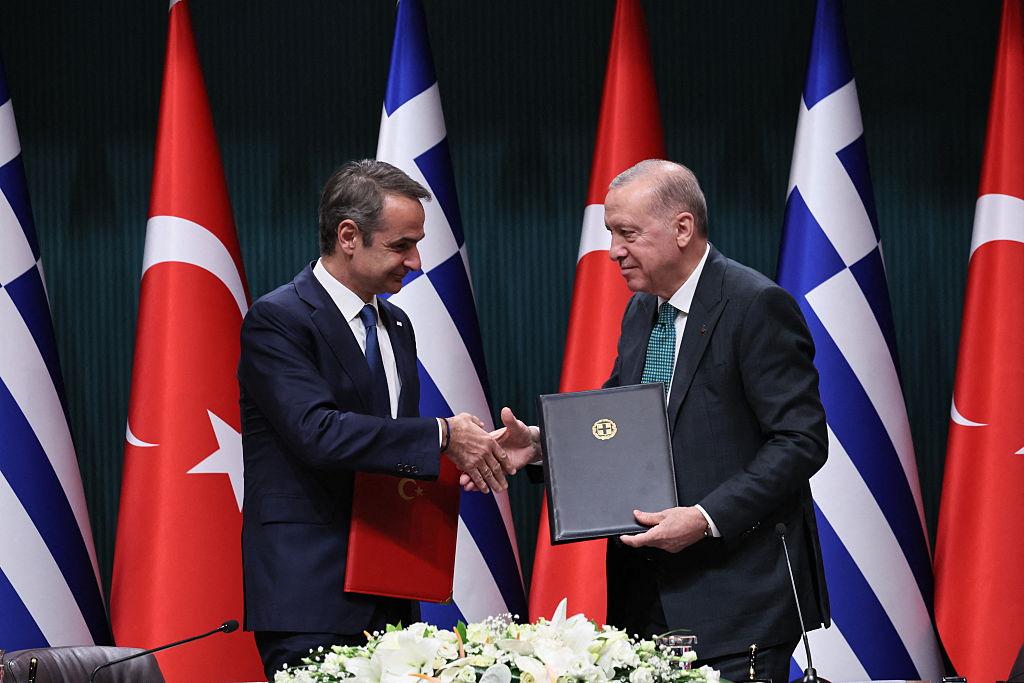
Today’s Ankara meeting between Erdogan and Mitsotakis and their ministers kept the “calm waters” script alive—pragmatic cooperation up front, unresolved sovereignty disputes in the background, and Athens again demanding an end to the standing “threat” embodied by Turkey’s 1995 casus belli.
The day in Ankara
Mitsotakis arrived in Ankara shortly after mid‑afternoon local time and was received at Ankara Esenboğa Airport by Turkey’s Minister of Culture and Tourism, Mehmet Nuri Ersoy, alongside local officials; the minister’s exact welcoming words were not disclosed in the public coverage reviewed.
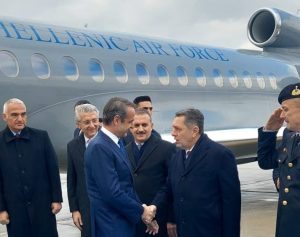
From there, the motorcade headed for the Presidential Complex—often dubbed the “White Palace” in Greek reporting—where Erdoğan formally received the Greek prime minister before their talks. The setting was the sixth High‑Level Cooperation Council session, with a heavy ministerial presence: Greek reporting lists a ten-member Greek delegation (including Foreign Minister Giorgos Gerapetritis), while Turkish Foreign Minister Hakan Fidan took part in the core format.
The tone—by design—was measured and future‑oriented: sustaining structured dialogue, “positive agenda” projects, and mechanisms meant to prevent crises even when core disagreements remain.
The “threats” line and what it was understood to mean
In his public remarks, Mitsotakis delivered the phrase that framed the day’s political headline: «είναι καιρός πια να αρθεί κάθε απειλή, τυπική και ουσιαστική… Αν όχι τώρα, πότε;» (English: “It is time to lift every threat, formal and substantive… If not now, when?”).
Greek primary coverage explicitly interpreted this formulation as a clear reference to Turkey’s 1995 casus belli—the Turkish parliament’s warning that a Greek extension of territorial waters in the Aegean beyond 6 nm would be treated as cause for war.
Erdoğan’s response, as relayed in Greek coverage, stressed solvability “on the basis of international law,” while also leaning into personal warmth—calling Mitsotakis «πολύτιμο φίλο» (English: “a valuable friend”).
Deliverables: migration, trade, ferry link, and memoranda
Substance came packaged as “low politics” deliverables. Mitsotakis highlighted that irregular flows in the Eastern Aegean “have decreased… by almost 60%” over the last year, crediting tighter border control and improved coordination, with an explicit call to intensify the fight against smuggling networks.
Economically, both sides reiterated the ambition to reach $10 billion in bilateral trade by the end of the decade.
The cooperation “stack” took written form in seven signed texts, including: a Joint Declaration; a culture MoU; Foreign‑Ministry cooperation in the Black Sea Economic Cooperation framework; “Enterprise Greece–Invest in Turkiye” cooperation; a bilateral research/technology program; earthquake‑preparedness cooperation; and a joint statement launching a Thessaloniki–Smyrna (İzmir) ferry link.
Here are the statements by the two leaders:
Conclusion: Sovereign Rights, Strategic Choices, and the Limits of Incrementalism
While the meeting reaffirmed a commitment to dialogue and confidence-building, the central strategic question remains unresolved: Greece’s sovereign right under international law to extend its territorial waters to 12 nautical miles.
Under the framework of the UN Convention on the Law of the Sea (UNCLOS), coastal states are entitled to extend their territorial waters from 6 to 12 nautical miles. Greece is effectively the only coastal state in the world that has not exercised this right across its maritime domain — not due to legal ambiguity, but because Türkiye has maintained a decades-old declaration of casus belli should Greece proceed with such an expansion in the Aegean.
This reality introduces a structural imbalance into the diplomatic equation.
From a legal standpoint:
The 12-mile extension is recognized as a sovereign right.
International maritime law provides mechanisms — including innocent passage and navigational guarantees — to ensure that international shipping and access to ports are not obstructed.
Greece has repeatedly pointed to arrangements such as “safe passage corridors” to safeguard Turkish navigation and commercial access, thereby mitigating operational concerns.
Therefore, arguments suggesting that a 12-mile extension would “block” Turkish ports or strangle maritime access do not withstand scrutiny under established legal norms.
This raises a strategic question: If Greece continues to refrain from exercising a universally recognized sovereign right under explicit threat of force, what is the reciprocal gain?
Diplomatic engagement, economic cooperation, and trade targets — while valuable — do not in themselves constitute a commensurate exchange for the indefinite suspension of a core sovereign entitlement. For restraint on such a fundamental issue to be strategically justified, one would expect substantial concessions or structural breakthroughs on other fronts: maritime delimitation agreements, formal withdrawal of the casus belli, binding dispute-resolution commitments, or concrete movement on long-standing regional disputes.
At present, no such transformative exchange appears to be on the table.
Thus, while the Ankara meeting reinforces positive momentum and reduces short-term tensions, it does not alter the underlying asymmetry surrounding Greece’s 12-mile right. Dialogue may manage friction, but absent meaningful structural reciprocity, the strategic calculus remains unchanged.
In that sense, the meeting represents stability management rather than strategic resolution — and the fundamental question of sovereign rights versus deterrent threats continues to define the core of the bilateral relationship.
When will Greece declare its 12-mile territorial water zone? As Andreas Papandreou once said, when asked a similar question (the question was “When the military junta of 1967-74 falls?”): “When a bird whistles in Washington D.C. and says ‘Greece should go ahead and do it!!’…
February 11, 2026, n.stamatakis@aol.com www.helleniscope.com
DISCLAIMER: The views and statements expressed in this article constitute constitutionally protected opinions of this author.















Under the 1960 treaty, in which colonial power Britain granted Cyprus limited independence, Article 1 bars Cyprus from entering into any political, military or economic union.
The idea is to hobble Cyprus and keep it neutral and not a threat to its neighbors.
The Treaty carves up the country and grants Britain sovereignty over two areas forever.
Despite EU and UN blather that territorial integrity is sacred, both support the treaty.
Turkey then invaded to protect allegedly its citizens and further carved up the country.
Today there are no (zero) EU and US sanctions against Turkey.
Invasions to protect threatened minorities are OK says NATO. Same with Kosova/Bosnia.
Cyprus is the international law model as to how to end the Kiev/EU war against Russia.