


ΕΑΝ ΠΡΟΤΙΜΑΤΕ ΕΛΛΗΝΙΚΑ ΠΑΤΗΣΤΕ ΤΗ ΣΗΜΑΙΑ ΣΤΟ ΚΑΤΩ ΜΕΡΟΣ ΤΗΣ ΟΘΟΝΗΣ
Two more aircraft carrier groups (an American and a French) head to the Middle East, while Iran declares it will protect the homeland, and Russia made a public statement that it will support Iran!
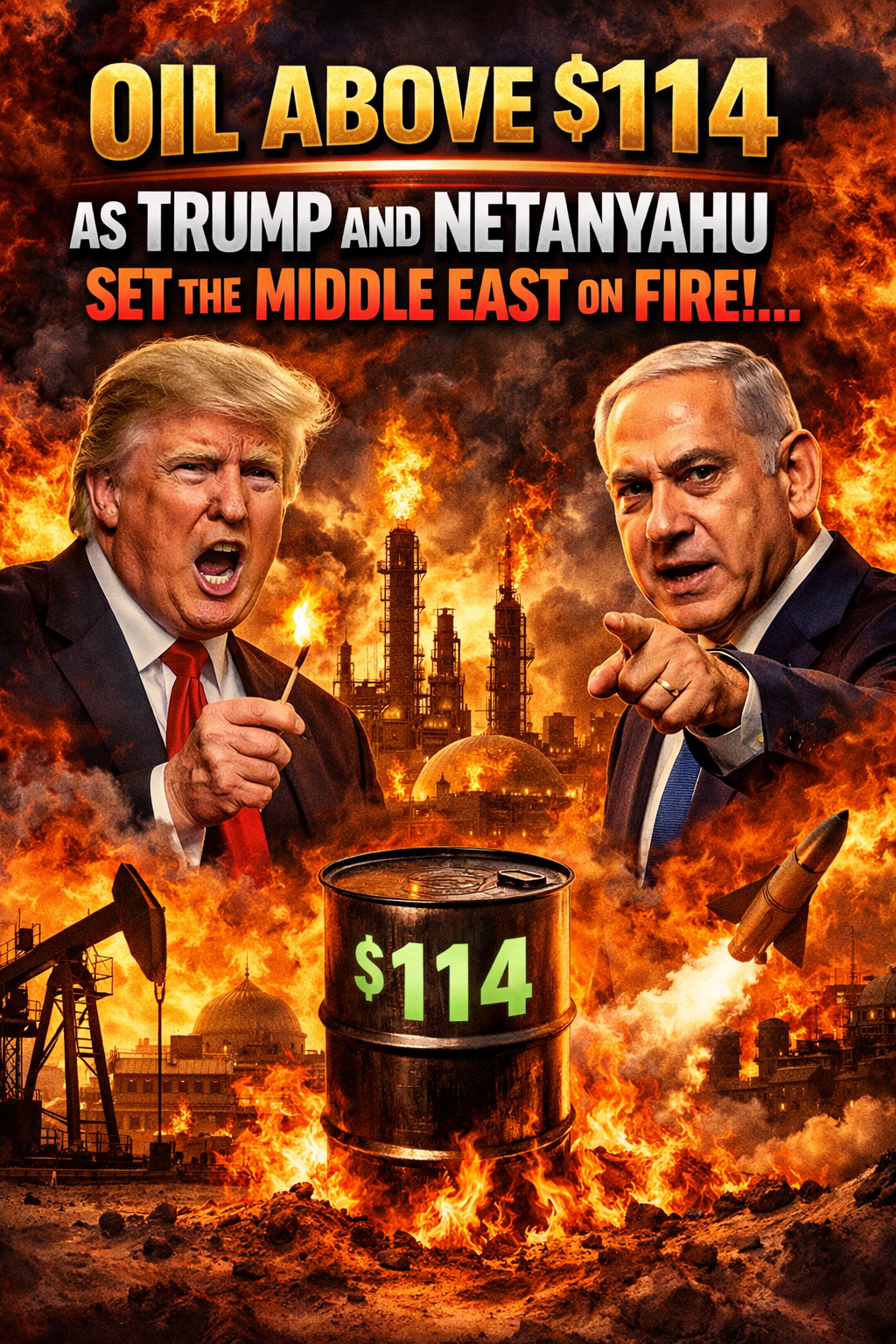
Oil prices have surged dramatically today, crossing the $110 mark and, in some trading sessions, pushing even higher, as the conflict across the Middle East injects a massive geopolitical risk premium into global energy markets. Traders following energy platforms such as OilPrice.com have been watching crude spike intraday above roughly $114 per barrel, levels not seen since the early phases of the Ukraine energy shock. The surge reflects not simply market speculation, but a rapidly deteriorating security environment in the region that produces a large share of the world’s oil.
At the center of the crisis is the expanding confrontation involving Iran, Israel, and the regional Gulf States. Roughly one-fifth of global oil flows through the Strait of Hormuz, the narrow maritime corridor between Iran and the Gulf states. Any credible threat to shipping there immediately pushes oil prices higher. Insurance costs for tankers are already rising, and even rumors of restricted transit are enough to spark rapid moves in crude futures.
Adding to the sense of escalation, Western military deployments to the region are increasing. A third U.S. aircraft carrier strike group (George H.W. Bush) is reportedly heading toward the Middle East, while France has also deployed a carrier group to reinforce naval presence. Such deployments signal that major powers believe ill the situation could widen beyond a localized confrontation.
The political dimension inside Iran has also intensified uncertainty. Reports indicate that Mojtaba Khamenei, the son of Iran’s long-time supreme leader Ali Khamenei, has assumed leadership after a rapid succession process. Leadership transitions during wartime are particularly destabilizing because they often empower hardline factions and complicate diplomatic channels. Energy traders interpret this as an additional risk factor that could prolong the crisis.
Meanwhile, rumors circulating in financial markets suggest that some Gulf sovereign wealth funds have been attempting to repatriate overseas investments amid the turmoil. There are unconfirmed reports that certain funds approached global asset managers, including BlackRock, seeking large withdrawals. Claims that only partial withdrawals were honored have circulated widely online, though there has not yet been authoritative confirmation from major financial outlets. Still, even rumors of liquidity stress among Gulf sovereign funds underscore how geopolitical shocks can ripple through global financial systems.
Another major geopolitical development is Russia’s public positioning in the conflict. Moscow has condemned the U.S. and Israeli strikes on Iran and signaled political support for Tehran. Russia’s ambassador to the United Kingdom stated that Moscow is “not neutral” in the conflict and supports Iran’s position, while criticizing Western governments for blaming Tehran alone for the escalation. () Reports from intelligence sources also indicate that Russia may have provided Iran with information about U.S. military assets in the region, potentially assisting Tehran in targeting Western forces. () While the Kremlin has simultaneously called for a ceasefire and diplomatic resolution, its alignment with Iran underscores the broader geopolitical stakes of the crisis and raises concerns that the conflict could evolve into a wider confrontation involving major global powers.
From an oil market perspective, the immediate driver of prices is fear of supply disruption rather than an actual collapse in production—at least for now. However, energy analysts note that the market is extremely sensitive to even small changes in supply. If only two to three million barrels per day were removed from the global market, the effect could be dramatic because spare production capacity is limited and inventories are relatively tight.
For this reason, traders are closely watching several indicators. Tanker traffic through the Strait of Hormuz remains the most critical. Any significant slowdown would likely push prices sharply higher. Production levels in Saudi Arabia and the United Arab Emirates are another key variable, since these states hold most of the world’s spare capacity. Markets are also watching whether the United States might release additional oil from the Strategic Petroleum Reserve to stabilize prices.
At present, analysts outline several possible price paths depending on how the conflict develops. If hostilities stabilize without major shipping disruptions, oil could settle back toward the $90–$105 range. If tanker traffic becomes partially restricted, prices could climb into the $110–$130 band. A full closure of the Strait of Hormuz, even temporarily, could send crude toward $150 or higher and potentially trigger a global economic slowdown.
In short, the oil market is once again functioning as the world’s geopolitical barometer. Prices are not rising because demand has suddenly surged, but because traders are pricing in the possibility that a major share of global energy supply could be threatened. The coming weeks will depend largely on whether the conflict remains contained or expands into a broader regional war that directly targets the infrastructure and shipping routes upon which the global energy system depends.
March 8, 2026, n.stamatakis@aol.com www.helleniscope.com
DISCLAIMER: The views and statements expressed in this article constitute constitutionally protected opinions of this author.















Severe suffering worldwide. starts now. Trump has moved like a blind shark. Lie, steal, and get what he can. He screwed all of us. Congress is defunct, due to their lack of courage, discernment and ability to act. Many administrations prior to Trump did the same. God help us.
In Greece, we are accustomed to $8 & $9 gasoline at the fuel pumps due to the “indirect fuel taxes”…the Greek economy usually “stinks” in comparison with the the US economy as a result of “over-taxation” / strangulation factors like this…
Let’s see how long it takes for the US population to get accustomed to such pries at the pump…especially 8 months before the midterm elections.
If the readers recall, G Bush “junior” had already conducted the experiment during his term, when oil spiked to above $140/barrel about 18 years ago:
https://en.wikipedia.org/wiki/World_oil_market_chronology_from_2003
“The highest recorded price per barrel maximum of $147.02 was reached on July 11, 2008”
If you adjust for inflation, in today’s dollars that would be about $222, according to https://www.usinflationcalculator.com/
…So unfortunately, it appears at a quick glance we still have a record-breaking ride to go…
That kind of price would certainly cause $8 per gallon gas in the United states, and probably 3 or 4 Euro per liter gas in Europe…long-term, those kind of numbers will cripple the global economy.
The government “advisors” certainly have the statistics to know the “breaking point” for the US / global economy…as well as the boundaries of “short-term” and “long-term” effects…perhaps they are even thinking of the midterm elections, that add an additional complexity to that “line”….it is unlikely that they want to cross that boundary….and they certainly know the clock is ticking….
The question is…when exactly will it be “time up” from an economics perspective, and what exactly will they have they achieved by all this that we are witnessing? Based on whatever the media has decided to “feed us” so far, doesn’t appear to be a logical path to a long-term “return on investment” here…for anyone other than the Military Industrial Complex, that will certainly see a spike in orders to replenish the arsenal that has been expended…
“Short term oil prices, which will drop rapidly when the destruction of the Iran nuclear threat is over, is a very small price to pay for U.S.A., and World, Safety and Peace. ONLY FOOLS WOULD THINK DIFFERENTLY!” Trump wrote.
Screw you, orange man. Who decided this “small price” was worth paying? Aren’t our representatives in Congress supposed to decide that? Gas prices have gone up more than 50% where I live in the last week. I don’t think blowing up a country that posed no threat to me is worth that cost. And protecting the Zionist Entity is definitely not worth and extra $20 per fill-up.