


By Nick Stamatakis
A consensus began to form among analysts regarding the two major issues, the two significant setbacks in Greek foreign policy in recent days. It points to the fact that Russia is dissatisfied with the Mitsotakis’ policies in Ukraine, the unnecessary (some would say treasonous) statements and actions that place Greece in confrontation with Russia, supposedly “on the right side of history”: Significant amounts of Greek weaponry and munitions were removed from the Eastern Aegean islands to be sent to Ukraine, followed by inappropriate statements by Mitsotakis (such as “We are in War with Russia”). Similarly, a Russian journalist was expelled from Greece… Just today, Russia took action and banned the entrance to its territory of a high-level Greek official to retaliate (link here).
It is not simply this humble writer who supports this view, but most experienced geopolitical analysts of Greece – and above all, one of the best among them, Stavros Lygeros, in today’s podcast, titled “Russia Punishes Us.” Lygeros refers to the events of a century ago, when Greek Prime Minister Venizelos sent a whole Army Division to fight the Bolsheviks in Crimea and Ukraine, resulting in the Great Catastrophe of 1922, mainly due to Russian support of Kemal Atatürk.
1) Regarding St. Catherine’s of Sinai, yesterday’s meeting in Cairo of the foreign ministers of Greece and Egypt produced no tangible results: NOT ONE mention of the ownership status of the monastery, just verbose references to its “continuing function as a religious institution”… Here is the summary of the meeting: During their meeting, Minister Abdelatty reassured that the court’s decision does not impact the monks’ access to the monastery or its religious value. He emphasized Egypt’s commitment to preserving the spiritual and religious significance of Saint Catherine’s Monastery and the surrounding archaeological sites. Minister Gerapetritis expressed satisfaction with these assurances, stating that both nations are dedicated to protecting the monastery and clarifying its legal status, recognizing its importance to the Greek Orthodox faith and historical tradition.
We would be remiss not to emphasize that in December 2021, the Russian Orthodox Church (ROC) established a Patriarchal Exarchate of Africa, partly due to canonical disputes with the Greek Orthodox Patriarchate of Alexandria. In essence, this was a form of retaliation for the Constantinople Patriarchate’s interference with the ROC’s jurisdiction in Ukraine, which led to the Schism in Orthodoxy. Also, the Russian Orthodox Church has cordial relations with the Coptic Orthodox Church of Alexandria, the dominant Christian church in Egypt. Both of these entities would be happy to assume the historic monastery of Sinai, with the help of the Egyptian State. Greece has been degrading its presence in the Eastern Mediterranean for decades, particularly since 2019, when Mitsotakis assumed power.
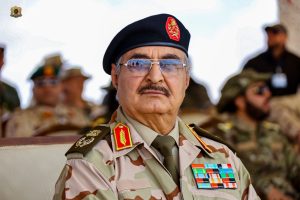
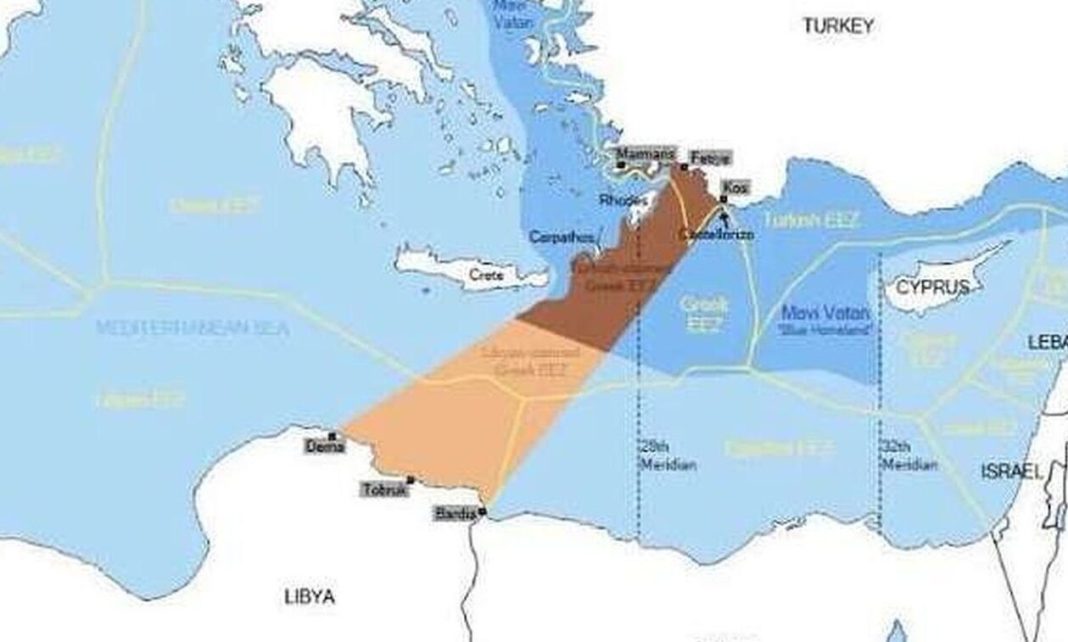
2) In a very recent development, the Libyan House of Representatives, based in Tobruk and aligned with General Khalifa Haftar, is reportedly considering ratifying the contentious maritime agreement with Turkey. This marks a significant shift, as the eastern-based authorities had previously rejected the MoU, labeling it as illegitimate and a violation of Libyan sovereignty. If the eastern Libyan authorities proceed with ratifying the maritime deal, it would align all major Libyan factions with Turkey’s maritime claims, potentially challenging Greece’s bilateral maritime agreement with Egypt and complicating regional energy exploration efforts.
This is a disaster for Greek foreign policy, which was relieved a few months ago when ExxonMobil, which operates oil and gas exploration fields both in Libya and South of Crete, proceeded to recognize the median line as the maritime border between the two countries.
Khalifa Haftar, the ruler of Eastern Libya (Benghazi), is mainly controlled by Egypt and secondarily by Russia, while Turkey has military bases in Western Libya (Tripoli). Some analysts already assume that a secret deal was done between Turkey and Russia regarding a peaceful resolution in Libya. This deal was blessed by Egypt, whose experienced leader, El Sisi, made the proper evaluation of the situation: he saw that Greece is impotent and has no real strategy in the region (except promoting the business interests of the cronies surrounding Mitsotakis.
Conclusion: Geopolitical Repercussions
A sharp decline in Greece’s geopolitical position is evident, primarily due to the Mitsotakis government’s firm alignment with Western policy on Ukraine, which has alienated Russia, a long-time, nuanced player in the region. Russia’s retaliatory moves, including diplomatic sanctions and expanded influence in Libya and through the Russian Orthodox Church, show a concerted effort to counter Greek interests.
Meanwhile, the Greek-Egyptian talks over St. Catherine’s Monastery yielded no concrete outcomes, signaling diminished influence. The situation is further complicated by Russia’s and the Coptic Church’s strengthened ties, which may undermine Greece’s religious and cultural foothold.
Most critical, however, is the potential ratification of the Turkey-Libya maritime agreement by Haftar’s faction. This would represent a significant blow to Greek maritime claims and energy strategy, effectively aligning all Libyan power centers with Turkey, backed by Russia and Egypt.
Altogether, these setbacks indicate a Greek foreign policy that lacks coherence and strategic depth. Without a recalibrated, regionally attuned approach, Greece risks becoming a marginal player in shaping its own neighborhood.














Informative. Thank you!