
Edited by iEpikaira (link here)
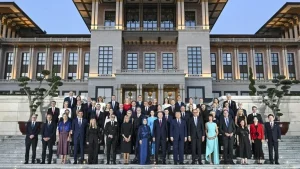
The NATO Summit in Ankara (July 7–8, 2026) has been presented by pro-Western media as a grand celebration of allied unity. Yet behind the handshakes, smiles, and official agenda—which focuses on the new target of spending 5% of GDP on defense and continued support for Ukraine—the reality is very different.
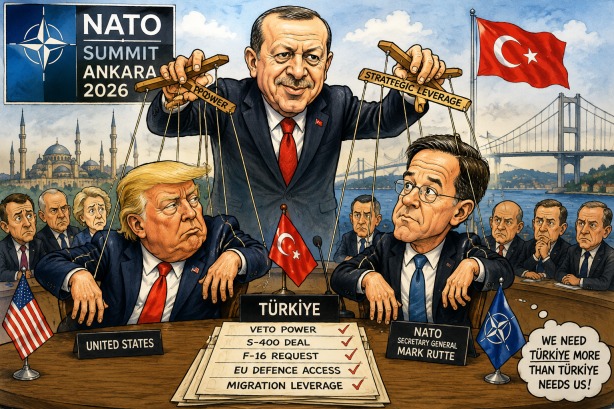
Let us not deceive ourselves: this is yet another demonstration of the cynical, transactional way in which Recep Tayyip Erdoğan approaches the Alliance and the West in general. Once again, Turkey is leveraging its strategic location and military weight to extract the greatest possible concessions from an increasingly uneasy West.
The Summit as a Stage for Blackmail
Having been excluded from key European defense initiatives, yet possessing one of NATO’s largest armies and a rapidly expanding defense industry, Ankara is using the summit to pressure its way into Europe’s defense architecture, demanding recognition and greater influence.
Erdoğan does not come to the table as a partner seeking consensus, but—as the author puts it—as an Eastern bazaar negotiator determined to extract the maximum possible concessions.
By hosting the summit, he also succeeds in changing the narrative. Instead of discussions centering on Turkey’s drift toward authoritarian methods of repression, human rights violations, and the erosion of the rule of law, Alliance leaders are praising the country.
Once again, strategic leverage overshadows democratic principles.
The West’s silence is no accident. It reflects an uncomfortable calculation: the cost of breaking with Ankara is considered greater than the cost of tolerating it.
A History of Instrumentalizing the Alliance
This summit is not an exception but rather the latest chapter in a well-established pattern.
Consider Turkey’s veto of Sweden’s and Finland’s NATO membership. Turkey delayed NATO enlargement for nearly two years, using the Alliance’s unanimity rule as leverage to force changes in other countries’ counterterrorism legislation and to unblock the sale of American F-16 fighter jets.
The issue, the author argues, was never solely Turkey’s genuine security concerns. The message was clear: NATO enlargement had become hostage to a broader negotiation unrelated to collective defense.
The same occurred with the Russian S-400 missile system.
Turkey’s purchase of the S-400 remains perhaps the greatest breach in NATO interoperability. Despite repeated warnings from Washington, Erdoğan proceeded with the purchase, fully aware of the consequences—including Turkey’s removal from the F-35 fighter program.
Rather than reversing course, Ankara portrayed itself as the victim and even demanded compensation.
Turkey’s strategic autonomy has been—and will remain—its highest priority, even above Alliance cohesion whenever doing so serves Ankara’s interests.
This followed, of course, the failed coup attempt of 2016, after which thousands of military officers—many with extensive NATO experience—were dismissed and imprisoned.
According to the author, this marked the point at which Erdoğan openly began portraying the West as, at minimum, complicit in undermining Turkey’s security. It was a rupture of trust that has never truly been repaired.
The Pendulum and Erdoğan’s Own Words
The defining feature of Turkish foreign policy remains its ambiguity.
Turkey remains within NATO while simultaneously cultivating relationships that directly undermine the West. It refuses to impose sanctions on Moscow, openly courts BRICS+ and the Shanghai Cooperation Organization, and while supplying military equipment to Kyiv, keeps the door to the Kremlin open.
This behavior surprises neither those living in Turkey nor those who closely follow the Turkish president’s rhetoric.
His own words, the author argues, constitute the clearest manifesto of this policy toward the West:
On CAATSA sanctions:
“With threats of this kind, you will never make Turkey back down. The language of threats is useless to us.”
(Referring to earlier disputes over the implementation of CAATSA sanctions and Turkey’s purchase of the S-400 system.)
On U.S. support for Kurdish fighters (YPG/PKK in Syria):
“If we are strategic partners, then you must respect your partner. You cannot arm terrorists on our borders and then claim we are allies.”
Regarding NATO:
“NATO must reconsider its stance. Some allies are trying to shape policies that undermine trust within the Alliance.”
Regarding Western tolerance of organizations such as the PKK and the Gülen movement:
“While we protect Europe’s eastern borders, certain NATO member states provide sanctuary to Turkey’s enemies.”
(Statement made during Turkey’s objections to Sweden’s and Finland’s NATO accession.)
Taken individually, some of these statements might be dismissed as rhetorical exaggerations aimed at a domestic audience.
Taken together, however, they reveal a consistent strategy: NATO is valuable only insofar as it advances Turkey’s national objectives.
Why Does the West Accept It?
This is not blindness.
Western governments fully understand the game being played. They simply believe the alternative would be worse.
Turkey hosts critical military infrastructure such as Incirlik Air Base, controls the Turkish Straits under the Montreux Convention, and holds the keys to migration flows into Europe.
As the United States increasingly focuses on strategic competition with China, Washington relies ever more heavily on regional powers to help secure Europe.
Meanwhile, European governments have become accustomed to accommodating Erdoğan’s tactical maneuvering, preferring appeasement over confrontation in the name of Alliance “unity.”
The Theater of the Absurd
Ultimately, the Ankara Summit reveals less about NATO’s strength than about its internal weaknesses.
Erdoğan is not “pro-Russian,” nor does he seek to withdraw Turkey from NATO.
Quite the opposite.
He has fully understood that by remaining inside the Alliance while simultaneously maintaining open channels with anti-Western blocs, he maximizes Turkey’s influence.
And his strategy appears to be working.
Every veto increases Turkey’s importance.
Every regional crisis enhances its geostrategic value.
Every Western concession reinforces Ankara’s belief that NATO needs Turkey far more than Turkey needs NATO.
The question hanging over Ankara, therefore, is not what Turkey wants.
The real question is this:
How is it that so few Western leaders dare to openly point out the theater of the absurd unfolding before our eyes?
Or perhaps, the author concludes rhetorically, they secretly admire the authoritarian methods of the “Sultan.”