


Murder at Sviatohirsk Lavra Raises New Questions – Russian Foreign Ministry Releases New Findings
By Helleniscope’s Editorial Team
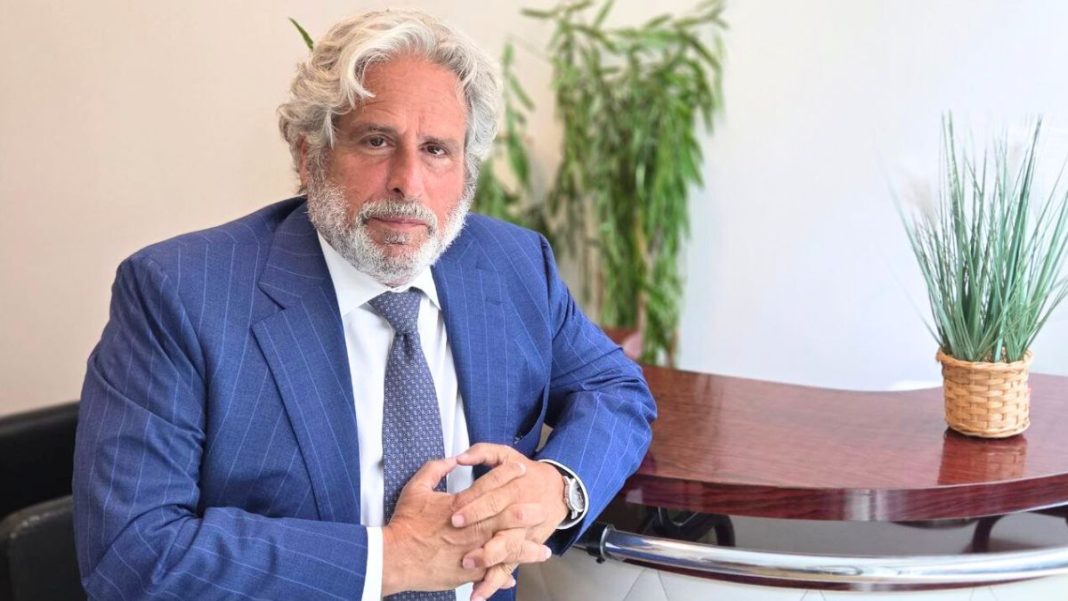
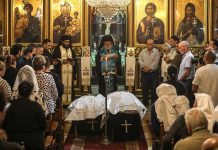
International attorney Robert Amsterdam, whose firm serves as international counsel to the Ukrainian Orthodox Church (UOC), has issued a sharp condemnation following the murder of Monk Varsanofy Turyansky at the historic Holy Dormition Sviatohirsk Lavra, warning that the killing cannot be separated from the increasingly hostile environment surrounding the canonical Orthodox Church in Ukraine.
According to Amsterdam & Partners LLP, unidentified individuals entered the Lavra on August 23 and attacked members of the monastery. Monk Varsanofy was killed, while Monk Hryhoriy and Andriy Kyriienko, a refugee living at the monastery, were wounded. Amsterdam’s firm has demanded an immediate, independent and transparent investigation and called for those responsible to be identified and prosecuted.
The timing, Amsterdam stressed, was particularly disturbing. On the same day, President Volodymyr Zelenskyy hosted Ukraine’s National Prayer Breakfast in Kyiv, attended by political figures, foreign guests and representatives of the Orthodox Church of Ukraine, while the UOC was excluded. Amsterdam accused the Ukrainian leadership of invoking religious freedom publicly while helping to create an atmosphere in which the canonical Church is increasingly marginalized and its believers exposed to hostility.
Religious Persecution Amid a Deepening War
The controversy is unfolding at an especially dangerous moment for Ukraine. Russian military pressure has intensified in the east, while large-scale missile and drone attacks continue to strike Kyiv, Odesa and other major Ukrainian centers. Western governments remain committed publicly to supporting Kyiv, yet concern is visibly growing over Ukraine’s manpower, air-defense and financial difficulties and over the possibility of further Russian territorial advances.
In some circles, the increasingly bleak military picture has revived fears that Moscow’s objectives could eventually extend well beyond the Donbas and toward strategically decisive cities such as Kyiv and Odesa. Such a scenario would radically alter the geopolitical map of Eastern Europe. It should be stressed, however, that current independent battlefield reporting does not establish that the Russian Army is on the verge of occupying the entirety of Ukraine or immediately capturing Kyiv and Odesa.
What is undeniable is that the military balance and the future of Ukraine are again producing serious anxiety throughout Europe. Against this backdrop, the treatment of the UOC assumes even greater significance: if Ukraine is defending itself in the name of European values, critics increasingly ask how restrictions on an historic Christian Church can be reconciled with those same principles.
Russian Foreign Ministry Documents Its Charges
The Russian Foreign Ministry has now released its latest report, On the Kiev Regime’s Unlawful Actions against the Ukrainian Orthodox Church, Its Clergy and Parishioners, updated through June 2026. Moscow says the document records discriminatory legislation, actions by security and law-enforcement agencies, alleged illegal mobilization of clergy, seizures and re-registration of churches, pressure on monasteries, violence and hate speech against clergy and believers, and the role that Russia alleges Western governments have played in the Ukrainian church crisis.
These are Russian government allegations and should be understood within the broader context of the war. Nevertheless, the issue can no longer easily be dismissed as a purely internal Ukrainian ecclesiastical dispute.
Lavrov Places the UOC Question Directly Before the Vatican
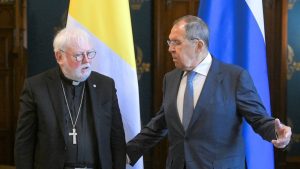
The most significant new development came in Moscow on August 25, when Russian Foreign Minister Sergey Lavrov met Archbishop Paul Richard Gallagher, the Holy See’s Secretary for Relations with States and International Organizations and effectively the Vatican’s foreign minister.
During the meeting, Lavrov raised directly the treatment of the Ukrainian Orthodox Church and handed Gallagher a copy of the Russian Foreign Ministry’s latest report. Lavrov told the Vatican representative that Ukrainian authorities were pursuing the destruction of the canonical UOC through legislative and administrative measures and urged the Holy See to examine the issue closely.
The Vatican itself confirmed that Gallagher and Lavrov held substantive discussions on Ukraine and humanitarian questions, with Gallagher declaring that the war “must end” and emphasizing the need for diplomacy, humanitarian cooperation and the rebuilding of trust.
For Helleniscope, this may prove to be the most important development of all: the persecution allegations surrounding the Ukrainian Orthodox Church have now moved beyond statements by lawyers and Orthodox organizations and have been formally placed on the diplomatic table between Moscow and the Holy See. As Ukraine’s military future grows increasingly uncertain, the fate of its canonical Orthodox Church is likewise becoming an international question that the Christian world—and particularly the Vatican—may find increasingly difficult to ignore.
August 27, 2026, www.helleniscope.com, n.stamatakis@aol.com
DISCLAIMER: The views and statements expressed in this article constitute constitutionally protected opinions of this author.












Good job keeping this issue at the forefront.
I’m a former Roman Catholic, Catholic-educated, and a long-time cynic. Methinks the Vatican can’t and won’t do anything. Overtures to them are meaningless.
The word in your headline should be: Persecution
Here is a link to Amsterdam’s original, in case you want to link it to words in your paragraph, above: https://www.businesswire.com/news/home/20260825567840/en/Amsterdam-Partners-LLP-Ukrainian-Orthodox-Church-Monk-Murdered-on-Day-of-Prayer-Breakfast-Underscoring-Government-Hypocrisy-Amid-its-Campaign-Against-the-Church
Zelensky appears to be in trouble. But we still may need a big protest in Sept. in NYC.
Helleniscope .. ” What kind of people would use Religion in the U.S government and Media to legalizes the persecution, ethnically and religiously cleansing , Terrorising , and Baning of the entire Orthodox Christian Churches, clergy, and faithful from worshiping their God, because they are affiliates with Moscow Church?
CJS it is not Persecition only , it is state sponsorhip of Terrorism …
And lets hope…they actually have the dinner so thousand of Orthodox and all Christians greet the Trustees of the Archidoces, Zelensky , Netanyahue, Geoffrey Pyatt, State department official and US senate and house or public official of America who attends this honor with a “Citizens arrest warrant” for aiding and abetting the persecution and sponsoring state acts of Terrorism against Orthodox Christians!
The damage that Evangelical Protestant Christian and Jewish Zionist members of the U.S. government are doing to Christians and Jews by weaponizing religion is horrific. This damage is not caused by all Evangelicals or all Jews, but by specific political actors who use religious identity as a tool of state power. These actors include Congressman Tom Kean Jr. and the leaders of the US Senate and housees , U.S. State Department official Geoffrey Pyatt, Israeli Prime Minister Benjamin Netanyahu, Ukrainian President Volodymyr Zelensky, and Members of the U.S. House of Representatives aligned with Evangelical political Zionism. Their actions have contributed to the persecution, suffering, and terrorizing of Orthodox Christians, other Christian denominations, and Muslims in Ukraine, Russia, Gaza, Lebanon, Syria, and Palestine.
These actors operate through political networks — not religious communities — including Evangelical Protestant political Zionist networks, Jewish Zionist political networks aligned with the Netanyahu government, and Greek Orthodox institutions such as GOARCH and St. Nicholas Shrine that have been used for political photo‑ops and diplomatic cover. Media institutions aligned with U.S. State Department narratives have further concealed these actions by framing dissent as “antisemitism” or “extremism,” sanitizing foreign‑policy violence, and suppressing public awareness of the suffering inflicted on clergy, monastics, churches, Christian children, and Muslim civilians.
The responsibility lies with these specific political actors and networks — not with innocent Evangelicals, innocent Jews, or innocent Americans. Their use of religion to justify geopolitical domination, undeclared warfare, and human suffering is a betrayal of God, a betrayal of faith, and a betrayal of humanity. And God will not hold us guiltless if we remain silent while these political actors destroy His churches and His children. Moral blindness will fall on all who refuse to act.