


By Nick Stamatakis
Some readers asked us why we did not give any space to the Archbishop’s appointment to President Trump’s Religious Liberty Commission. The main reason is that we know how to distinguish the meaningful from the superficial, as you will see below. We are also keen to discern political cynicism: what is the reason to appoint a hierarch of the Patriarchate to ANY religious freedom committee, the moment that the Patriarchate has been instrumental in suppressing religious freedom in Ukraine? Not to mention numerous other examples elsewhere, especially during the COVID-19 pandemic… Let’s be real…
President Trump‘s Religious Liberty Commission has raised a wave of criticism since its creation, with many arguing that the commission is more symbolic than substantive. Criticism is there in the form of questioning the legitimacy, its actual impact on policy, and whether it reflects the religious diversity of the United States. The main issues raised regarding the commission are listed below.
1. Lack of Legislative or Executive Authority
One of the main complaints is that the commission has no legal authority. It can’t pass laws, regulate with mandates, or compel the government to act. Rather, it is present in an advisory capacity only, suggesting that the administration can accept or reject at will. This has led many to describe the commission as nothing more than a political posturing exercise—intended to do something rather than doing something. Critics also note that advisory boards in previous administrations were largely ceremonial and had little influence on policy-making.
2. Overlapping with Existing Institutions
The Religious Liberty Commission is duplicating existing federal entities, such as the U.S. Commission on International Religious Freedom and the White House Faith and Opportunity Initiative. Critics argue the new board imposes bureaucratic redundancy without seeming justification, at the risk of diluting concentration and resources. Should the administration truly be committed to promoting religious liberty, critics ask, why not strengthen and broaden the mandates of existing institutions rather than creating a new and potentially duplicative one?
3. Instrument of Political Signaling
The commission has chiefly been read as an instrument of political signaling. By establishing it and naming prominent religious figures, the Trump administration is likely attempting to mobilize support from Orthodox Christian and evangelical constituencies ahead of the 2024 election. The use of religious freedom as a wedge issue diminishes its significance and politicizes it, critics argue. This can have the effect of blurring the lines of impartiality in the commission and of its impartiality to all Americans irrespective of religion or political party.
4. Skepticism Over Policy Effect
Past experience with such advisory bodies has led many to doubt whether the commission will have the ability to influence policy in the outside world. Products of these bodies tend to be tabled or ignored unless they fit easily into established political agendas. Without a mandate, enforcement powers, or an administrative drive, the reports of the commission might be nothing more than window dressing—statements of principle rather than plans of action.
Conclusion
Overall, the Religious Liberty Commission appears to be more cosmetic than substantive. Concerns over its lack of influence, duplicative role, and political agenda suggest that it will ultimately be more symbolic as a token to key constituencies than as a force for substantive policy reform. Whether it can overcome these criticisms hinges upon how its recommendations are implemented and if it can learn to be an inclusive, genuinely pluralistic organization.
BELOW IS THE NEWS
=================
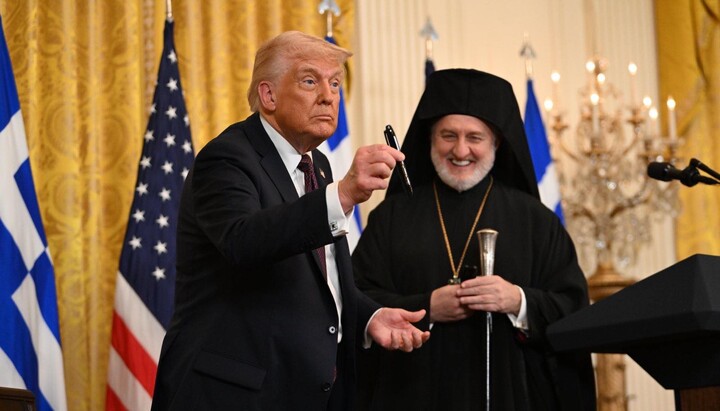
Trump includes hierarch of Constantinople in Religious Liberty Commission

Archbishop Elpidophoros of America has joined the Advisory Board of Religious Leaders for the newly established commission created by the U.S. President’s executive order.
Donald Trump included the head of the Archdiocese of the Ecumenical Patriarchate in the United States, Archbishop Elpidophoros, in the Advisory Board of Religious Leaders for President Donald J. Trump’s newly established Religious Liberty Commission, as reported on the hierarch’s Facebook. The Commission, created by executive order on May 1, 2025, aims to advise the federal government on safeguarding and promoting religious freedom across the United States.
In response to his appointment, Archbishop Elpidophoros stated: “Religious liberty is a cornerstone of our nation, and I look forward to contributing to efforts that promote understanding, dialogue, and peaceful coexistence among all faiths. This mission aligns closely with the vision of His All-Holiness Ecumenical Patriarch Bartholomew, who has long advocated for ecumenical dialogue and reconciliation.”
The Advisory Council of Religious Leaders also includes representatives from various religious denominations, including Catholic bishops, Protestant pastors, and rabbis. Among them are: Bishop Salvatore Cordileone – Archbishop of San Francisco and member of the USCCB Committee on Laity, Marriage, Family Life and Youth; Pastor Jentezen Franklin – Senior Pastor of Free Chapel, a multi-campus church based in Gainesville, Georgia, Father Thomas Ferguson – Pastor of Good Shepherd Parish in Alexandria, Virginia, Rabbi Mark Gottlieb – Chief Education Officer of Tikvah and founding dean of the Tikvah Scholars Program; Pastor Jack Graham – Senior Pastor of Prestonwood Baptist Church in Dallas, Rabbi Yaakov Menken – Executive Vice President of the Coalition for Jewish Values, Bishop Thomas Paprocki – Bishop of Springfield, Illinois and other religious figures.
The Commission is chaired by Texas Lieutenant Governor Dan Patrick, with Dr. Ben Carson serving as vice chair. The commission’s tasks include producing a comprehensive report on the foundations of religious liberty in America, identifying current threats to religious freedom, and recommending strategies to preserve and enhance protections for future generations. The Commission will also advise the White House Faith Office and the Domestic Policy Council on religious-liberty policies.
Earlier, the UOJ reported that Trump signed an executive order creating the Commission on Religious Freedom.













For the protection of Orthodoxy in America, this appointment is hugely important. If the U.S. declares war on Russia, then Russian Orthodoxy in America will be in the crosshairs, just like it is in Ukraine now.
Sorry but i think You are hallucinating…
Όταν θα μάθουν το ευρύτερο νόημα
της λέξης “ ΑΚΡΟΓΩΝΙΑΙΟΣ ΛΙΘΟΣ”
ίσως υπάρξει ελπίδα αποκατάστασης
της αλήθειας και προχωρήσουμε εις
την επαναίδρυση της Μίας Αγίας
Καθολικής και Αποστολικής Εκκλησίας.
Δύσκολο γιατί το χρήμα η ύλη
έφυγε από την τσέπη και πήρε την
θέση του πνεύματος στο ανθρώπινο
κρανίο και εφυλάκισε το πνεύμα στην
τσέπη.
Όταν ο Βαρθολομαίος υπάκουσε την
ΧίλαρI Κλίντον να κάνει την Ουκρανική Εκκλησία αυτοκέφαλη διότι
αν δεν το έκανε θα σταματούσε την
χορηγία στο Φανάρι , είναι τρανή
απόδειξη πως δυστυχώς πλέον το
χρήμα είναι προσκύνημα το οποίον
προσκυνούν όλοι οι Ανεγκέφαλοι
Αρχηγοί Θρησκειών και κοροϊδεύουν
τα πρόβατα….. Οι πολεμίστρες μας
είναι οι ψυχές μας και έξω από τις
στάνες ….. οι οποίες αιχμαλωτίζουν
τα πρόβατα…..και τα οδηγούν επί σφαγήν.
Ridiculous. I will not elaborate because it is so shameful.
Having a place at this table might give Orthodox Christianity no noticeable benefit at this time. But it might come in handy at some point in the future.